
 E-Paper



'India in different league': Congress's Salman Khurshid during anti-terror drive in Seoul
Addressing Operation Sindoor, Khurshid defended India’s actions and emphasised that its military operations were measured and targeted.

 Prefer HTon Google


Congress leader Salman Khurshid, part of an all-party Indian delegation currently visiting South Korea's Seoul, said India is now viewed globally as a major power, and must protect its growing stature.
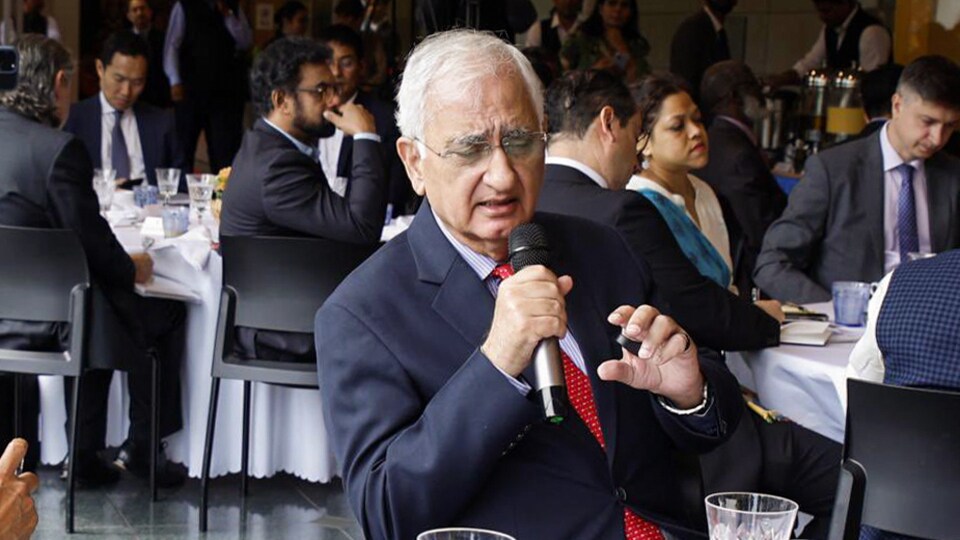
Salman Khurshid is a member of the multi-party delegation sent abroad to project India’s united stance against terrorism and highlight its firm response through Operation Sindoor, Indian armed forces' military strikes targetting terror hideouts in Pakistan and PoK in response to the deadly April 22 Pahalgam attack.
“The message to the world is that India is in a different league today. They see us as a country that's emerging as a top country globally,” ANI news agency quoted Khurshid telling members of the Indian diaspora during an address.
The ongoing outreach is part of a diplomatic campaign targeting key nations, including UN Security Council members, following the Pahalgam terror attack, which killed 26 civilians.
What Khurshid said in Seoul
Referring to India’s economic growth, Khurshid said: “We have emerged beyond Japan as the fourth-largest economy, and we are going by leaps and bounds.”
“This is something we need to protect, and we will protect it. We will not allow anybody to distract us from this purpose,” Khurshid added, underscoring the need to protect this progress.
Addressing Operation Sindoor, Khurshid defended India’s actions and emphasised that its military operations were measured and targeted.
“We don't do things to hurt somebody, we only do things to defend ourselves. First reaction that the world gave to us was, that India has the right to defend itself,” Salman Khurshid said.
“We didn't attack any area of Pakistan except the terrorist camps, and we attacked them with precision. If they hadn't attacked us back, we would have stopped there, but they did attack us back, and when they attacked us back, what did we do? We neutralised the platforms they were using to attack us, so we neutralised their air bases... That sent the message clearly to them that you can't take India on, and they therefore said Please let's stop it and they've stopped. But we have to be careful, which is why the government very clearly said, we are not putting an end to the Operation Sindoor...,” he added.
On global perceptions of terrorism
Salman Khurshid also touched on global perceptions of terrorism, saying “The world looks at a variety of things... their own geopolitical circumstances, their own purposes, etc. And therefore, fortunately, a very limited number of countries stood by Pakistan. Many more countries stood by India.”
He noted a shift in how some countries view terrorism. “The countries that have suffered from terrorism have changed their attitude,” Khurshid said. “But those countries that have been fortunate not to suffer the hands of terrorists continue to make these distinctions between militants and terrorists, freedom fighters and terrorists, and therefore it's very important that our narrative continues...”
Speaking on India’s global role, he said, “...We want to be Vishwa Guru, we want to be Vishwa Mitra - that's a huge responsibility. We have an enormous responsibility and therefore restraint...”
The all-party delegation Salman Khurshid is part of is led by JDU MP Sanjay Kumar Jha and includes BJP MPs Aparajita Sarangi, Brij Lal, Pradhan Baruah, and Hemang Joshi; CPI(M)’s John Brittas; AITC’s Abhishek Banerjee; and Ambassador Mohan Kumar.
The government’s initiative follows Operation Sindoor, launched on May 7. The Indian military struck terror camps in Pakistan and Pakistan-occupied Kashmir (PoK), killing over 100 terrorists linked to groups such as Jaish-e-Mohammed, Lashkar-e-Taiba, and Hizbul Mujahideen.


