E-Paper



India joins US move to set up Indo-Pacific economic bloc
India joined a dozen other nations on Monday to launch the Indo-Pacific Economic Framework for Prosperity (IPEF), a US-led trade initiative meant to counter China’s aggressive expansion in the region, with Prime Minister Narendra Modi emphasising the need to establish an “inclusive and flexible” structure.

 Prefer HTon Google


India joined a dozen other nations on Monday to launch the Indo-Pacific Economic Framework for Prosperity (IPEF), a US-led trade initiative meant to counter China’s aggressive expansion in the region, with Prime Minister Narendra Modi emphasising the need to establish an “inclusive and flexible” structure.
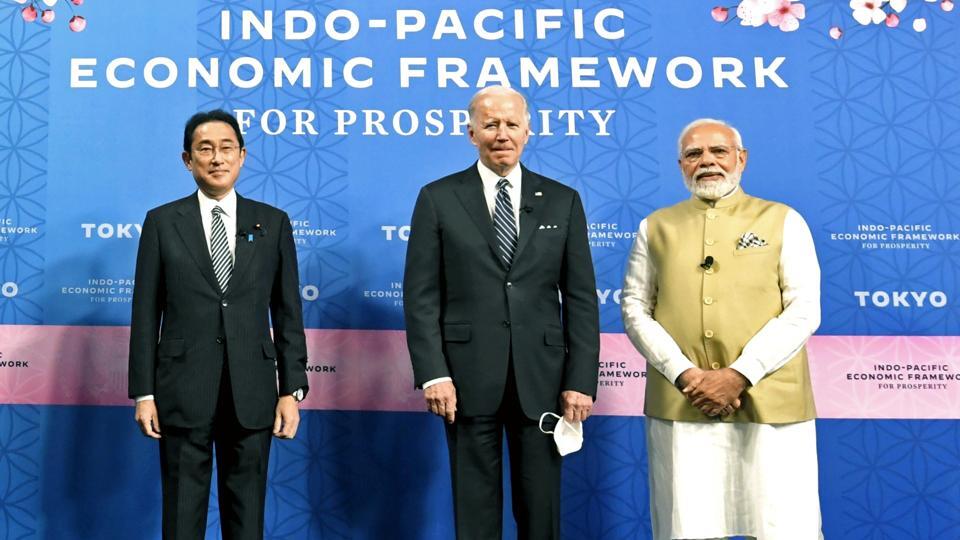
Among the 13 countries backing the initiative are Australia, Brunei, Indonesia, Japan, Malaysia, New Zealand, the Philippines, Singapore, South Korea, Thailand and Vietnam, and the members jointly account for 40% of the global GDP. Unlike traditional trade blocs, IPEF won’t negotiate tariffs or market access, and the framework will focus on integrating partner countries in four areas – the digital economy, supply chains, infrastructure projects and clean energy, and tax and anti-corruption measures.
In his remarks at the launch event, Modi described the unveiling of IPEF as the declaration of the collective will to make the Indo-Pacific an engine of global economic growth. Thanking US President Joe Biden for the “important initiative”, he said it is necessary to find common and creative solutions to the region’s economic challenges.
Also read: Indo-Pacific strategy bound to fail: China
“India will work with all of you to build an inclusive and flexible IPEF,” Modi said, speaking in Hindi.
He listed trust, transparency and timeliness as the three main pillars for resilient supply chains. “I am confident this framework will help strengthen these three pillars and pave the way for development, peace and prosperity in the Indo-Pacific region,” he said.
Modi noted the Indo-Pacific has always been a centre of manufacturing, economic activities, trade and investments, and said India has historically been at the centre of trade flows across the region. He pointed out that India’s oldest commercial port was located at Lothal in his home state of Gujarat.
The event in Tokyo marked the launch of discussions toward negotiations on IPEF, and the framework partners invited other Indo-Pacific countries to join the framework. Besides the in-person participation of Biden, Modi and Japanese Prime Minister Fumio Kishida, senior officials and leaders of the 10 other countries joined the event virtually.
The external affairs ministry said IPEF seeks to strengthen economic partnership among participating countries in order to enhance resilience, sustainability, inclusiveness, economic growth, fairness and competitiveness in the Indo-Pacific. The partner countries will now have discussions focused on strengthening economic cooperation and achieving shared goals.

India is committed to a free, open and inclusive Indo-Pacific and believes deepening economic engagement among partners is crucial for continued growth, peace and prosperity. “India is keen to collaborate with partner countries under the IPEF and work towards advancing regional economic connectivity, integration and boosting trade and investment within the region,” the ministry said.
Also read: Quad Summit to focus on key challenges, ways to keep Indo-Pacific free and open
Biden said the partner countries will write the “new rules for the 21st century economy” and take on the “most acute challenges that drag down growth”. He added, “Let’s start with new rules governing trade in digital goods and services so companies don’t have to hand over the proprietary technology to do business in a country.”
He also spoke about creating a “first-of-its-kind supply chain commitments” to eliminate bottlenecks and developing early warning systems to identify problems before they occur. He said the emphasis on high standards and inclusivity will be key to the framework’s success.
IPEF is perceived as a bid by the US to assume a larger role in the economic sphere and regain credibility following former president Donald Trump’s decision in early 2017 to pull out of the Trans-Pacific Partnership (TPP). The framework will focus on flexibility and inclusion, and partners can pick and choose modules without having to sign on for all four pillars.
A joint statement on IPEF said all 13 partners share a commitment to a free, open, fair, inclusive, interconnected, resilient, secure, and prosperous Indo-Pacific and recognise that the Covid-19 pandemic has underscored the need to work closely to ensure economic recovery grounded in resilience and sustainability.
In the field of trade, the partners will build high-standard, inclusive, free and fair trade commitments and develop creative approaches in trade and technology policy to promote sustainable and inclusive economic growth. They will improve the transparency, security and sustainability of supply chains and expand cooperation to mitigate the effects of disruptions while ensuring access to key raw and processed materials, semiconductors and critical minerals.
The partners will accelerate development of clean energy technologies and build resilience to climate impacts. They will also promote competition by enforcing robust tax, anti-money laundering and anti-bribery regimes to curb tax evasion and corruption in the Indo-Pacific.
Though IPEF is being positioned as an alternative to China’s burgeoning economic heft across the region, its appeal to Asian countries keen on accessing the huge US market is expected to be limited. The lack of incentives also triggered questions about the effectiveness of the framework.
US national security adviser Jake Sullivan dismissed China’s description of the initiative as a closed club, saying IPEF is an open platform by design and definition.
Some members of Asean that are perceived as pro-China, including Myanmar and Cambodia, were not part of the launch. Taiwan lobbied for membership of IPEF, a move that received bipartisan support in the US because of its importance in the supply of semiconductors, but was not included in the framework.
Also read: India will work with Indo-Pacific partners for inclusive, flexible IPEF: PM Modi
Vivek Mishra, a fellow for the strategic studies programme at the Observer Research Foundation (ORF), described IPEF as signalling in response to China’s actions across the region. However, he said it would take the framework partners at least five years to a decade to building something substantive on the ground.
“In the short term, the US is showing from a grand strategy perspective that the Ukraine crisis will not shift the focus from the Indo-Pacific, and it is attempting to reassure its allies that America is in for the long haul. In the long-term, IPEF will seek to create a pool for financing mechanisms for infrastructure that are an alternative to China’s Belt and Road Initiative (BRI),” he said.