E-Paper



India, Maldives sign agreement on UPI
The two sides also renewed another MoU between India’s National Centre for Good Governance and the Civil Service Commission of the Maldives for an additional 1,000 slots for training Maldivian civil servants

 Prefer HTon Google


New Delhi: India and the Maldives on Friday signed an agreement on introducing the Unified Payments Interface (UPI) in the Indian Ocean archipelago, with external affairs minister S Jaishankar saying it will have a positive impact on tourism.
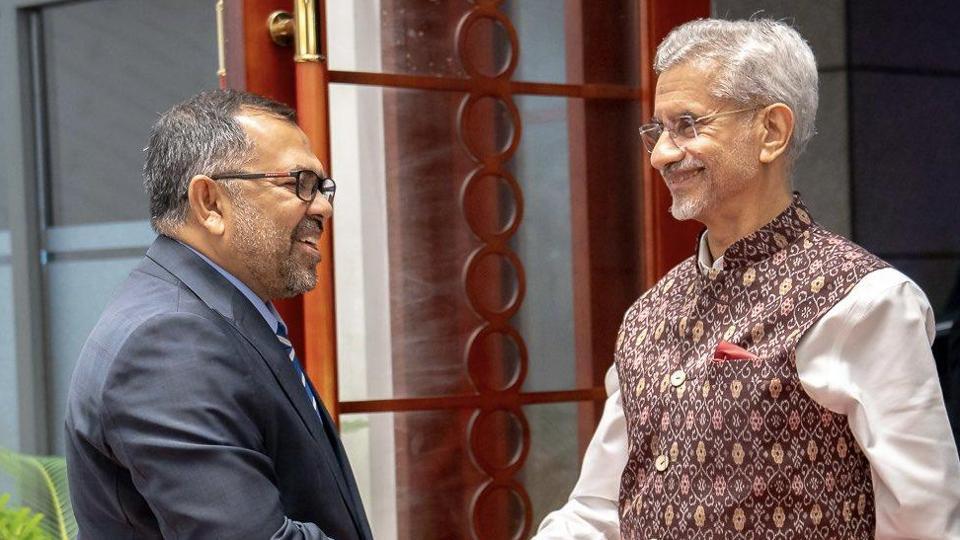
The memorandum of understanding (MoU) on the digital payment system was signed between the National Payments Corporation of India and the Maldives’ economic development and trade ministry after Jaishankar concluded his meeting with his Maldivian counterpart Moosa Zameer.
Jaishankar began a three-day visit to the Maldives on Friday, his first since the government of President Mohamed Muizzu assumed office in November 2023. The visit is being seen as part of efforts to reset bilateral ties, which ran into rough weather after Muizzu took several steps to reduce his country’s dependence on India and to move it closer to China.
The two sides also renewed another MoU between India’s National Centre for Good Governance and the Civil Service Commission of the Maldives for an additional 1,000 slots for training Maldivian civil servants.
At a joint media interaction with Zameer, Jaishankar said UPI has taken financial inclusion to new levels, with 40% of the world’s real-time digital payments taking place in India. The MoU signed on Friday is the “first step towards bringing this digital innovation to the Maldives.”.
“I wish the very best to stakeholders on both sides and hope that we will soon see the first UPI transaction here. I should mention that it will have a very positive impact on tourism,” he said.
The two ministers jointly inaugurated six community development projects, including a speech therapy unit, a mental health unit, and a child development centre at three different hospitals, that were implemented with Indian grants.
Despite the recent downturn in bilateral ties, which began with Muizzu’s demand last year for the removal of more than 80 Indian military personnel deployed in the Maldives to operate two helicopters and an aircraft mainly used for humanitarian missions, New Delhi continued with its development aid for Male.
On Saturday, the Indian side is set to hand over 28 water and sewage projects and a reclamation and shore protection project in Addu city.
Zameer thanked India for providing vital budgetary support to the Maldives with the rollover of treasury bills worth $50 million and described India as an important source market for tourism.
Referring to cooperation in the defence and security sector, Zameer said: “This ongoing collaboration reflects our commitment to work together to ensure the security of our nations as well as ensuring the security and stability of the Indian Ocean region.”
Zameer said the two sides will continue their cooperation in combating terrorism, violent extremism, drugs, and human trafficking, while Jaishankar described the Maldives as “one of the cornerstones of our ‘Neighborhood First’ policy.”
Jaishankar is scheduled to meet Muizzu and the Maldivian ministers for economic development, finance, and defence on Saturday.
Referring to new challenges arising from international conflicts, Jaishankar said, “In this tumultuous environment, India has been and will be, an anchor of stability for its friends, partners and neighbours.”