E-Paper



India, Saudi Arabia sign agreements for long-term supply of fertilisers
Union fertilisers minister JP Nadda visited Dammam and Riyadh during July 11-13, with the focus on enhancing cooperation with Saudi Arabia in chemicals and fertilisers

 Prefer HTon Google


New Delhi: India and Saudi Arabia on Sunday finalised long-term agreements for 3.1 million metric tonnes of DAP fertiliser per annum for five years during the visit of Union fertilisers minister JP Nadda, assuring New Delhi of supplies of key crop nutrients at a time when China has tightened restrictions on exports.
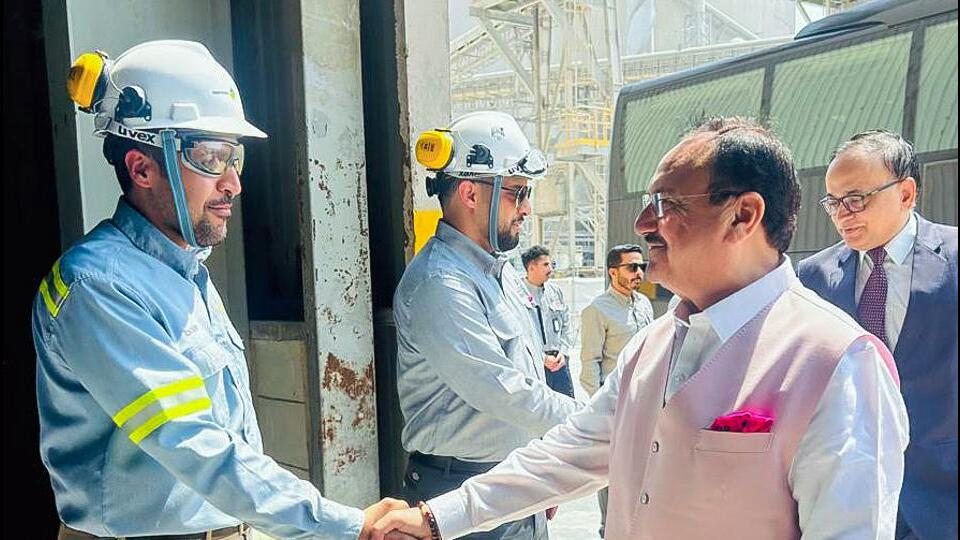
Nadda visited Dammam and Riyadh during July 11-13, with the focus on enhancing cooperation with Saudi Arabia in chemicals and fertilisers. He held talks with Saudi mineral resources minister Bandar bin Ibrahim Al Khorayef in Riyadh on mechanisms to strengthen the partnership in fertilisers, petrochemicals and pharmaceuticals.
The two ministers witnessed the signing of the long-term agreements for supply of DAP fertilisers between Ma’aden, Saudi Arabia’s state-owned mining and minerals major, and India’s Indian Potash Limited (IPL), KRIBHCO and Coromandel Fertilisers & Chemicals Co.
Under the pacts, Saudi Arabia will supply 3.1 million metric tonnes of DAP fertiliser per annum for five years from 2025-26, with the option of a further extension of five years with mutual consent.
In 2024-25, India’s imported 1.9 million metric tonnes of DAP fertiliser from Saudi Arabia, an increase of 17% over the 1.63 million metric tonnes imported in FY 2023-24.
“We had detailed discussions with the leadership of Ma’aden’s Phosphate Business, led by Chairman Mr. Hassan Al-Ali, to review the ongoing collaboration with Indian partners, particularly the supply of DAP and long-term fertiliser contracts that play a crucial role in supporting India’s agricultural needs,” Nadda said on social media after visiting Ma’aden’s phosphate production facilities in Ras Al Khair on Saturday.
People familiar with the matter said on condition of anonymity that the new agreements represent a substantial increase in availability of crucial DAP fertiliser that will ensure food security in the medium to long term. The agreements also come at a time when China has adopted a restrictive approach towards the supply of fertilisers.
HT reported on July 2 that China has significantly tightened its restrictions on fertiliser exports, slowing down imports into India and leading to a spurt in global prices. China is a large supplier of di-ammonium phosphate or DAP, the second most widely used crop nutrient in India, whose imports have dwindled due to the halting of export clearances by China.
Signs of China’s curbs first emerged last summer when global supplies of urea and phosphates began tapering.
During the talks on Sunday, India and Saudi Arabia emphasised their commitment to broadening the scope of bilateral cooperation to include other key fertilisers such as urea, along with DAP and NPKS, with the aim of further ensuring India’s fertiliser security, according to an official statement.
They also held discussions on facilitating mutual investments in fertilisers, with the focus on opportunities for Indian public sector undertakings (PSUs) to invest in the Saudi fertiliser sector. Nadda and his Saudi counterpart discussed avenues for collaborative research, especially in developing India-specific customised and alternative fertilisers to enhance agricultural productivity.
The two sides set up a joint team led by India’s fertiliser secretary and the Saudi vice minister for mining affairs to explore long-term collaboration in this sector.
The people cited above said that the commitment from Saudi Arabia demonstrates that India’s partners are working closely to deliver on the country’s requirements and to collaborate on future investments.
Fertiliser supplies from Saudi Arabia are not impacted by the crisis in the Red Sea as they are shipped from the eastern ports, the people said.
Nadda held a separate meeting Prince Abdulaziz bin Salman Al Saud, the Saudi energy minister and co-chair of the economy and investment committee of the bilateral Strategic Partnership Council, and held talks on ways to enhance the economic partnership.
He also met Abdulaziz Al-Rumaih, the Saudi vice minister of health, and discussed ways to enhance cooperation in the medical sector, health services, pharmaceuticals, and digital health solutions. Nadda highly appreciated Saudi Arabia’s support to Indian pilgrims during this year’s Haj pilgrimage and discussed medical arrangements for the Haj 2026.
India’s strategic partnership with Saudi Arabia has seen steady growth over the past few years and evolved into a comprehensive relationship that spans the economic, defence and energy spheres. High-level visits, such as those by Prime Minister Narendra Modi and Saudi Crown Prince Mohammed bin Sultan, have resulted in the recent expansion of the Strategic Partnership Council, which oversees cooperation in key sectors such as defence, energy, trade and technology.
India is Saudi Arabia’s second largest trade partner. Indian investments in Saudi Arabia totalled $3 billion as of August 2023. Defence ties have deepened with joint exercises and new agreements on defence exports and training.
Saudi Arabia is home to an Indian community of 2.7 million and it has been growing over the past few years.