
 E-Paper



India-China strategic dialogue focuses on stabilising ties, next steps
The discussions “primarily focussed on the recent progress made in stabilising and rebuilding bilateral ties and ways to take bilateral engagement forward”

 Prefer HTon Google


Foreign secretary Vikram Misri and his Chinese counterpart Ma Zhaoxu held a strategic dialogue on Tuesday to review the process of stabilising and rebuilding bilateral ties, including increasing air connectivity and visa facilitation, and to discuss “concerns on sensitive issues”.
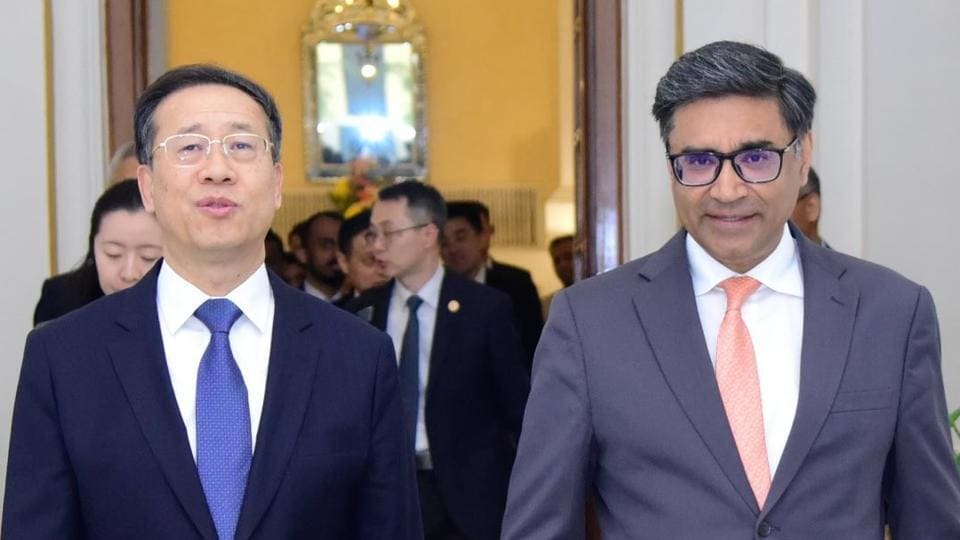
Ma, the executive vice foreign minister in China’s foreign ministry, was in New Delhi to participate in the Brics Sherpa meeting on February 8-10. His meeting with Misri was part of the ongoing engagements between the two sides since they reached an understanding in October 2024 to end the military face-off in the Ladakh sector of the Line of Actual Control (LAC).
Misri and Ma discussed a range of bilateral, regional and international issues, and their discussions “primarily focussed on the recent progress made in stabilising and rebuilding bilateral ties and ways to take bilateral engagement forward”, the external affairs ministry said in a readout.
External affairs ministry spokesperson Randhir Jaiswal said on social media that the two sides discussed ways to “further advance ties by enhancing people-to-people exchanges and addressing concerns on sensitive issues”. He did not give details.
“Both sides underscored the importance of peace and tranquillity in the border areas for overall progress in bilateral relations,” the readout said. They reiterated their commitment to implement the guidance provided by the leaders of India and China, including on the “need to proceed from a political and strategic direction to approach issues and concerns related to bilateral trade”.
India has long had concerns about limited access to the Chinese market and non-tariff barriers, which have impeded exports and skewed two-way trade in China’s favour. Bilateral trade touched a record high of $155.62 billion in 2025, with India’s trade deficit widening to $116.12 billion.
India also has concerns about China’s curbs on exports of strategic items, including rare-earth magnets, fertilisers, and heavy machinery. These concerns were taken up with the Chinese side last year, resulting in limited concessions.
The readout said Misri noted the successful resumption of the Kailash Mansarovar Yatra, which the two sides agreed to resume in 2025 after a gap of five years, and hoped for the “continued expansion of the scale” of the pilgrimage to holy sites in Tibet.
Both sides “recognised the need for an early conclusion of an updated Air Services Agreement”, and also agreed to continue to take “practical steps for visa facilitation and promote people-to-people contacts”, the readout said.
The two sides discussed multilateral cooperation, including in the context of India’s Brics presidency this year, and the Chinese side expressed its support for a successful summit. Ma “conveyed that China understands and respects India’s aspirations for UNSC membership”, the readout said.
A statement from China's foreign ministry focused on the need for New Delhi and Beijing to build better bilateral ties against the backdrop of "complex and profound changes in the international situation". It noted that the two sides had "friendly, candid and in-depth communication" on the international and regional situation and bilateral relations.
The Chinese side called for implementing common understandings reached by the leadership of both countries and upholding the "strategic perception that China and India are cooperative partners instead of rivals", and each other’s "development opportunity instead of threat". They should also deepen mutual trust and properly manage differences, the statement said.
Soon after the understanding on ending the standoff on the LAC, Prime Minister Narendra Modi and Chinese President Xi Jinping met in Russia in October 2024 and agreed to revive various mechanisms to normalise relations and address the long-standing border dispute. The face-off on the LAC and a brutal clash in Galwan Valley in June 2020, which killed 20 Indian soldiers and at least four Chinese troops, had taken bilateral relations to their lowest point since the 1962 border war.



