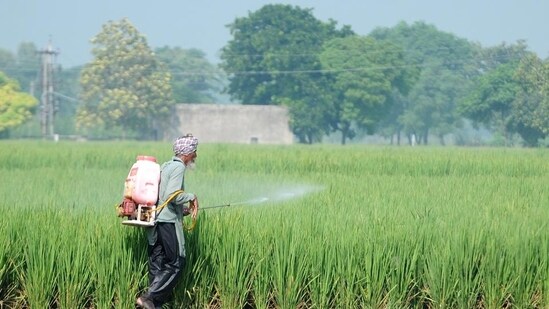
In his recent G7 address in Hiroshima, Prime Minister (PM) Narendra Modi spelt out a ten-point agenda for global food security and freeing up fertiliser supplies from geopolitical gridlocks. In November last year, while addressing the G20 summit in Bali, the PM made a similar pitch, saying, “Today’s fertiliser shortage is tomorrow's food crisis.”
In November last year, while addressing the G20 summit in Bali, the PM said, “Today’s fertiliser shortage is tomorrow's food crisis.” (HT)
The 2022 crisis of manures, triggered by sanctions on Russia and its allies such as Belarus, which are major producers, sent international prices to multi-year highs, plunging several African nations into famine-like situations.
India relies on imports to meet a third of its annual domestic demand of crop nutrients, which it gives at a discount to farmers. The crisis forced the Union government to scour international markets, paying exorbitant rates to avert a food crisis at home. This resulted in the highest ever fertiliser subsidy bill of ₹2.56 lakh crore in 2022-23, widening the fiscal deficit.
“The global fertiliser supply chains have to be strengthened. Political obstacles in this have to be removed. And the expansionist mentality that is occupying the fertiliser resources has to be stopped. This should be the purpose of our cooperation,” said Modi in Hiroshima.
India's position is that for the Global South, conflicts, such the one in Ukraine, have had severe consequences in terms of food, fertiliser and fuel security. That's why the PM has sought multilateral cooperation to secure these commodities, an official of the Union fertiliser ministry said, requesting anonymity.
“India is now very serious that food and fertiliser supply lines should not be held hostage to geopolitical developments. That’s why India is trying to make this a part of multilateral agreements and that’s why the prime minister mentioned this in Bali as well as in Hiroshima,” the official said.
India heavily subsidised fertilisers for its 120 million farmers, who use them over two cropping seasons in a year. Adequate availability of manures is closely linked to the nation’s food security. Shortages can set off political protests, as farmers are an influential voting bloc.
In 2022, fertiliser prices rose nearly 30%, following an 80% surge in 2021. Prices are driven by rising input costs, supply disruptions caused by sanctions on Belarus and Russia, and export restrictions put on China.
The highest gas prices in a decade, especially in Europe, also inflamed prices because gas is a key raw material for production of fertilisers. Urea prices surpassed their 2008 peaks. Phosphates and potash prices were near 2008 levels, when a recession stoked a similar crisis.
Russia accounts for about 16% of global urea exports and 12% of Di-ammonium Phosphate (DAP) and Monoammonium Phosphate, two key manures. Russia and Belarus together account for two-fifths of global exports of Muriate of Potash – another important fertiliser. China also suspended exports to ramp up domestic availability, further squeezing supplies.
Aside from seeking to make energy and food security a key element of India’s multilateral diplomacy, the country is also firming up long-term deals with several countries to secure fertiliser imports.
Union chemicals and fertilisers minister Mansukh Mandaviya travelled to several key supplier nations last year to finalise a memorandum of understanding for supply of critical raw materials at steady prices, a senior official has said.
Deals have been signed with Egypt, Senegal, Israel, Oman, Canada, Saudi Arabia and Jordan, an official said. Indian firms have for the first time, finalised investments in several mineral-rich nations.
To hedge against volatility, India is moving towards self-sufficiency in urea, while preparing to diversify away from countries such as China and Russia to source non-urea DAP fertilisers, whose supplies have dwindled.
“These measures will help make the country atma nirbhar (self-reliant) in fertilisers. The goals are to diversify sources of supply, have long-term contracts and get price discounts,” the official said.
On August 25, 2022, Mandaviya was in Saudi Arabia to chaperone bilateral pacts with several Indian firms and cooperatives with the Ma’aden, theSaudi Arabian Mining Company. The deals will ensure the supply of 2.5 million tonnes of fertiliser through a three-year contract. The pacts also included one with the state-owned Indian Potash Company for supply of phosphate products.
Another key deal was with Gujarat State Fertilisers and Chemicals for supply of ammonia and one each with Krishak Bharati Cooperative Company and Coromandel International for supply of phosphate products and ammonia.
On May 17, the Cabinet announced a fertiliser subsidy of ₹1.08 lakh crore for the upcoming kharif or summer sown season. “International rates of fertilisers have come down slightly. To ensure that farmers keep getting timely access to fertilisers and don’t face any financial burden, the Modi government has always been prompt. There will be no increase in fertiliser prices for the kharif season for farmers,” fertiliser minister Mansukh Mandaviya had said after the Cabinet nod.
According to Mandaviya, the country’s strategic goals are to secure long-term supply deals and increase domestic production. The minister said India is unlikely to import urea beyond 2025.
As far as foreign policy is concerned, the country is seeking to create a common agenda on food and fertilise security across all multilateral forums. “I am confident that our discussions today will be useful in creating an important link between the agenda of the G20 and the G7. And will be successful in prioritising the hopes and expectations of the Global South," the PM said in Hiroshima.
Get the latest India News, breaking headlines and real-time updates from across the country. Stay informed about politics, government policies, crime, weather and major national developments.
Home/India News/India's Gameplan For Food Security: Steady Cost And Supply Of Fertilisers

 E-Paper