E-Paper



Number theory: Four macro trends in India’s health spending
NHA gives data on health spending by the Centre and the state governments. A comparison of these numbers over the last six years is shown here in four charts.
Updated on: Jun 5, 2023, 18:08:06 IST

 Prefer HTon Google
Share via


Copy link


Number theory: Four macro trends in India’s health spending
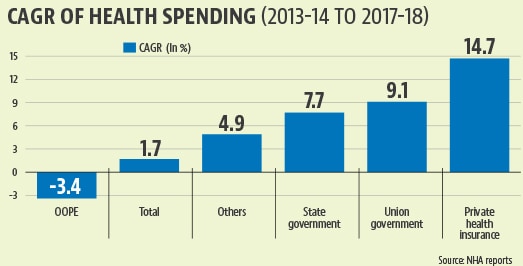
 Health insurance spending has seen the highest growth since 2013-14Despite a declining trajectory, OOP spending continues to have the highest share in total health spending in India. What about the growth in each kind of spending over the last six years? NHA data shows that private health insurance spending shows the highest growth on this count. OOP spending, in real terms, has actually come down during this period (more on this later). While a growth in health insurance spending shows a greater awareness about the importance of buying such coverage, 77% were still not covered by it in 2017-18, according to a survey of the National Sample Survey Office (NSSO).
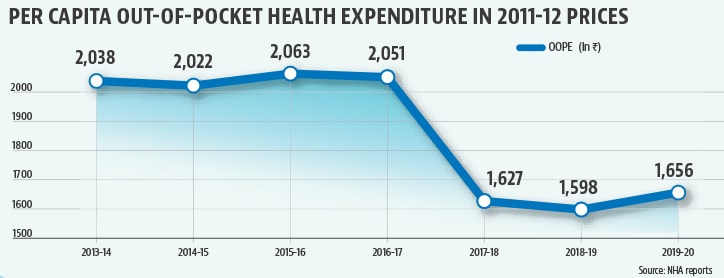
- The trend of falling OOP spending in absolute terms seems to have reversed course in 2019-20A contraction in terms of CAGR notwithstanding, absolute OOP spending in real terms increased between 2018-19 and 2019-20. Does this mean that the falling trend of OOP spending in real terms has reversed course? It is unlikely that we will get the answer to this question in the next couple of years. The pandemic’s extraordinary health burden, if captured properly, is likely to keep health spending elevated in 2020-21 and 2021-22. To be sure, unless there is comprehensive data on overall household spending and health spending as a part of it, it is difficult to say whether OOP spending has led to an increasing financial burden for households. This will need a comprehensive consumption expenditure survey data.
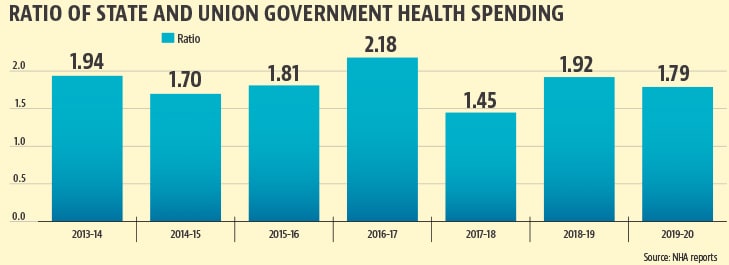
- States continue to outspend the central government when it comes to healthNHA gives data on health spending by the Centre and the state governments. A comparison of these numbers over the last six years does not show any clear trend, but state spending has 1.45 to 2.18 times central spending. However, as can be seen in the first chart, the centre’s spending has shown a higher growth than state spending during this period. These numbers also mean that both the centre and the states will have to increase their spending on health if India has to meet its stated target of spending 2.5% of GDP on health
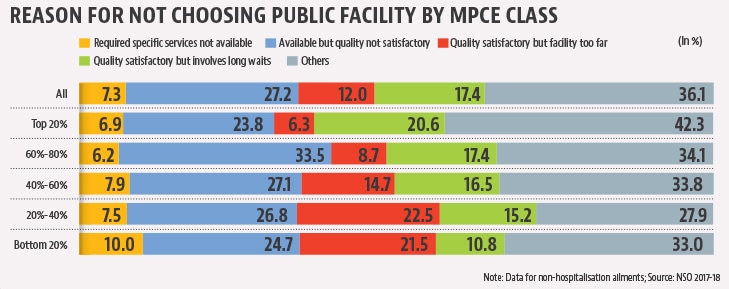
- Meeting this goal is critical to plug the supply-side problems in India’s public health infrastructureWill increasing the government’s footprint in the health sector help India’s poor? Data from a 2017-18 NSSO survey shows that the answer is an unambiguous yes. Average medical cost in private facilities (for ailments that don’t need hospitalisation) is 2.4 times that in government facilities. To be sure, one could argue that people are voluntarily spending a higher amount for availing private facilities. Data from the same report shows that supply inadequacies are a bigger driver in pushing people away from public health facilities than anything else. Around two-thirds of the people who choose a private facility over a public one (70% did this for ailments that did not require hospitalisation) cite factors such as non-availability of a required service or quality issues, facility being too far or long waiting for using a private facility over a public one. This number actually increases for the poorer sections of the population..