
 E-Paper



India’s Ramsar sites rise to 54 as 5 wetlands get ‘international importance’ tag
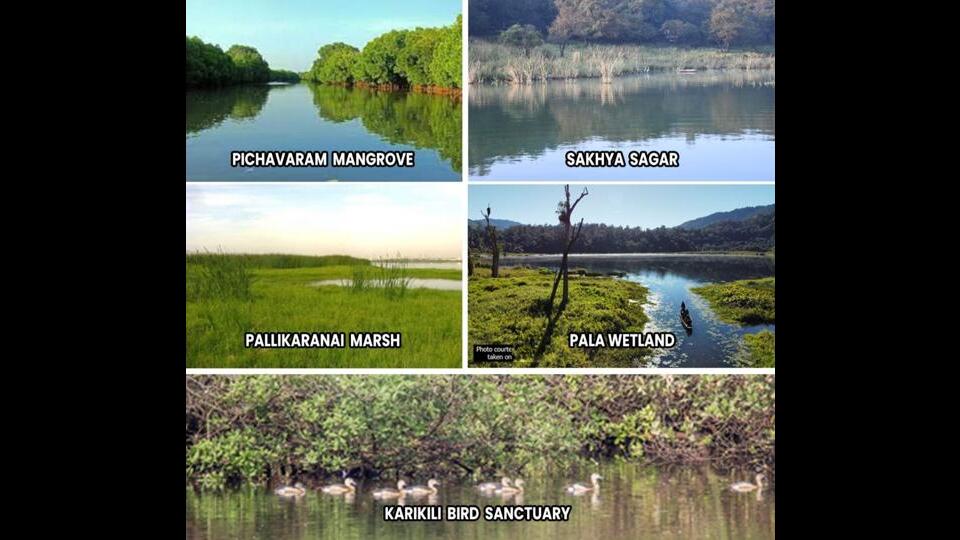
These sites include three wetlands (Karikili Bird Sanctuary, Pallikaranai Marsh Reserve Forest and Pichavaram Mangrove) in Tamil Nadu, one (Pala wetland) in Mizoram and one (Sakhya Sagar wetland) in Madhya Pradesh

 Prefer HTon Google


The Union environment ministry on Tuesday announced that India has designated five new Ramsar sites — Karikili Bird Sanctuary, Pallikaranai Marsh Reserve Forest and Pichavaram Mangrove in Tamil Nadu; Pala wetland in Mizoram and Sakhya Sagar in Madhya Pradesh — as ‘wetlands of international importance’, increasing the number of such sites in the country from 49 to 54.
“The emphasis PM Shri @narendramodi ji has put on environmental protection and conservation has led to a marked improvement in how India treats its wetlands. Delighted to inform that 5 more Indian wetlands have got Ramsar recognition as wetlands of international importance,” Union environment minister Bhupender Yadav said on Twitter.
India has the largest number of Ramsar sites in Asia, according to data available with the ministry. A wetland is an ecosystem flooded by water, seasonally or permanently.
Under the Ramsar Convention, an intergovernmental treaty for the conservation of wetlands, contracting parties are expected to identify and place suitable wetlands onto the ‘list of wetlands of international importance’, also known as the Ramsar List.
Also Read:Healthy wetlands vital for sustainable cities
The convention has several mechanisms to help parties designate their most significant wetlands as Ramsar Sites, and to take the steps necessary to manage them effectively by maintaining their ecological character.
“Ramsar Sites are designated because they meet the criteria for identifying wetlands of international importance. The first criterion refers to sites containing representative, rare or unique wetland types, and the other eight cover sites of international importance for conserving biological diversity. These criteria emphasize the importance the convention places on sustaining biodiversity,” the convention’s website states.
The Pichavaram mangrove, for instance, which got the Ramsar tag on April 8 this year, is one of the largest mangrove ecosystems in India with littoral and swamp forest habitats, located between the estuaries of the Vellar and Kollidam rivers. Trees here are permanently rooted under a few feets of water.
The mangrove in Tamil Nadu supports several threatened species, such as the critically endangered great white-bellied heron, spoon-billed sandpiper, the endangered spotted greenshank and the vulnerable olive ridley turtle.
The Pala wetland, which got the tag last year, is the largest natural wetland in Mizoram. The wetland, a deep lake (over 16 metres deep), supports a rich diversity of animal species, including at least seven mammals, 222 birds, 11 amphibians and 21 reptiles.
The low-lying marshy areas within the wetland provide an excellent habitat for the sambar deer, wild boars and barking deer. It’s also a habitat for the endangered Hoolock gibbon and Phayre’s leaf monkey. The Pala wetland is revered by the local Mara people, the Ramsar website states.
“The Ramsar designation recognises that a wetland site has global value. It also calls for wise use of wetlands. India has recently declared many Ramsar sites and this is an opportunity to boost our wetland management and ensure we don’t carry out activities that harm the ecological integrity of the area. Pallikaranai, much like Assam’s Deepor Beel, is used as a garbage dump. Sultanpur, also a recent wetland site, is set to have rampant construction on its eco-sensitive zone...but we have to keep sewage treatments in mind so that waste does not go inside wetlands. The Ramsar designation should mean that we consider the ecological needs of the wetland as first priority before planning other low-impact activities and wetland uses,” said Neha Sinha, conservation biologist and author.


