
 E-Paper



INS Vikrant to elevate India’s status as maritime power
India plans to buy 26 new fighters for INS Vikrant through a government-to-government deal, with US firm Boeing’s F/A-18 Super Hornet competing with French aircraft maker Dassault Aviation’s Rafale-M for the order.

 Prefer HTon Google


KOCHI: India’s new aircraft carrier, INS Vikrant, will elevate the country’s status as a maritime power, boost the navy’s sea control and power projection capabilities, and help the navy fulfil its growing responsibilities in the Indian Ocean and Indo-Pacific regions, officials tracking the navy’s moderisation said on Friday.
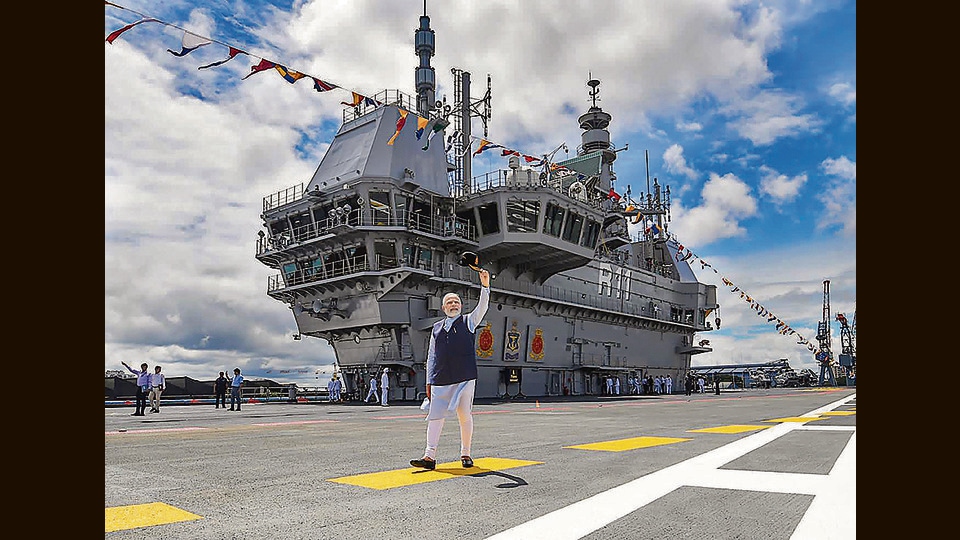
The warship, India’s first indigenous aircraft carrier, will also allow the navy to counter China’s steadily increasing naval capabilities and check People’s Liberation Army-Navy’s (PLAN) ambitions in the Indian Ocean region, said one of the officials cited above, asking not to be named.
INS Vikrant’s integral air power is formidable and the aircraft carrier significantly enhances the navy’s capability to conduct missions in the far seas, said a second official.
When fully operational, INS Vikrant will operate an air wing consisting of 30 aircraft including new deck-based fighters that India plans to buy, Russian-origin MiG-29Ks, Kamov-31 choppers, MH-60R multi-role helicopters, and advanced light helicopters.
Also read: Explainer: Why Vikrant’s induction is a watershed moment for Indian Navy
INS Vikrant will allow India’s maritime endeavours to survive both in times of peace and conflict, said Vice Admiral Pradeep Chauhan (retd), director general, National Maritime Foundation.
“It enables India to become a maritime power of eminence. It makes sure that Indian merchant vessels and warships can actually survive because it provides air power both ‘here and now.’ A shore-based aircraft can always provide air power ‘here.’ But to get air power ‘here and now’, you need integral air power, and without that survival is an impossibility,” Chauhan said.
The aircraft carrier, along with INS Vikramaditya, will put the navy on an equal footing with China depending on how and where the Indian aircraft carriers are deployed, he added.
India plans to buy 26 new fighters for INS Vikrant through a government-to-government deal, with US firm Boeing’s F/A-18 Super Hornet competing with French aircraft maker Dassault Aviation’s Rafale-M for the order.
These fighters will only be stopgap as the indigenous twin-engine deck based fighter (TEDBF), which is expected to be ready in a few years, will be the final carrier-based fighter for the navy.
Critical flight trials will be conducted aboard the aircraft carrier from November, and the warship is expected to be fully operational by the middle of next year, the officials said.
The flight trials will involve the Russian-origin MiG-29K fighter jets that will use the ski-jump to take off from INS Vikrant and will be recovered by arrestor wires or what is known as STOBAR (short take-off but arrested recovery).
Also read: INS Vikrant: All you need to know about largest India-made warship
To be sure, Vikrant hasn’t operated a fighter jet from its flight deck thus far. The solitary MiG-29K on the flight deck of the warship came in the form of knocked-down kits and was assembled on board.
The navy is pushing a case for building a second indigenous aircraft carrier, though the government will take a final call on that capability enhancement. The navy believes the second carrier can be built faster than Vikrant by tapping into the ship-building experience and expertise acquired though the construction of the first carrier.
Vikrant has been commissioned into the navy on the back of China launching its third aircraft carrier Fujian, the first designed and built entirely in that country, on June 17. A warship’s launch refers to the vessel entering the water for the first time. China currently operates two aircraft carriers -- CV-16 Liaoning and CV-17 Shandong.


