
 E-Paper



Is a spice war in the offing between Odisha and Andhra Pradesh?
For years, Andhra Pradesh has cornered much of India's chilli exports, riding on the back of Guntur chilli. Now, the Spices Board of India has found that the Kuchinda chilli, grown in Odisha, may well be spicier.


Bhubaneswar/Hyderabad: Already in dispute over the fate of villages on their borders, the relationship between Andhra Pradesh and Odisha is set to sour, over the pungency of a chilli. For years, Andhra Pradesh has cornered much of India's chilli exports, riding on the back of the famous Guntur chilli. Except, as it now turns out, the Spices Board of India has found that the Kuchinda chilli, grown in Odisha, may well be spicier.
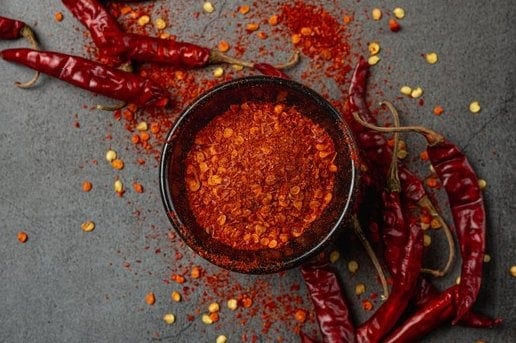
The Kuchinda chilli is grown in the western Odisha district of Sambalpur, while the popular Sannam chilli is grown in the Guntur area of Andhra Pradesh.
In its test report of the sample of Kuchinda chilli sent by the Regulated Market Committee of Kuchinda, one of the 67 such committees in Odisha working under the Odisha State Agricultural Produce Marketing Board, the spices lab found that its Capsaicin content was 0.26% with a Scoville Heat Unit of 41,000.
In comparison, the data from the Spice Board revealed that the popular Sannam Chilli that is grown in Guntur area had a Capsaicin percentage of 0.226% (35,000 - 40,000 Scoville Heat Unit) while the Byadagi chilli grown in Guntur, Kurnool and Prakasam districts had capsaicin percentage of 0.226% (15,000 - 30,000 Scoville Heat Unit).
"Capsaicin value determines how much pungent a chilli would be," said CM Srilatha, scientist C of the Spices Board quality evaluation lab in Kochi, refusing to comment on which chilli was "better".
India is the world's largest producer, consumer, and exporter of chillies with Andhra Pradesh topping the list of states in chilli production, cornering over 37% of the total harvest. As per the National Horticulture Board statistics, in 2021-22, Andhra Pradesh produced seven lakh tonnes of chilli, while Telangana came second with 4.33 lakh tonnes. Odisha produced just about 69,000 tonnes in the same period.
Srimant Hota, deputy director of Odisha Rural Marketing Society (ORMAS), a body under the state Panchayati raj department that is marketing the Kuchinda chilli, said the lab report of the Spices Board has proved the Odisha chilli has more pungency than Guntur chilli.
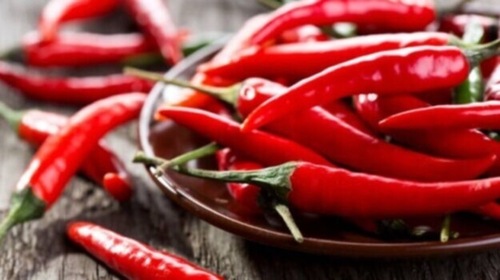
“The Kuchinda chilli is very hot and is cultivated by the local farmers as a cash crop. The lab test has proved that the pungency and other qualities of Kuchinda chilli are far better than other chillies. Popularly known as ‘Bamra chilli’, it has earned a distinct identity like Guntur chilli over the years as traders from across the country came to Sambalpur to procure the chilli, but there was a lack of promotion and marketing facilities," said Hota.
Chilli cultivation became popular in Kuchinda in 1901 when the area was part of the Bamanda (Deogarh) kingdom. The erratic rainfall in the region led the king of Bamanda Basudev Sudhal Dev to substitute paddy crop with chilli cultivation to tide over an agricultural crisis. It later proved to be a long-term solution.
Narasimha Rao Tanneru of ACE Exports in Guntur, a prominent exporter of Guntur chillies, however, said the pungency of the chillies depends on the variety. “There are various varieties like Guntur Sannam (S4), Teja (S17), Bydagi, DD Chilli, and so on. It is for the Spices Board to analyse how much pungency each variety has and the exports depend on the demand for that particular variety,” he said.
According to gunturmichi.com, a website operated by Guntur chillies market yard, Guntur Sannam Chilli (S4 variety) is the most pungent variety of the chillies with national and international acclaim. It belongs to the “Capsicum annum var, longhum” variety with long fruits (5 to 15 cm in length) and a diameter range from 0.5 to 1.5 cm. “It has thick skin and is hot and pungent with the average pungency of 35,000 to 40,000 SHU. The content of Capsaicin is about 0.226%. This chilli is rich in Vitamin C (185mg/100g) and Protein (11.98g/100g),” the website said.
While the last word on which chilli is better is up in the air, agriculture officials in Odisha said the report of the Spice Board lab would motivate more farmers to grow the crop. "Around 12,000 farmers are engaged in chilli cultivation in Kuchinda. It is being cultivated over 5,000 hectares in both rabi and kharif seasons. While the green chilli is sold at ₹3,000 per quintal, the dry red variety is priced at around ₹15,000 per quintal. So far 10 producers’ groups have been formed for the management of the chill units," said deputy director of horticulture in Sambalpur, Ranjan Kumar Das.
Das said the Tribal Development Cooperative Corporation Limited of SC/ST development department has been actively marketing Kuchinda chilli through its Adisha retail outlets over last one year. "The quantity of chilli being procured from the farmers would be increased in the coming days. We plan to market the chilli at the national level," he said.
There is one problem though. ORMAS officials, however, said the marketability of the Kuchinda chilli was a little suspect because it acquires a yellowish tinge upon grounding, unlike Samman or Byadagi chilli which retains their dark red colour. “Maybe there is some issue with the fertiliser that farmers are using or the way the chilli is being dried. We would try to address this,” he said.
The biggest problem is going to be getting a Geographical Indication (GI) Tag for the chilli, as there is no documented history of the chilli — which is essential. "Though the GI tag will help all the farmers of Kuchinda and motivate more farmers to continue growing this chilli, lack of documented history is still a major impediment," said Hota.
_1658304691562_1658304691982.jpg "Kuchinda chilli powder. ")
 ABOUT THE AUTHORDebabrata Mohanty
Debabrata Mohanty is a senior assistant editor of Hindustan Times who works as state correspondent from Odisha covering the state's politics, governance, public policy, natural disasters, environment and its society for close to three decades. With his long years of reporting from the state capital of Bhubaneswar, Mohanty has been known as one of the most experienced and credible journalists covering Odisha for the national English dailies. His reporting combines on-ground detail with deep institutional knowledge detailing the state's changing politics, governance issues, administrative reforms and the functioning of its public institutions. He has regularly reported on issues ranging from legislative developments and public policy implementation. Politics is his core areas of expertise as he closely tracks Odisha's political landscape, including the rise and transformation of the Bharatiya Janata Party (BJP), the Biju Janata Dal (BJD), the two principal political parties in Odisha. His long association with the state's political establishment enables him to write on contemporary developments in a larger political context. Mohanty takes a deep interest in writing human interest stories, environmental issues and documenting the impact of cyclones, floods, heatwaves, and other climate-related events in one of the most disaster-prone states. His coverage extends to public health, governance reforms and stories on accountability of government institutions. Before joining Hindustan Times, Mohanty worked with The Indian Express, Mail Today, and The Telegraph, where he covered at least six general elections and as many assembly elections. In 2007, he was selected for the prestigious Chevening Young Indian Print Journalist Programme at the University of Lincoln, United Kingdom, where he received advanced training in print journalism. In 2009 he won the Press Institute of India-International Committee of Red Cross award on conflict reporting for his on-ground reportage of 2008 Kandhamal riots.Read More
- ABOUT THE AUTHORSrinivasa Rao Apparasu
Srinivasa Rao is Senior Assistant Editor based out of Hyderabad covering developments in Andhra Pradesh and Telangana . He has over three decades of reporting experience.Read More



