Is Congress still an ideology based pan-Indian party?
The Indian National Congress, founded in 1885, led India’s freedom movement and then went on to become India’s dominant political party after Independence. For years, it was the only pan-Indian political party in the country. Does the Congress enjoy a similar stature today?
The Indian National Congress, founded in 1885, led India’s freedom movement and then went on to become India’s dominant political party after Independence. For years, it was the only pan-Indian political party in the country. Does the Congress enjoy a similar stature today? Its leaders think that it does. “It (Congress president) is not just an organisational post, it is an ideological post, which represents a belief system and vision of India”, Rahul Gandhi said on September 22.
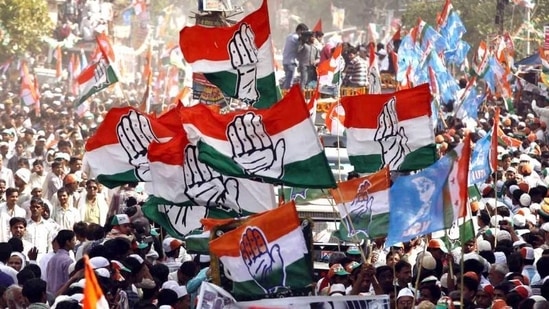
Congress flags waves at rallies
Developments since then suggest that things are very different in the party. After it became clear that the “one man – one post” principle will require Ashok Gehlot to give up the chief ministership in Rajasthan before becoming party president, he seems to have engineered a revolt by his own loyalists to prevent Sachin Pilot from becoming chief minister. Gehlot is clearly unwilling to let go of political power in Rajasthan to take on the ‘ideological’ job of the Congress president. What does this say about Gehlot and more importantly, the Congress party? Here are three charts which explain this.
The political logic to Gehlot not wanting Sachin Pilot as chief minister
India follows a parliamentary form of democracy and the head of executive, both at the level of centre and states, at least in principle, is elected by the legislative group of the party which wins the elections. In reality, many of these decisions are often taken by the “high command” of political parties. If majority of the MLAs do not want a person to become the chief minister – this seems to be the case as far as Sachin Pilot is concerned in Rajasthan – then there is nothing wrong about it. In fact, Gehlot has demonstrated many times that he enjoys much bigger support among MLAs in Rajasthan than Pilot. This holds not only for Congress MLAs, but also among independents (all 13 of them support the Congress government in the assembly). The fact that 12 out of these 13 independents won in constituencies where Congress candidates contested (three Congress candidates finished second and five finished third) suggest that they are more loyal to Gehlot than the party itself. Gehlot also engineered a merger of six MLAs of the Bahujan Samaj Party with the Congress in 2019. It is a result of all these factors that the Congress’s effective strength in the assembly is much more than the 99 MLAs elected on the Congress’s symbol in the 2018 elections.
But Gehlot’s clout was of little use for the Congress in 2019 general elections
Gehlot’s political prowess, which he has demonstrated more than once as far as state politics is concerned in Rajasthan, was of no help to the Congress in the 2019 Lok Sabha elections. Despite winning the assembly elections just a few months previously, Congress could not even win one Lok Sabha constituency from Rajasthan in the 2019 elections. To add insult to injury, Gehlot’s son lost the elections from his home district of Jodhpur. To be fair, Gehlot was not the only state-level leader of the Congress to suffer this rout. The Congress’s performance was quite underwhelming, if not equally worse in Madhya Pradesh and Chhattisgarh as well, the other two states where it won elections in 2018. This raises a serious question on the ability of otherwise effective state-level leaders to help revive the national fortunes of the Congress party.
So is the Congress’s claims of being a national alternative to the BJP valid?
A simple analysis of Congress performance in latest assembly elections shows that there are only seven states and UTs with legislature (out of 30) where the party’s total vote share is more than one-third. Even if one were to lower the bar to 20%, the number of state/UTs reaches 15. In just the election before the latest (the last of them were held in 2017), these numbers were 12 and 21. This suggests that the Congress has lost a lot of ground in the post-2014 period.
To be sure, the Congress has MLAs in many states where it polls less than 10% votes as well, as it contests elections in alliance with other regional parties. If the Congress’ footprint is getting increasingly limited, and it is failing to defeat the BJP even in states where it has a strong presence at the state level, it is only natural that people question its claims of being an ideology driven national alternative to the BJP.
Even the Congress’s claim of being an ideological pole to the BJP does not stand up to scrutiny. The biggest example is the party’s posturing in Kerala, where the Congress is still a major political player and the BJP is not. In the 2019 Lok Sabha and 2021 assembly elections, the Congress aggressively attacked the Communist Party of India (Marxist)-led Left Democratic Front over the latter’s support of a (now stayed) Supreme Court judgment which allowed women of all age-groups to enter the Hindu shrine of Sabarimala. The BJP’s stand on the issue was exactly the same. This when read with the Congress’s ambivalence on a lot of other “core Hindutva” issues suggests that it is hesitant to champion the so-called secular alternative to the BJP when it comes to electoral battles.
So is the Congress now a bunch of state-level leaders who are determined to retain or capture power with or without the party’s stated ideology and the challenges it faces? This a question the grand old party needs to answer for itself.

 E-Paper