
 E-Paper



Isro begins new year with XPoSat success
The mission aims to study bright astronomical X-ray sources, including Black Holes, to understand the nature and behavior of celestial objects.

 Prefer HTon Google


The Indian Space Research Organisation (Isro) on Monday successfully launched the Polar Satellite Launch Vehicle-C58 carrying X-ray Polarimeter Satellite or XPoSat and 10 other payloads in a mission that aims to study the dynamics of bright astronomical X-ray sources, including Black Holes, which could provide vital information on the nature and behaviour of celestial objects.
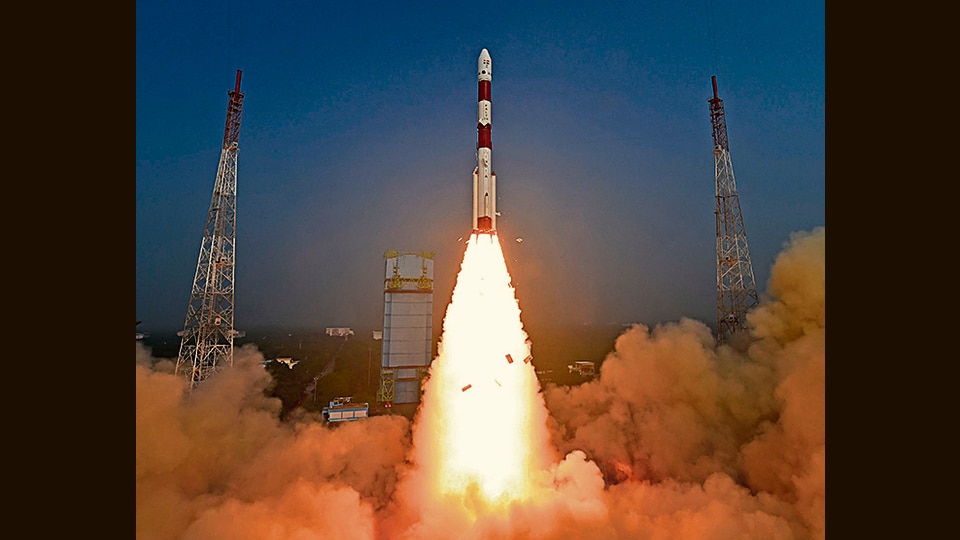
Isro chairman S Somanath said that XPoSat is a unique mission that will test India’s capabilities of X-ray Polarimetry with locally built instruments.
“On January 1, 2024, yet another successful mission has been achieved with PSLV. PSLV-C58 has placed XPoSat in the desired orbit of 650km, six-degree inclination... We are looking forward to an exciting year ahead,” Somanath said after the launch.
XPoSat is India’s first polarimetry mission and only the second such mission in the world. The US’s National Aeronautics and Space Administration (Nasa) first launched its Imaging X-ray Polarimetry Explorer (IXPE) mission in 2021 on-board a SpaceX Falcon 9 rocket from Kennedy Space Center.
A joint effort with the Italian Space Agency, IXPE was dedicated to measuring the polarization of X-rays from the “most extreme and mysterious objects in the universe”, including supernova remnants, supermassive black holes, and dozens of other high-energy objects.
At 9.10am on Monday, Isro’s trusted launch vehicle PSLV-C58 lifted off from the Satish Dhwan Space Centre in Sriharikota.
Isro officials said that in the course of its five-year mission, XPoSat will investigate the polarization of intense X-ray sources. While India currently has a well-established space-based X-ray astronomy programme, this mission will predominantly focus on imaging, time-domain studies, and spectroscopy.
“The emission mechanism from various astronomical sources such as Black Holes, neutron stars, active galactic nuclei, pulsar wind nebulae etc, originates from complex physical processes and are challenging to understand. While the spectroscopic and timing information by various space-based observatories provide a wealth of information, the exact nature of the emission from such sources still poses deeper challenges to astronomers,” Isro said in its mission statement.
It added, “The polarimetry measurements add two more dimension to our understanding, the degree of polarization and the angle of polarization and thus is an excellent diagnostic tool to understand the emission processes from astronomical sources. The polarimetric observations along with spectroscopic measurements are expected to break the degeneracy of various theoretical models of astronomical emission processes.”
Polarimetry is a powerful tool that allows astronomers to infer information about celestial objects, from passing comets to distant galaxies.Such emissions are mostly tracked by studying the chemical make-up (using a spectroscope) and the time it takes them to travel a distance.
XPoSat will carry out its studies from a low Earth orbit — a non-Sun synchronous orbit of ~650 km altitude, low inclination of ~six degree — using two payloads. The primary payload is Polarimeter Instrument in X-rays or, POLIX, designed to measure polarimetry parameters, specifically the degree and angle of polarization, in the medium x-ray energy range of 8-30 keV photons originating from astronomical sources. The mission also carries X-ray Spectroscopy and Timing or XSPECT, which will provide spectroscopic information within the energy range of 0.8-15 keV.
POLIX is developed by the Raman Research Institute (RRI), Bangalore, with support from Isro labs, while XSPECT has been developed by Isro’s UR Rao Satellite Centre.
Somanath said that depending on the findings of XPoSat over the next five years, the space agency will plan a follow-up mission to explore the astronomical origins of celestial bodies in the coming year.
Along with XPoSat, the PSLV orbital platform module carried 10 other payloads including Radiation Shield Experiment Module (RSEM) by TakeMe2Space, Women Engineered Satellite (WESAT) by LBS Institute of Technology for Women, BeliefSat by KJ Somaiya Institute of Technology, Green Impulse Transmitter (GIT) by Inspecity Space Labs Private Limited, Launching Expeditions for Aspiring Technologies Technology Demonstrator by Dhruva Space, RUDRA0.3 HPGP by Bellatrix Aerospace, Dust Experiment (DEX) by Physical Research Laboratory, Fuel cell Power System (FCPS) and SI-based High Energy cell by Vikram Sarabhai Space Centre.


