E-Paper



Energy cooperation, balanced trade on agenda at Jaishankar-Lavrov meet
Jaishankar also raised India's concerns, including a massive trade deficit, non-tariff barriers, and the issue of Indians serving in the Russian Army.

 Prefer HTon Google


New Delhi: India and Russia on Thursday explored ways to expand trade in a balanced manner, ensure long-term supplies of key commodities such as fertilisers, and sustain energy cooperation, with external affairs minister S. Jaishankar saying bilateral ties were among the steadiest of the world’s major relationships due to geopolitical convergence.
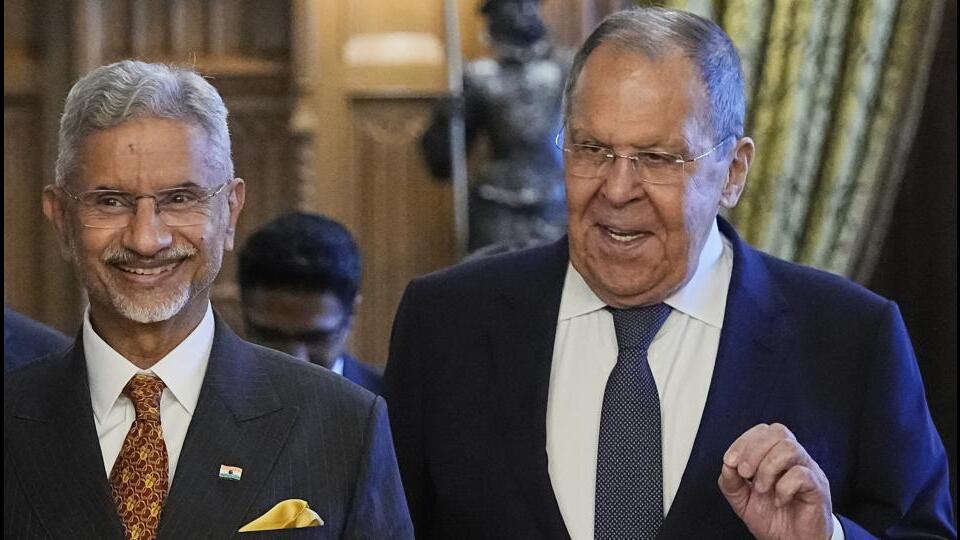
Jaishankar, who held talks with his Russian counterpart Sergey Lavrov in Moscow a day after co-chairing a meeting of a bilateral trade and economic body, also raised New Delhi’s concerns, including a massive trade deficit, non-tariff barriers, regulatory impediments, and the issue of Indians serving in the Russian Army.
He also met Russian President Vladimir Putin, who is expected to visit India later this year for a summit with Prime Minister Narendra Modi. Jaishankar travelled to Russia after meeting Chinese foreign minister Wang Yi in New Delhi to take forward the normalisation of India-China relations, against the backdrop of growing estrangement between New Delhi and Washington over trade-related matters and the US administration’s punitive tariffs on Indian goods.
Also Read: From Moscow, Jaishankar delivers a blunt rebuttal to barbs from US officials
“The global context for our meeting today is provided by the evolving geopolitical situation, the shifting economic and trade landscape, and our shared goal is to maximise our complementarity,” Jaishankar said at the start of his meeting with Lavrov, which focused on bilateral ties and cooperation in trade, investment, defence, technology, and people-to-people exchanges.
Lavrov added, “We see a special importance in our relations as we see the emergence of a new architecture of international relations.”
Jaishankar said at a subsequent joint news conference with Lavrov that India-Russia ties are among the steadiest of the world’s major relationships, with geopolitical convergence and popular sentiment as key drivers.
As the two sides work to grow bilateral trade, it must be done in a “balanced and sustainable manner” by increasing India’s exports and addressing non-tariff barriers and regulatory impediments, he said. Enhancing Indian exports in sectors such as pharmaceuticals, agriculture, and textiles will help correct the imbalance.
Two-way trade touched a record $68.7 billion in 2024–25, though India’s exports were worth only $4.88 billion. The imbalance has risen nine-fold, from $6.6 billion to $58.9 billion, in the past four years.
Also Read: Terms of Trade: From strategic ally to voodoo doll
The two sides discussed steps to ensure long-term supply of fertilisers and sustain energy cooperation through trade and investments. Russia currently provides almost 40% of India’s energy needs, and India’s imports of petroleum and crude in 2024 were worth $53 billion, according to data aggregated by the UN.
Jaishankar raised the issue of mobility for Indian skilled workers to address labour needs in Russia—especially in IT, construction, and engineering—and called for fast-tracking the opening of two Indian consulates in Kazan and Yekaterinburg. The two ministers also discussed connectivity initiatives such as the International North‑South Transport Corridor, the Chennai–Vladivostok maritime corridor, and the Northern Sea Route to deepen economic linkages and reduce transit times.
He described defence and military cooperation as robust and said Russia supports India’s “Make in India” goals through joint production and technology transfer.
Jaishankar brought up the issue of Indians serving in the Russian Army and said: “While many have been released, there are still some pending cases and some missing persons. We hope that the Russian side would expeditiously resolve these matters.”
According to the external affairs ministry, 126 Indians were recruited by the Russian military, and 12 were killed while fighting on the frontlines of the conflict in Ukraine. Ninety-six of them were discharged by Russian authorities, while another 16 were listed as missing.
Regional issues such as developments in Ukraine, West Asia, and Afghanistan, and India’s fight against cross-border terrorism also figured in the discussions. Jaishankar reiterated India’s approach of emphasising dialogue and diplomacy to resolve differences, and said India and Russia will jointly fight all forms of terror. “I conveyed India’s strong resolve to adopt a zero‑tolerance policy against terrorism and our sovereign right to defend our citizens against cross-border terrorism,” he said.
“We are lining up outcomes for the [Modi-Putin] summit. We are taking practical steps so that the substance of our relationship grows,” he added.