
 E-Paper



Joint parliamentary panel set up to examine waqf bill
The Lok Sabha and the Rajya Sabha adopted a motion moved by Union minority affairs minister Kiren Rijiju, who also holds the parliamentary affairs portfolio, naming the members to be part of the committee. 21 members were from the Lok Sabha and 10 from the Rajya Sabha.

 Prefer HTon Google


A 31-member joint parliamentary committee was set up on Friday to examine the contentious Waqf (Amendment) Bill, 2024 and its report will be submitted in the first week of the next session.
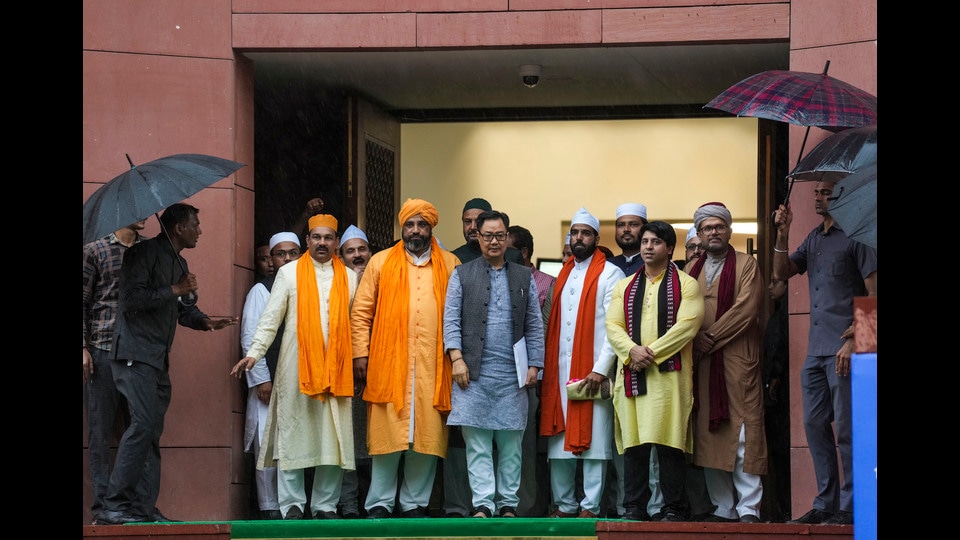
The Lok Sabha and the Rajya Sabha adopted a motion moved by Union minority affairs minister Kiren Rijiju, who also holds the parliamentary affairs portfolio, naming the members to be part of the committee. 21 members were from the Lok Sabha and 10 from the Rajya Sabha.
The bill, introduced by Rijiju in the Lok Sabha on Thursday, seeks to bring changes to the powers of state waqf boards, survey of waqf properties and removal of encroachments by amending the Waqf Act, 1995.
A waqf is a Muslim religious endowment, usually in the form of landed property, made for purposes of charity and community welfare. Rijiju also introduced the Mussalman Wakf (Repeal) Bill, 2024 which seeks to repeal the Mussalman Wakf Act, 1923.
“I give notice of my intention to move the following motion during the current session of the House…That the Waqf (Amendment) Bill 2024 be referred to a joint committee of the Houses with the following members,” the notice moved by the minister said.
Lok Sabha members nominated by the government to the cross-party panel includes All India Majlis-e-Ittehadul Muslimeen lawmaker Asaduddin Owaisi, who fiercely opposed the bill, Congress members Gaurav Gogoi and Imran Masood, apart from Jagdambika Pal (BJP), Nishikant Dubey (BJP), Tejasvi Surya (BJP), Aparajita Sarangi (BJP), Sanjay Jaiswal (BJP), Dilip Saikia (BJP), Abhijit Gangopadhyay (BJP), DK Aruna (BJP), Mohammad Jawed (Congress), Maulana Mohibullah Nadvi (SP), Kalyan Banerjee (TMC), A Raja (DMK), Lavu Sri Krishna Devarayalu (TDP), Dileshwar Kamait (JDU), Arvind Sawant (Shiv Sena UBT), Suresh Gopinath (NCP), Naresh Ganpat Mhaske (Shiv Sena) and Arun Bharti (LJP-Ram Vilas).
In Rajya Sabha, Rijiju proposed the names of 10 lawmakers – Brij Lal (BJP), Dr. Medha Vishram Kulkarni (BJP), Gulam Ali (BJP), Dr. Radha Mohan Das Agrawal (BJP), Syed Naseer Hussain (Cong), Mohammed Nadeem Ul Haq (Trinamool), V Vijayasai Reddy (YSR Congress), M. Mohamed Abdulla (DMK), Sanjay Singh (AAP) and Dr Dharmasthala Veerendra Heggade (nominated member)
“With this bill, there is no interference in the freedom of any religious body....Forget about taking anyone’s rights, this bill has been brought to give rights to those who never got them....” Rijiju said while introducing the bill.
In the Lower House, 12 members of the panel are from the ruling National Democratic Alliance (NDA), including eight from the BJP, and nine from the Opposition. In the Upper House, four are from the BJP, four from the Opposition, one from the YSR Congress Party that has opposed the bill, and one is a nominated member.
The draft bill proposes sweeping changes in the regulation and governance of India’s waqf boards, that manage Islamic charitable endowments. The government argues that the bill would modernise an archaic and complex system in line with recommendations of the 2006 Rajender Sachar Committee.
The bill reworks the definition of waqf to ensure that only lawful property owners practising Islam for at least five years can create waqf through formal deeds.
The role of surveying waqf properties, handled by survey commissioners under the 1995 act, is now to be entrusted to district collectors or officers of equivalent rank.
The most controversial provision is a proposal to induct non-Muslims in the central waqf council, state waqf boards and waqf tribunals, calling for such bodies to become “more broad-based”, with representation of Shia, Sunni, Bohra, Agakhani, and other Muslim sects, along with non-Muslims. Additionally, the bill mandates the registration of all waqf properties through a central portal.
The government argues the bill modernises norms and brings in uniformity but the Opposition has called it an attempt to infringe on religious rights and the Constitution.


