
 E-Paper



Joshimath land cracks: Govt cautions experts over U’khand theories
Asserting that an expert group is already looking into the incident, NDMA asked concerned departments to avoid sharing details on social media or interact with media.

 Prefer HTon Google


The Centre has asked all government agencies and institutions involved in the rescue, relief and analysis works of the Joshimath ground subsidence to refrain from sharing any details publicly, citing the possibility of “confusion” that it can lead to.
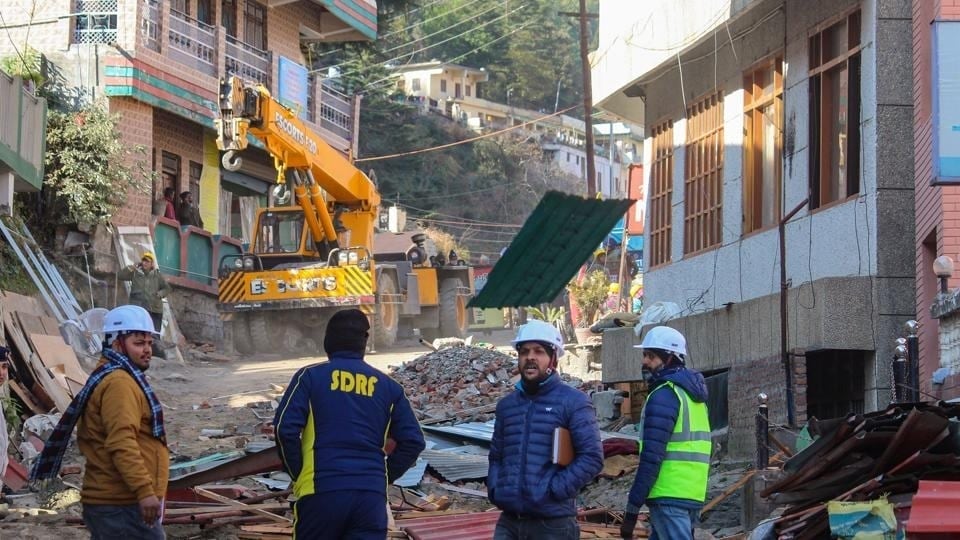
On the ground at the hill town, demolition crews worked gingerly on Saturday to bring down two precariously standing hotels in Joshimath, amid fears that they could collapse and lead to widespread destruction.
The order, issued by the National Disaster Management Authority (NDMA) late on Friday, came as assessments and reports purported to show the gravity of the problem, and that some signs may have gone unnoticed.
Also Read: Staring at uncertain future, say Joshimath residents
One of these was a preliminary report by the ISRO’S National Remote Sensing Centre (NRSC) in Hyderabad uploaded on January 11. It found that in the seven months between April and November 2022, Joshimath recorded subsidence of 8.9 cm, but the rate grew to an alarming 5.4cm in a little under 13 days till January 8.
The report, “Joshimath subsidence: Satellite-based preliminary results” was no longer available on the website on Saturday.
“It is observed that various government institutions are releasing data related to the subject matter in social media platform and also they are interacting with media with their own interpretation of the situation,” said the NDMA order, which was titled “No interactions with media and sharing of data on social media regarding ground subsidence at Joshimath”.
Also Read: As Joshimath sinks, what about these Himalayan towns?
“It is creating confusion not only among affected residents but also among citizens of the country. The issue was highlighted during a meeting chaired by Honorable Union Home Minister (Amit Shah) on January 12, 2023,” it added.
Joshimath has been declared a disaster zone and all agencies working in connection with it are bound to follow directions of the NDMA.
The Centre has already formed a team of experts from the NDMA, National Institute of Disaster Management, Geological Survey of India, IIT Roorkee, Wadia Institute of Himalayan Geology, National Institute of Hydrology and Central Building Research Institute to study and give recommendations on the Joshimath situation.
Asserting that an expert group is already looking into the incident, NDMA asked concerned departments to avoid sharing details on social media or interact with media.
“You are requested to sensitise your organisation about this matter and refrain from posting anything on the media platform until the final report of the expert group is released by NDMA,” it added.
A senior NDMA official, asking not to be named, said: “It is just a precautionary letter to convey that sharing details separately can create confusion and panic among residents in Joshimath area. We must wait for final report of the expert group to know what happened”.
On Saturday, residents and government officials who asked not to be named told HT that they believe an aquifer -- a layer of water underground -- may have been punctured, causing rocks above to move due to the flow. This, they said, likely happened between January 2 and 3, when several houses developed cracks overnight.
District magistrate of Chamoli, Himanshu Khurana, did not react to the theory, saying: “I don’t know what escalated the situation after January 3. Only experts and scientists can tell.”


