
 E-Paper



Judiciary can't play the role of opposition in Parliament: Ex-CJI DY Chandrachud
Justice Chandrachud said the judiciary's job is to scrutinise laws.

 Prefer HTon Google


Former Chief Justice of India DY Chandrachud has said that the judiciary cannot fulfil the role of the opposition in Parliament.
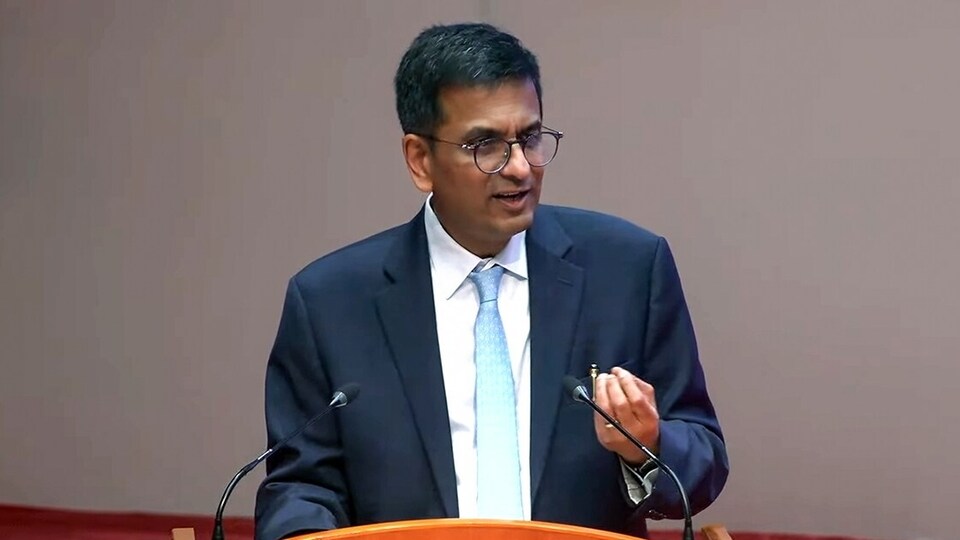
Justice Chandrachud made the remark in response to a query linked to Leader of Opposition in Lok Sabha Rahul Gandhi's jibe that the opposition was alone working on the behalf of the media, investigative agencies and judiciary.
Justice Chandrachud said the judiciary's job is to scrutinise laws, not play the role of the opposition in legislatures.
"Well, I don't want to join issue with the leader of the Opposition because that's not the ambit of what we are here to speak about. But what I want to say is this, people should not presume that the judiciary should be performing the role of the opposition in Parliament or the State legislatures. Too often, there's a misconception that the judiciary has to play the role of the Opposition in legislatures, which is not so. We are here to scrutinise laws," he told ANI in an interview.
"We are entrusted with the duty to scrutinise executive action on whether it is consistent with the law, and whether it is consistent with the Constitution. There's a different space in a democracy for the political opposition. And what people try to do is to use the judiciary and to shoot from the shoulders of the judiciary and to try and convert the court into a space for the political opposition," he added.
Also read: CJI calls liberal system of adjournments counterproductive; defends new rules
Answering a question on intense social media scrutiny on the duration of his interactions with the Leader of the Opposition and the Prime Minister, Justice Chandrachud said it was natural as human beings to socialise during official meetings.
"Well, there are times when you interact with the leader of the Opposition as well. For instance, many of our statutes require that a selection committee for appointment to a particular post must consist of the Prime Minister, the Chief Justice of India, and the Leader of the Opposition. Now, you know, you discuss what you have to discuss, and you arrive at your conclusions. And after you're done with those conclusions, you are human beings, right? You're going to spend 10 minutes after that having a cup of tea, talking about everything under the sun from cricket to movies to something," he told ANI.
He also reacted to the controversy linked to PM Narendra Modi attending a puja at his house in September. He said it wasn't an isolated incident, and other judges have visited the homes of prime ministers in the past.
"Look at the work which we have done...I think something which is, you know, a social visit, a sociable visit, and this is not unique. I've said this before, prime ministers visit people in the homes of judges on social occasions, sometimes on sad occasions as well. This is the element of elementary social courtesy which is followed within the system. And, you know, these social courtesies do not detract from the fact that despite these social curtsies which are observed at different levels of the government, in the work which we do, we are entirely independent of each other," he added.
DY Chandrachud retired as CJI on November 10. Justice Sanjiv Khanna has succeeded him.


