
 E-Paper



Justice Chandrachud will take over as CJI on November 9
“In exercise of the powers conferred by clause (2) of Article 124 of the Constitution of India, the President is pleased to appoint Dr Justice Dhananjaya Yashwant Chandrachud, judge of the Supreme Court, to be the Chief Justice of India with effect from November 9, 2022,” stated a law ministry notification released on Monday evening.


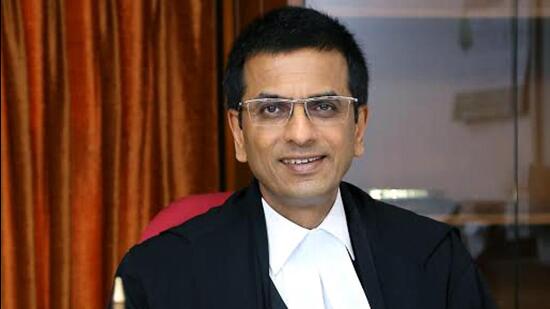
Justice Dhananjaya Y Chandrachud was on Monday appointed as the 50th Chief Justice of India (CJI) following a ratification of his appointment by President Droupadi Murmu. Justice Chandrachud, 62, will assume charge on November 9 after incumbent CJI Uday Umesh Lalit demits office the day before.
“In exercise of the powers conferred by clause (2) of Article 124 of the Constitution of India, the President is pleased to appoint Dr Justice Dhananjaya Yashwant Chandrachud, judge of the Supreme Court, to be the Chief Justice of India with effect from November 9, 2022,” stated a law ministry notification released on Monday evening.
Union law minister Kiren Rijiju announced the appointment of justice Chandrachud through tweets and congratulated the most senior judge of the top court. “Extending my best wishes to Justice DY Chandrachud for the formal oath taking ceremony on 9th Nov,” tweeted the law minister.
On October 11, CJI Lalit put in motion the process of appointment of his successor by recommending the name of justice Chandrachud to the Union government. On October 7, the government sent a letter to CJI Lalit, who is set to retire on November 8 following a tenure of 74 days as CJI, to recommend his successor.
As a matter of convention, the law ministry writes to the CJI a little over a month before the latter’s retirement, seeking the name of his successor. The incumbent then writes back, sending the recommendation to the ministry between 28 to 30 days before his retirement.
According to the memorandum of procedure (MoP) which governs the process of appointment and transfer of judges in the constitutional courts, appointment to the office of CJI should be of the most senior judge of the Supreme Court considered fit to hold the office.
Justice Chandrachud, who was elevated to the Supreme Court in May 2016, will have a term of two years as the head of the judiciary in India, and will retire on November 10, 2024. He is the son of former CJI YV Chandrachud, and they will be the only father-son duo to have served as CJIs. Justice YV Chandrachud earned the distinction of being the longest-serving CJI as he remained at the helm for over seven years between February 1978 and July 1985.
Speaking to HT on October 11, justice Chandrachud said he continues to be in awe of the judicial position after six and a half years of his tenure as a judge of the Supreme Court. “It’s a humbling experience to get an opportunity to be a part of the Supreme Court and to head the judiciary,” he added.
“Every judge in the country has an immense power to do good and with it comes a duty to serve society with compassion. Our institutions are vital to preserving the rule of law,” justice Chandrachud added then.
After obtaining two advanced degrees in law from Harvard University, justice Chandrachud went on to become one of India’s youngest lawyers to be designated senior advocate at the age of 39. Immediately after that, in 1998, he was appointed additional solicitor general of India ; he was appointed a judge in 2000 in the Bombay high court, where he served for 13 years.
Justice Chandrachud was appointed chief justice of the Allahabad high court in 2013 and was elevated to the top court three years later.
From authoring the lead judgment for the nine-judge constitution bench in 2017 to assign privacy a status of fundamental right to decriminalising gay sex between consenting adults by partly striking down the 158-year-old colonial law under Section 377 of the Indian Penal Code, justice Chandrachud has remained a voice of reason, dispensing justice through his decisive, fiercely independent and humane decisions.
During his tenure in the top court, he has constantly been associated with a string of high-profile and other important cases of social and constitutional importance, making him known for his progressive views and impetus on personal liberty, rights and autonomy.
Some other crucial judgments by justice Chandrachud relate to quashing of the adultery law under Section 497 of the Indian Penal Code for being an affront to women’s dignity; holding the age-old practice of prohibiting women of menstruating age from entering Kerala’s Sabarimala temple as violative of women’s fundamental rights; recognising “living will” made by terminally ill patients for passive euthanasia; and that the MTP Act must include marital rape under the meaning of rape.


