
 E-Paper



Kalpana travels to space on board Nasa’s Columbia
Dr Kalpana Chawla, the first Indian-American woman to go into space, zoomed into orbit aboard space shuttle Columbia on November 19, 1997, on a journey that would take her and her five fellow astronauts on a 16-day scientific mission.


Dr Kalpana Chawla, the first Indian-American woman to go into space, zoomed into orbit aboard space shuttle Columbia on November 19, 1997, on a journey that would take her and her five fellow astronauts on a 16-day scientific mission.
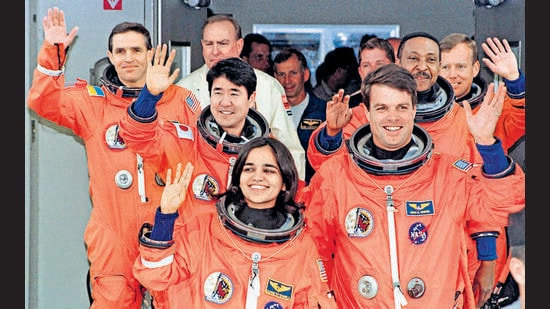
The shuttle crew also included Leonid Kadenyuk of Ukraine and Japanese Astronaut Takao Doi, who became the first person from his country to walk in space. The three American astronauts were Commander Kevin Kregel and Pilot Steven Lindsey at the controls, and Winston Scott, making his second flight. It was Kregel’s third space flight. AII the others were first-timers.
A delegation headed by Charge d’Affaires TP Srinivasan of the Indian Embassy was on hand at the Kennedy Space Centre at Cape Canaveral Florida, to greet the first Indian-American Astronaut on the eve of the space shuttle launch.
“This is a proud moment for India,” diplomat Srinivasan told Dr Chawla, adding that she had added a new and glorious chapter to the history of the Indian-American community which had made a significant contribution to different facets of life in the US.
Srinivasan noted that Chawla was not only born in India, but had also received her early education there. He felt that her early upbringing and education in India and her Indian heritage must have contributed to her accomplishments.
Chawla thanked the people and Government of India for their affection and encouragement and expressed the hope that her flight would further strengthen cooperation between the two countries.
Just six minutes after lift-off, Columbia achieved a first of its own, when, on instructions from onboard computers, it undertook a 180-degree flip which placed it in position to have radio link with communication satellites high above. Mission control resorted to tracking of the shuttle through satellites because NASA’s Bermuda tracking station was about to be shut down to save an estimated $5 million.
There was a minor glitch during the countdown when a broken seal on the crew hatch had to be re- placed.
Among those who attended the launch was Ukrainian President Leonid Kuchma, who cheered on his countryman on board the shuttle.
One of the first tasks for the Astronauts was to release a solar observatory named Spartan, which was supposed to make simultaneous observations of the Sun with Soho, another solar observatory that had been in space for two years. However, Soho shut itself down due to voltage problems and mission control postponed the Spartan release.
Other Columbia programmes included a practice space walk by the Astronauts, as well as experiments with plants, crystals and metals.
(Excerpts from an article published in HT on November 21, 1997)


