
 E-Paper



Keeping up with UP: How BJP won Muslim majority seats in bypolls
BJP won Muslim dominated constituencies in Assam and Uttar Pradesh bypolls—was it an aberration or experiment?


New Delhi: Yogi Adityanath and Himanta Biswa Sarma, the Bhartiya Janata Party (BJP) chief ministers of Uttar Pradesh (UP) and Assam, who have a penchant for delivering polarising speeches and slogans are key leaders for the party in the North and the Northeast.
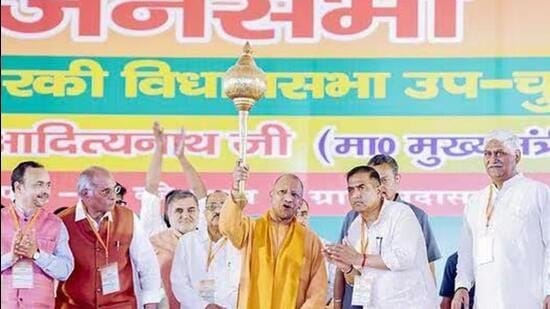
But the recent bypoll results took all by surprise. Amid BJP’s push on the Waqf Bill to change the laws governing Muslim endowments and madrasa reforms, it won the bypolls in Muslim majority constituencies of Kundarki in West UP and Samaguri in Assam in November.
Were these wins just an aberration or an experiment in the two states with a sizeable Muslim population? Muslims account for about 20% of UP’s population with a concentration in western and central UP and account for 34% in Assam. Muslims form 60% of Kundarki’s population and 56% in Samaguri.
Yogi, who faced much flak after the party’s poor performance in the 2024 Lok Sabha elections, had called for a 100% strike rate -- 9/9 in the bypolls. They won seven seats but Kundarki was a surprise.
Even BJP leaders say they are still trying to fathom how they got Muslim votes, that too in bulk. Their argument is that their candidate polled 170,371 votes as compared to 25,580 votes going to the Samajwadi Party (SP) candidate. Politically, the explanation is that the Muslim votes were divided with the upper caste Muslim votes (Turks), a business community, voting for the BJP. They bought security for themselves. Second, the Hindu votes consolidated in the wake of the “Batenge toh katenge” slogan.
In Assam, Sarma described the win as a milestone in state politics and gave credit to welfare schemes. Now, he said, the BJP will focus on six Muslim majority seats. What he did not say was the role played by two Muslim leaders who had moved from Congress to the BJP and strategised the elections. Interestingly, a Hindu won the seat, a rare phenomenon.
If an experiment, these wins should ring an alarm bell for the Opposition, especially the SP -- the first choice of Muslims in UP -- and the Congress in Assam as the BJP may try to replicate the winning formula in other Muslim-dominated constituencies. The route could be two - one, the welfare schemes and, second, the fear of being isolated and marginalised in the new socio-political scenario.
It was in the mid-1980s when the BJP, considered an upper caste party then, had launched a drive to win over Dalits. The welfare schemes and consistent outreach programmes eventually won them sizeable numbers 2019. The BJP may adopt the same route of welfare schemes to influence Muslims but it may also require toning down their Hindutva agenda, aggressively pursued in both the states. Communal incidents like what happened in Sambhal and Bahraich are detrimental.
Political expert M Hasan does not see the migration of the Muslim vote to the BJP, even in small chunks, in the 2027 state assembly polls. “They are hopeful the SP-led opposition will form the government and thus will not abandon the SP as of now.”
The BJP, in fact, is eyeing small chunks of Muslim votes to dent or divide the Opposition’s support base. Senior BJP leader Sunil Bansal, former in-charge of UP, had directed local leaders in western UP to get 10,000 community votes in each assembly segment in the region in the 2022 assembly polls. The BJP had then deployed two Pasmanda Muslims in each booth, telling them to concentrate on community members who had benefited from the government’s welfare schemes. A small Muslim ‘labarthi (beneficiaries)’ meet too was organised to explain how the party was their well-wisher and did not treat them as vote banks. The plan was to ensure at least 20 community votes in each booth.
The BJP stepped up its outreach programmes after Prime Minister Narendra Modi’s message of “tushtikaran nahin, triptikaran” (fulfilment, not appeasement) at the party’s national executive meeting in Hyderabad in July 2022. Largely, focusing on Pasmandas, the party had fielded more than 350 Muslim candidates for the local bodies’ elections in UP in May 2023, ahead of the Lok Sabha elections. A counter to the SP’s MY, which stood for Muslim and Yadav, was coined and, in this instance, MY stood for Modi-Yogi.
The Pasmandas form 75% of the total Muslim population, including Malik (Teli), Momin Ansar (Julaha), Quresh (Kasai), Mansoori (Dhuniya), Idrisi (Darzi), Saifi (Lohaar), Salmani (Nai) and Hawari (Dhobi). Pasmanda Muslim is a term largely referred to OBCs, SCs and ST equivalent among the community.
Though the Muslim outreach programmes were carefully crafted, overall, the community support has only fallen by about a percent between 2022 assembly and 2024 Lok Sabha elections. Only two per cent Muslims polled for them.
But the BJP’s always plans for the long-term. Party spokesperson Hero Bajpai said, “We have been working on the Pasmanda community but we got support of the upper castes, and not Pasmandas, in Kundarki. Now, after victories in two Muslim majority constituencies – Rampur and Kundarki -- we are drawing up winning strategies for the Muslim-dominated constituencies in the state for the 2027 assembly polls. The BJP had earlier won the Rampur assembly constituency in 2022 bypoll while its ally Apna Dal had won the neighbouring Suar constituency in the 2023 bypoll.”
UP has about 100 constituencies where Muslims play a decisive role. Political expert Athar Hussain disagreed with the contention that the BJP can replicate Kundarki or Rampur victories in general elections in future polls. “Bypolls are different. The ruling Samajwadi Party had won nine of the 11 assembly seats in the 2014 bypolls.”
Bypolls have generally gone in favour of the ruling party as micro-management of elections is easier. Why will the Pasmanda community vote for the BJP? They are building a narrative, otherwise over 70% of the impacted population in Sambhal riots are Pasmandas.
Personal relations, however, matter. Muslims voted for former PM Atal Bihari Vajpayee and now vote for senior BJP leader and defence minister Rajnath Singh in Lucknow and for Rita Bahuguna in Allahabad. This is precisely what happened in Kundarki where voters preferred a non-Muslim among 11 Muslim candidates. Bajpai is confident that by fielding moderate candidates like Ramvir Singh in Kundarki who befriended Muslims, wearing their skull caps and scarfs, the party can penetrate the so-called no zones areas.


