As of July 10, farmers had sown kharif crops over 350.85 lakh hectares of land, about 16% below the same point last year, despite a revival in rainfall over early July. The gap had narrowed from a 21% deficit a week earlier, but monsoon activity has since weakened again, pushing the nationwide rainfall shortfall back to 18% by Monday.
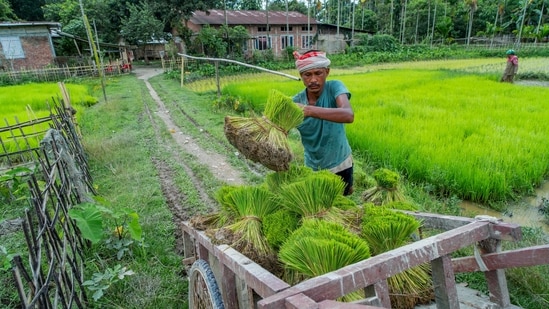
India's agricultural calendar, as the data reflects, isn't set by farmers but by the clouds.
When the southwest monsoon arrives late, or delivers its rain in the wrong quantities at the wrong time, the entire kharif season — one of the two key cropping cycles that is most exposed to the rain — is thrown into disarray.
Also read: What an El Niño year means for India’s monsoon
Kharif crops
The word "kharif" comes from Arabic for "autumn". It made its way into Indian agricultural terminologies through the Mughals, who used the word to describe crops sown at the onset of monsoon and harvested during autumn.
Sowing typically runs from June to July and harvesting from September to October, though the window varies by region. In Kerala, sowing can start as early as May, and the same may extend into July for parts of north India.
{{/usCountry}}Sowing typically runs from June to July and harvesting from September to October, though the window varies by region. In Kerala, sowing can start as early as May, and the same may extend into July for parts of north India.
{{/usCountry}}The main kharif crops are paddy (rice), maize, cotton, soybean, groundnut, pearl millet, sorghum, and pulses such as pigeon pea (tur), green gram (moong) and black gram (urad). They anchor India's food security, rural incomes and, through cotton and oilseeds, several downstream industries.
These crops need warm, humid conditions for germination and early growth, and dry, sunny weather for maturation and harvest. Both the halves must fall in place. Too much rain, too little, or rain at the wrong time can lay waste to the entire cycle.
Why timely showers matter
Kharif sowing is timed to the first substantial showers of the southwest monsoon. Seeds are placed in the soil on the expectation that rainfall will soon build up the moisture needed for germination, root establishment and the early vegetative phase.
An article published by the National Academy of Agricultural Research Management (NAARM) this month noted that any delay in the monsoon's onset postpones sowing, effectively shortening the growing season and exposing crops to moisture stress during critical stages of development.
That's also why data on just seasonal averages can be misleading.
As former agriculture secretary Devesh Chaturvedi told HT, "For several crops, what is needed is a round of rain, which can bring moisture to the soil pre-sowing, and then some intermittent rain. Even those districts that remain deficient will do fine as a result."
Conversely, districts that receive their full quota in one or two extreme spells may still see germination fail and nutrients wash away, because excessive rain can leach nutrients and fertiliser out of the soil before plants can use it.
The vulnerabilities are also crop-specific. In rice, the principal kharif crop, reduced rainfall affects nursery establishment, transplanting, tillering, flowering and grain filling, with the sharpest yield losses when dry spells coincide with flowering. Oilseeds suffer poor seed formation under moisture stress; pulses experience weak flowering and pod development. Cotton plants become stunted, reducing boll formation, rain-fed maize sees reduced cob development, and coarse cereals show diminished grain filling, the NAARM paper notes.
El Niño and July rain
This year's monsoon is front-loaded with risk because of El Niño. The El Niño–Southern Oscillation is a phenomenon marked by warming of the central and eastern equatorial Pacific Ocean. It can weaken the atmospheric circulation, which drives India's southwest monsoon and has been associated with some of the country's drought years.
The US National Oceanic and Atmospheric Administration (NOAA) formally declared on June 11 that El Niño had set in. Before that, the IMD projected monsoon rainfall at 90% of the long-period average, with a 60% probability of a below-normal rainfall.
Southwest monsoon lagged in June, which was the fifth-driest in more than a century, with only 99.5 mm of rainfall recorded — a shortfall comparable to 2014, when El Niño conditions weighed on the monsoon and hurt agricultural output.
But monsoon staged a brief recovery in July, with the system covering the entire country and narrowing rainfall deficit from 40% in end-June to 18% this week.
Research firm Crisil cautioned that "the swings between scarcity and surplus can be as disruptive to agriculture as a weak monsoon itself, influencing sowing decisions, crop health and ultimately rural incomes".
The India Meteorological Department (IMD) has forecast July rainfall at 6% below the long-period average, implying that the second half of the month could turn considerably drier.
The IMD has already flagged subdued rainfall over the northwestern plains, west-central India and south Peninsular India for the next six to seven days. Several key agricultural regions such as eastern Uttar Pradesh, Bihar, Jharkhand, Punjab, parts of Gujarat, Maharashtra, Telangana and Karnataka recorded rainfall deficits above 20% as of Monday, with some pockets running short by as much as 47%.
On the ground
Sowing data maps the deficit onto the ground.
Pulses acreage (area sown) stood at 2.3 million hectares till July 10, down 23.3% year-on-year. Oilseeds stood at 7.1 million hectares, down 21%, coarse cereals at 5.3 million hectares, down 22.5%, and cotton at 9.2 million hectares, down 15.3%.
Rice was the only major foodgrain that showed signs of recovery at 4.8 million hectares, still 8.6% below last year but 17.3% above the normal for the date**, following improved rainfall in eastern India.**
The pattern reflects just how uneven irrigation coverage across the country is, and that rain-fed crops absorb the shock first.
Economist Ramesh Chand pointed out that "about three-fourths of the area under rice is irrigated, compared with barely 9% for soybean. The acreage numbers reflect this difference. The same relationship holds true for pulses."
Garima Jain, chief executive officer at Torq Commodities, which specialises in trading oilseeds, grains, spices and other resources, told HT that lower rainfall since July 8 in Madhya Pradesh, Maharashtra, Karnataka and Gujarat had already begun pushing up temperatures and pulling down soil moisture. "Based on current conditions, we can confidently say acreage under pulses, millets and oilseeds is likely to decline. The bigger concern is the rainfall forecast for the next seven to 10 days," she said.
Using its deficient rainfall impact parameter — which combines rainfall deficiency with irrigation coverage — Crisil identified Karnataka, Bihar, Uttar Pradesh, Andhra Pradesh and Telangana among states likely to face significant agricultural stress.
The pressure, it said, was highest on tur and coarse cereals while well-irrigated sugarcane and the relatively resilient soybean and groundnut crops were less affected.
The geography of concern narrows further to what meteorologists call the monsoon core zone — a swathe running from Gujarat across central India to West Bengal, which accounts for a large share of India's rain-fed agriculture. It is the heartland for soybean, pulses and millets, and a prolonged dry spell during the peak sowing window could both reduce acreage and dent yields later in the season.
Also read: Infrastructure takes battering across India in wake of heavy rain
A late rain may not come to the rescue
When it comes to kharif crops, wet August or September can't make up for dry June or July.
Kharif crops need dry, sunny weather to mature and to be harvested. Late showers that arrive after flowering has failed or after pods have set poorly cannot reverse the initial damage; they can only add to it.
Because harvest coincides with the tail end of the monsoon, the produce is also more vulnerable during storage. Grain and pulses have to be dried thoroughly before storing them to prevent fungal growth, and rain during or immediately after harvest raises the risk of spoilage and post-harvest losses.
That double bind — rain in June and July, and clearer skies by September and October — is what makes the monsoon's timing, and not merely its volume, a key factor for the kharif season. As Crisil put it, “Copious showers have offered relief, but whether they herald a sustained blessing or merely a brief respite remains a question that only the coming weeks can answer.”
(With inputs from ANI)