
 E-Paper



Khichan: A haven for Demoiselle Cranes faces conservation challenges
Khichan, situated in Rajasthan’s Thar Desert, is an example of bird-human coexistence, where the villagers play a crucial role in supporting the Demoiselle Cranes


JODHPUR: A new study by the Bombay Natural History Society (BNHS) and local conservationist Sevaram Mali has shed light on the vital role of the Khichan bird sanctuary, Rajasthan, as a wintering site for the Demoiselle crane, locally known as Kurja. Every year, approximately 20,000 cranes migrate to this small village, making it a globally significant site along the Central Asian Flyway and the urgent need to conserve the habitat.
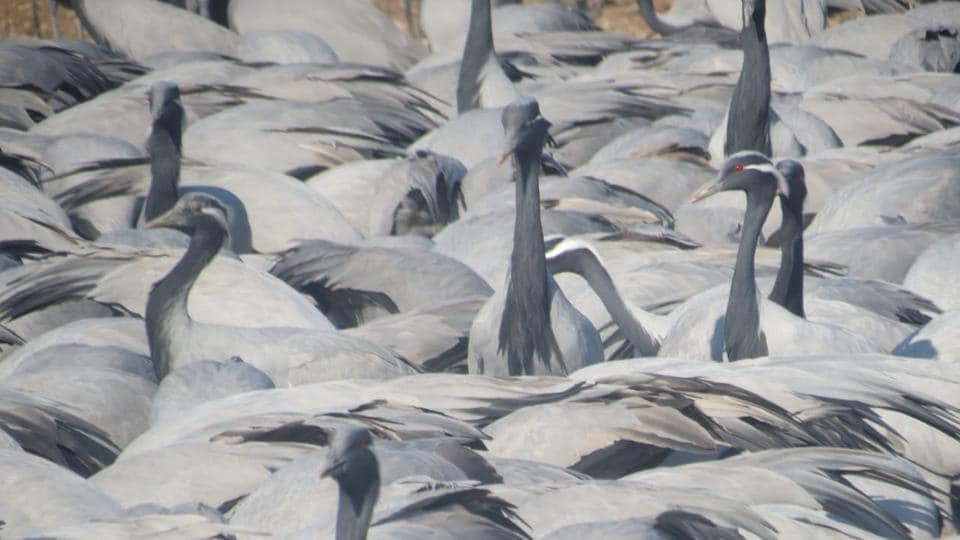
The study highlights the urgent need for effective conservation measures to safeguard the migratory birds, whose survival depends on the protection of their feeding and roosting habitats.
Khichan, situated in Rajasthan’s Thar desert near Jodhpur, is an example of avian-human coexistence, where the villagers play a crucial role in supporting the Demoiselle Cranes.
Speaking about this unique relationship, Mali, one of the study’s key contributors, said, “For decades, the people of Khichan have fed these birds with unwavering dedication. This tradition has turned the village into a haven for Demoiselle Cranes, showing how communities can actively contribute to conservation.”
Mali said, “The open grounds and shallow waters of the salt pans, combined with the care provided by the villagers, create a perfect sanctuary for these migratory birds. It’s a rare example of how human intervention can positively influence wildlife.”
This unique harmony has made Khichan a vital wintering ground and a global hub for birdwatchers and conservationists.
From 2014 to 2024, researchers recorded 20 Demoiselle Cranes in Khichan with identification rings or Platform Transmitter Terminals (PTTs), used for tracking their migratory patterns. Among these, one bird was a resighting of a previously identified individual. The data revealed that ten cranes originated from Mongolia, while nine were traced back to Russia.
A collaborative migration study by the Severtsov Institute of Ecology and Evolution and the Vavilov Institute of General Genetics provided further insights, showing that all 21 tagged cranes monitored in Russia primarily travelled to northwestern India, particularly the Thar and Kutch Deserts. Observations in Khichan revealed that these birds arrive from northern, eastern, and northeastern regions, yet strongly prefer the habitats of Khichan over other locations in India during their wintering stops.
The study also brought attention to significant threats faced by the Demoiselle Cranes, including collisions with high-tension power lines. During field observations, researchers documented crane fatalities in Rawra village, where power lines cross key roosting areas.
“The loss of even a few from such an important migratory population is significant. Infrastructure modifications, such as installing bird flight diverters or transitioning to underground power lines, can make a huge difference,” said Sujit Narwade of BNHS highlighted the urgency of addressing these issues.
Another challenge identified in the study is the invasion of habitats by exotic plant species like Prosopis juliflora, which threatens to render traditional roosting areas unsuitable for the cranes.
Despite these challenges, the resilience of Khichan’s ecosystem and the dedication of its residents continue to support the Demoiselle Cranes during their winter migration. However, experts stress that community efforts alone are not enough. Structured conservation planning, habitat restoration, and long-term monitoring are essential to ensure the survival of these migratory birds.
The study underscores the importance of understanding the migratory behaviour of the Demoiselle Cranes to develop effective conservation strategies.
The tracking data reveals how the Thar Desert’s unique ecosystem remains a preferred wintering destination for these birds, offering vital insights into their habitat preferences. “Protecting Demoiselle Cranes is about more than just preserving a species—it is about safeguarding a legacy that connects ecosystems and communities across continents,” Narwade added.


