
 E-Paper



Loss, denial, mourning: Inside West Bengal’s village of explosives
A village in West Bengal, India, has been in mourning multiple times due to explosions at illegal firecracker factories that have killed many people

 Prefer HTon Google


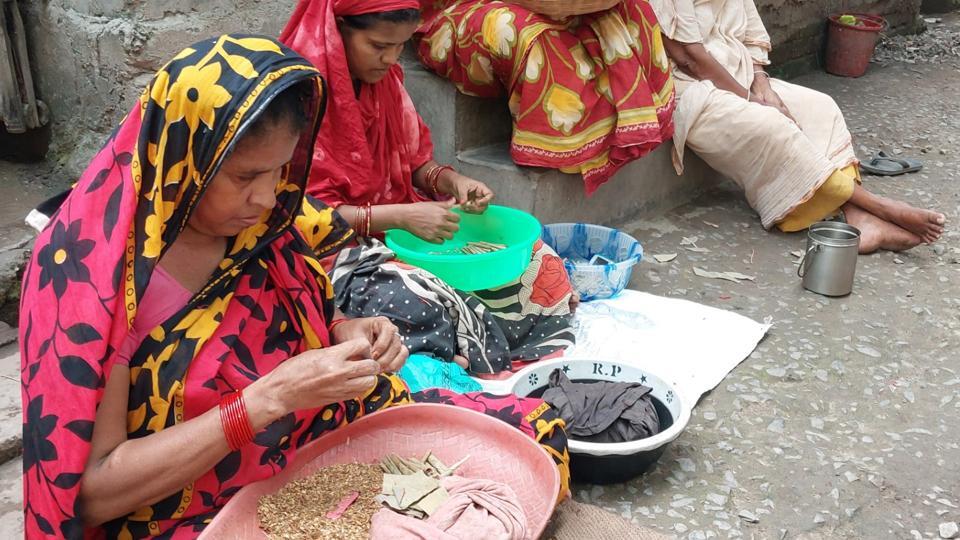
Rahima Bibi sits on the road with three other women, draped in a faded red-and-yellow sari, and a shroud of silence. On her lap is a pink winnower, holding a pair of rusted steel scissors and a pile of crushed tobacco. The women work in silence, their practised fingers rolling beedis. The silence is unbroken even when they are asked the directions to the home of Jerat Sheikh, who was killed with eight others at an illegal “firecracker factory” two weeks ago. Nutan Chandra is a village in mourning. But Nutan Chandra is a village that has been in mourning several times before.
On August 27, a powerful blast at a building in Duttapukur in North 24 Paraganas, barely 30km north of Kolkata, left nine people dead. So powerful was the explosion that three homes collapsed entirely; three others suffered extensive damage; the bodies of some victims were ripped apart, parts flinging several metres away from the blast site.
Read here: West Bengal CM Mamata Banerjee reshuffles Cabinet ahead of Spain, Dubai visit
As always, almost inevitably in West Bengal, questions were asked if this was indeed an illegal firecracker factory, or crossed the thin but deadly line into a cottage crude bomb-making unit. Police found sacks full of stone chips in the gutted premises; and in makeshift shelters inside a brick kiln about a kilometre away, a makeshift laboratory with beakers and test tubes. Police have officially maintained that it was a firecracker factory, albeit illegal, and not the more sinister alternative. They are still waiting for the final forensic reports even after more than two weeks of the incident.
“Thus far, we have not found anything which suggests that there was the manufacturing of crude countrymade bombs. Even the preliminary forensic reports suggest so. We are yet to get the final report,” Bhaskar Mukherjee, superintendent of Barasat police district, told HT.
He said that police have seized more than 350 tonnes (350,000 kilos) of firecrackers stacked in multiple godowns located within a 2-3km radius of the blast site along with raw material such as explosives, cellophane papers and packing machines.
At least five people have been arrested thus far under various sections of the Explosives Act. Raids are still continuing, police said.
Two weeks later, and more than 240km north of Duttapukur, there is still a hushed silence in the thin, often unpaved, roads that criss-cross the village of Nutan Chandra. Five of the nine dead, including two minors, were from this village. They came from one family. An inconsolable Khaleda Parveen, 32, says, “My son Rony Sheikh (16), my brother-in-law Jerat Sheikh (45), his two sons Andaz (20) and Masum (16), and another brother-in-law College Sheikh (42) were all killed in the blast.”
The village of explosives
Three kilometres away from the India-Bangladesh border, Natun Chandra is a village comprising around 150 houses in Suti block. Densely populated, the lanes are narrow and teeming with people, the homes are either one- or two-storey structures with exposed brick; barely anyone has money for plaster or cement. They are used to both tragedy and prying eyes. Every outsider is watched; in the mouth of every by-lane is a gaggle of women, watching keenly, but ready to hide.
The village first came under the scanner in May 2015, after an explosion at an illegal fireworks factory in West Midnapore’s Pingla, around 370km south of Suti, left 13 people dead. “At least 10 minors who were killed in that blast were from Natun Chandra village,” said a former officer of Suti police station.
Local residents said that the families of the victims of the 2015 blast had all moved out of the village, and were not available for comment. But they aren’t the only ones. Look closely, and there are very few young men in the village left.
“Teenage boys and men move out in search of work to other districts and states. Many go to firecracker units. The women make a living rolling beedis,” said Olilul Rahman, a local moneylender.
In the years after, the link between Natun Chandra and the tenuous line between illegal firecrackers and allegations of bomb-making blurred further.
In 2016, police in West Bengal questioned some men from the village after explosives were found within 5km of former President Pranab Mukherjee’s home in Jangipur, Murshidabad. Among those questioned were Jerat Sheikh, one of the men who died on August 27. The other man they questioned was 35-year-old Isha Sheikh alias Isha Khan, the father of the 16-year-old Rony Sheikh, who also died in the August blast.
The most attention that the village got was in February 2022, when 38 days before the West Bengal assembly elections took off, the then West Bengal minister of state for labour, Jakir Hossain, was among 22 people injured in an explosion at the Nimtita railway station, 1.5km away from Natun Chandra. The National Investigation Agency (NIA) took over the case under various sections of the Unlawful Activities (Prevention) Act, Explosives Substance Act and the Indian Penal Code, and Isha Sheikh was arrested in June 2022. A statement issued by the federal agency said that Sheikh had supplied the explosives used to trigger the blast. The case is under trial.
So when Isha Sheikh came to Natun Chandra on August 29, he did so on parole from the Presidency jail in Kolkata. His wife Khaleda Parveen said, “My husband is innocent. He was brought to the village on August 29 to attend the burial of Rony and the other members of our family. He is completely broken.”
Locals, however, said that the family were suppliers for explosives. “Isha and Jerat were into bomb-making and were the suppliers of explosives. They lured villagers to work in illegal firecracker manufacturing units in other districts. People were offered more than ₹10,000 a month and this attracted the youth. There are several that still work there (in firecracker-cum-crude bomb-making factories),” said a villager who has his own business.
“My husband (Isha) was falsely implicated. He was picked up for questioning at least four times and then suddenly arrested. He is innocent. Even Jerat was not into bomb-making. These are all false charges. He worked as a labourer. He had gone to meet his son in the factory. Even my son never told me that he was working in a firework factory. It has been just a week since he went there to work with Masum and Andaz,” said Parveen.
Thin line between firecrackers and bombs
The question is now inevitable. It was asked in Duttapukur in North 24 Parganas in August when nine people died; it was asked when 11 people were killed at Egra in East Midnapore; and it was asked in 2017 when five people died at Amdanga in North 24 Parganas: Was it an illegal firecracker unit or a bomb-making factory?
In some minds, the answer is clear. Arjun Singh, a Trinamool Congress (TMC) member of Parliament, who himself has 24 criminal cases (according to his 2019 ECI affidavit) against him, recently told reporters, “Around 10% make firecrackers. The rest make bombs. It is more lucrative. The lower level police are involved.”
But what makes the switch between illegal firecracker factories and bomb-making factories so seamless, and often interchangeable? Experts say that the ingredients to create the combustible explosive – charcoal, sulphur and potassium nitrate – are the same for both, and are easily available in the market. “If ingredients for gunpowder are easily produced from wholesale markets, jute strings, ball-bearings, nails and stone chips are available at the local hardware shop,” said a 32-year-old man from Murshidabad who said he once manufactured crude bombs but gave up the profession later.
Bombs come in various shapes and sizes, the man said, and their names depend on the design and the material used to make them. “The most commonly used bomb, that is round, and comes tightly wound with jute ropes is called peto. This could be with or without shrapnel. The one without shrapnel is primarily to scare people with the sound, flash and smoke and is used on polling day to keep voters away from the stations. Stone chips, iron nails, and pieces of tin are used for shrapnel and make the bomb lethal. If these ingredients are sealed in a small iron pipe it is called a socket bomb, and if it is in a tin container that once held chewing tobacco, it is called a kouta bomb. One advanced version is an indigenous grenade, which has a pin attached that needs to be pulled out before it is hurled,” he said.
Read here: West Bengal assembly passes resolution to observe April 15 as Bengal Day
Even outside of explosions in factory units, there have been tragic costs that come attached to the process. Over the last two years, many children have died and many more have bene injured in separate incidents after picking up stray explosives in the garbage thinking they were balls.
This July, two children were injured at Salar in Murshidabad district when they mistook a crude bomb to be a ball and were playing with it. Similarly, a seven-year-old boy was killed while a 10-year-old was seriously injured after a crude bomb exploded when they mistook it for a ball near Barrackpore in October 2022. And in January 2022, three boys, aged between 11 and 14 years, were injured when they lobbed a crude bomb assuming it was a ball in Berhampore in Murshidabad district.
Why Natun Chandra’s villagers gamble with life
In a corner of the two-storey room, 15-year-old Ripa Khatun stands in silence.
She is half-hidden behind a curtain made of an old sari. An unkept bed, two plastic chairs, and a table fan are the only furniture in the room with no plaster or paint. The room is on the ground floor of the half-complete two-storey building. An open staircase (no railing) goes by the side of the room. Except for Isha Khan’s 10-year-old son, there are no boys or men in the house.
The other women, slightly older, slightly more inured to the pain of loss, speak in loud voices. When Ripa Khatun does speak, it is barely a whisper. “My brother Masum and cousin Rony had done it for the first time. They went a week ago, and they are now all dead. Everyone is gone. My father and brother Andaz too,” she whispers.
With Isha Sheikh in jail, there are barely any men left.
Khaleda Parveen is louder, angrier. “What were we to do? Nearly every woman, from young girls to old women, roll beedis while the men and the boys go out to cities. We were not told that they had gone to work in firecracker units. Jerat used to tell us that they were going to work as masons,” she said.
But outside the home that is in mourning, in the densely packed lanes, there is little doubt what the men in the village go to do. In fact, Natun Chandra has a colloquial name. “Baajigar Gram” (the village of firecracker workers) is what they call it.
“It is well known that men from this village work in these illegal factories. When elections come around, the demand rises even further. In a week, you could earn between ₹8,000 and ₹10,000,” said another local, who was not willing to be named.
Retired West Bengal-cadre IPS officer Nazrul Islam says, “We have seen how crude bombs are indiscriminately used in political clashes and riots. These illegal units are used to prepare the bombs. Everything happens in the full information of the local police. They turn a blind eye.”
There was almost an admission from the government’s highest echelons after the Duttapukur blast when on August 28 chief minister Mamata Banerjee pulled up the state police at a political rally in Kolkata. “Some people are engaging in activities and a section of police are turning a blind eye. I don’t want to go into details as to what the local police stations are doing. We are keeping a watch,” she said.
Government officials say there is no data with the state government about how many illegal firecracker units exist in Bengal. A state pollution control board official said that there were less than 10 green firecracker manufacturers in the state registered till May this year. “The rest are all illegal,” he said.
In October 2022, the Calcutta high court directed the West Bengal government and the Pollution Control Board to ensure that only green firecrackers with QR codes were sold in the state.
Senior government officials said that the first principle to tackle the problem of villages like Natun Chandra was to approach it as an employment issue. “This is a huge workforce and [bomb-making] provides livelihood to several thousand families directly or indirectly. We need to utilise this workforce in the right direction. Otherwise they will continue to be used for all the wrong reasons,” said the official cited above.
Read here: Railway projects stuck in West Bengal due non-availability of land: Centre
The stakes are high; for peace in Bengal, and for peace in the bylanes of Natun Chandra.
Meanwhile, Rahima Bibi and the other women continue to roll beedis, living through another round of mourning.


