E-Paper



Madhya Pradesh college bans hijab after VHP women’s wing protests against it
Durga Vahini, the women’s wing of Vishva Hindu Parishad (VHP), staged a protest against the institute in Datia for allowing Muslim students to wear headscarves on campus

 Prefer HTon Google


BHOPAL: A government college in Madhya Pradesh’s Datia district has banned hijab after members of Durga Vahini, the women’s wing of the Vishva Hindu Parishad (VHP), staged a protest against the institute for allowing Muslim students to wear headscarves on campus.
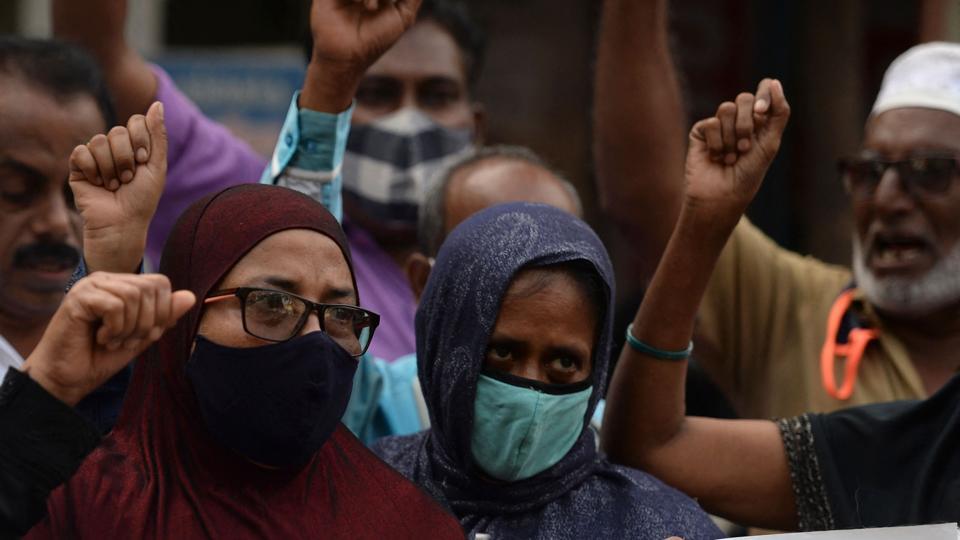
The ban comes days after a directive in Karnataka against allowing women wearing hijab in classrooms triggered protests. The Karnataka high court issued an interim order on Friday barring students from wearing religious attire in classrooms until it decides on the case.
High schools across Karnataka opened on Monday, but Muslim students were forced to remove their hijab amid simmering tensions in the state.
“All the admitted students/girls in the college are informed that they will not be allowed to enter the college in clothes belonging to any particular community or other special dress like hijab, etc. All the students should enter this temple of education in a decent dress,” said Datia College’s principal, DR Rahul, in an order on Monday.
The order followed Durga Vahini’s protest after its members spotted two students wearing hijab in the college. The members created a ruckus at the principal’s office and demanded action to stop the entry of students wearing hijab.
Durga Vahini district convener Rani Sharma said they were informed that students were going to college wearing hijab and burqa. “When we came here on Monday afternoon, we spotted two students in burqa and hijab. We staged a protest for equality of students.”
Rahul said the order was issued for uniformity in the college dress. “Earlier, the students used to come in normal dress but after this (Karnataka) hijab row, a few have started wearing hijab and burqa.”
Home minister Narottam Mishra, who is a lawmaker from Datia, said there is no confusion about hijab in Madhya Pradesh. “I request you not to create any confusion about it. I have asked the district collector to inquire into the [college] order.”
Last week, a principal forced a Muslim student to write an apology letter for wearing hijab in the college in Satna after some students staged a protest against her dressing.