
 E-Paper



Maha Kumbh: Akharas kickstart ‘Amrit Snan’ amid vigil over crowding in 1st holy dip ritual after stampede
The key holy dip day on occasion of Basant Panchami comes days after the previous auspicious bathing day saw a deadly stampede in which at least 30 people died.

 Prefer HTon Google


Akharas kickstarted the third grand ‘Amrit Snan’ at ongoing Maha Kumbh Mela in Uttar Pradesh's Prayagraj in the early hours of Monday, amid tighter protocols days after the previous auspicious bathing day saw a deadly stampede in which at least 30 people died.
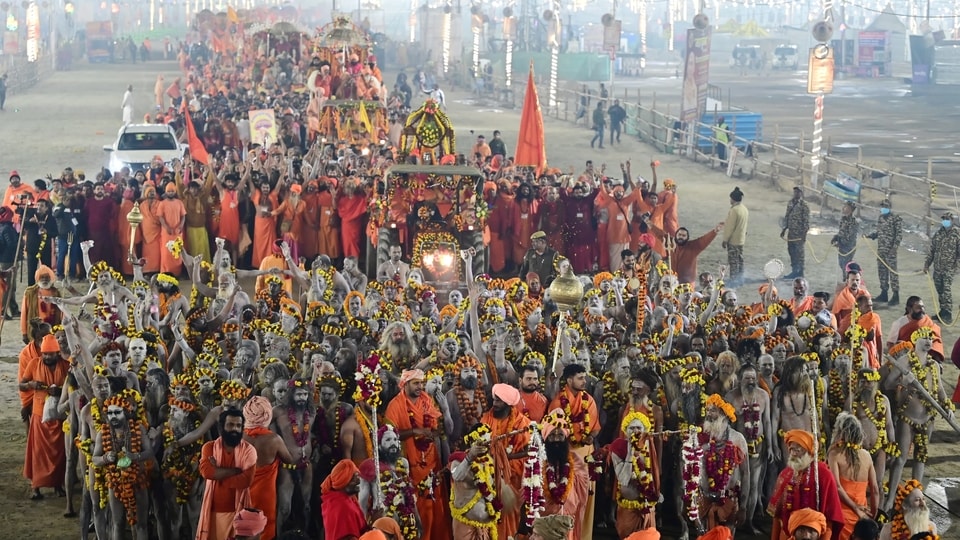
The third 'Amrit Snan' of Maha Kumbh 2025 is on the occasion of Basant Panchami. Follow Maha Kumbh live updates
To ensure a mishap-free event, a schedule of bathing was decided by the mela administration in tune with the senior sadhus of the akharas. Each akhara was allotted a 40-minute window at the holy waters, with the first procession completing their ritual and returning to their camps by 8.30 am.
Amid mounted policemen keeping close watch on Sangam Nose in Maha Kumbh Nagar in Prayagraj, Mahanirvani and Atal Akharas left their camps for the bathing ghats at 4 am itself and were expected to complete the bathing by 5.40 am instead of leaving the camps at 5.15 am as they did on Makar Sankranti on January 14.
Sadhus of akharas arrived at the bathing ghats in royal processions with full pomp and show and were asked to complete their bathing by 3.55 pm on Monday. Common devotees were allowed to start taking a dip at Sangam ghats once the once the sadhus move out.
Visuals showed ‘Mahamandleshwars’ or chiefs of different akharas leading the processions for the third 'Amrit Snan' of Maha Kumbh 2025. At the break of dawn, sadhus, including the ash-smeared Nagas from various akharas, began their ceremonial journey towards the Triveni Sangam.
Basant Panchami amrit snan schedule
The holy bathing ritual of Basant Panchami holds particular significance in the wake of the stampede at Sangam Nose during the previous ‘Amrit Snan’ on ‘Mauni Amavasya’, which resulted in at least 30 deaths and left 60 others injured.
The stampede took place at the Sangam Nose, which many believe holds greater spiritual significance, however, the akharas as well as the Uttar Pradesh government have urged people to not make reaching the main confluence point a priority, saying that all ghats hold equal importance.
By 4 am on Monday, 16.58 lakh devotees had taken the holy dip, with the overall figure of those who took the dip since Janyary 13 reaching 34.97 crore, information director Shishir said, adding the figure included 10 lakh kalpvasis and 6.58 pilgrims.
So far, over 33 crore devotees have taken a dip at the Maha Kumbh and the Uttar Pradesh government expects a footfall of around five crore pilgrims on Monday alone.
Determined to prevent any more untoward incident since ‘Mauni Amavasya’, the Uttar Pradesh government has reinforced security and crowd management measures. With chief minister Yogi Adityanath personally inspecting preparations on Saturday, additional personnel, medical staff, and resources have been deployed to ensure a “zero-error” Amrit Snan on Monday.
Akharas take dip in sequence
As per tradition, the akharas belonging to the three sects—Sanyasi, Bairagi, and Udaseen—are taking their holy dip in a pre-determined sequence, with the first group already immersing in the confluence of the Ganga, Yamuna, and the mythical Saraswati.
According to the schedule released by the Kumbh Mela authorities, the ‘Amrit Snan’ (formerly known as ‘Shahi Snan’) commenced at 4 am with akharas of the Sanyasi Sect. Leading the sacred procession were Shri Panchayati Akhara Mahanirvani, Shri Shambhu Panchayati Atal Akhara, Sri Taponidhi Panchayati Sri Niranjani Akhara, Sri Panchayati Akhara Anand, Shri Panchdashnam Juna Akhara, Shri Panchdashnam Avahan Akhara, and Shri Panchagni Akhara.
As mentioned above in the report, each akhara was allotted a 40-minute window at the holy waters, with the first procession completing their ritual and returning to their camps by 8.30 am.
Next in line are the akharas of the Bairagi Sect, whose bathing sequence began at 8.25 am. The processions include the All India Shri Panch Nirvani Ani Akhara, All India Shri Panch Digamber Ani Akhara, and All India Shri Panch Nirmohi Ani Akhara, with their turn concluding by 12.35 pm before the final group enters the sacred waters.
The last to perform the ‘Amrit Snan’ will be the Udaseen sect, comprising Shri Panchayati Naya Udaseen Akhara, Shri Panchayati Akhara Bada Udaseen Nirvana, and Shri Panchayati Nirmal Akhara. Their journey towards the river starts at 11 am, with the final ascetics completing their ritual and returning to their tents by 3.55 pm.


