
 E-Paper



MDMK scion’s political rise revives dynastic politics debate
Vaiko, who was ousted by the DMK in 1993, broke away to float the Marumalarchi Dravida Munnetra Kazhagam

 Prefer HTon Google


The debate over dynasty politics in Tamil Nadu has revived after the entry of Durai Vaiko, son of G Vaiko who famously rebelled against Dravida Munnetra Kazhagam (DMK) supremo M Karunanidhi for favouring his sons.
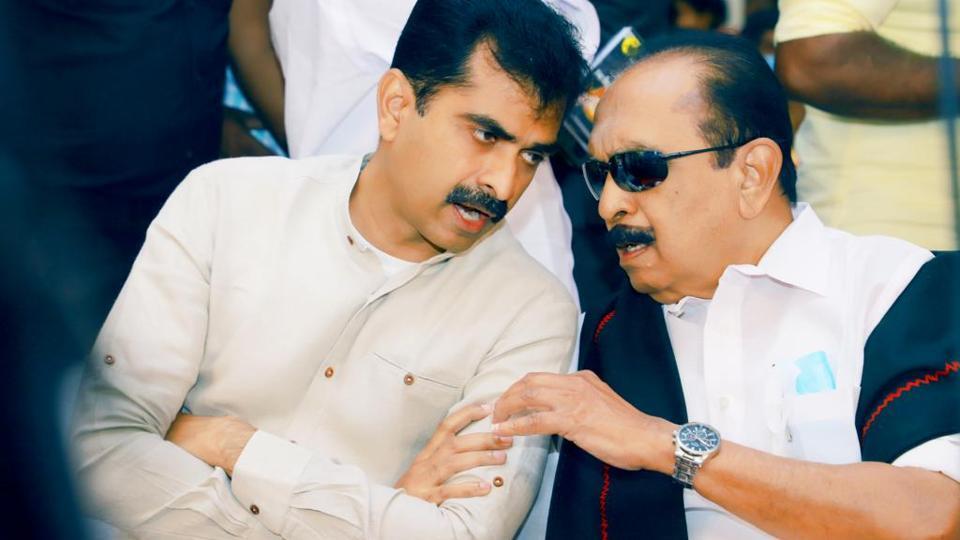
Vaiko, who was ousted by the DMK in 1993, broke away to float the Marumalarchi Dravida Munnetra Kazhagam (MDMK). According to people aware of the development, he now sees his son Durai internally elected as headquarters secretary of the party. He joined the DMK in 1964, and was a brand of his own, managing to pull the masses with his fiery speeches. The DMK expelled him in 1993 after the rift, which began after Vaiko’s meeting with LTTE chief V Prabhakaran in Sri Lanka. When Vaiko was ousted, his followers immolated themselves and hundreds of DMK cadres left with him. Back then, Vaiko was even considered an alternative to the duopoly of Karunanidhi and the late J Jayalalithaa.
A Rajya Sabha MP and lawyer by profession, Vaiko is a powerful orator and a zealous supporter of the Eelam issue (separate statehood for Tamils in Sri Lanka), among other core Dravidian issues. He has also remained at the forefront of the protests against the Mullaiperiyar dam, Kudankulam nuclear power plant and Sterlite plant and is regularly on a collision course with the Bharatiya Janata Party (BJP).
Durai, 50, who worked in an American MNC, and ran his own business, got into active politics in the past 3 years since his father’s health at 77 started deteriorating. “I hated politics, politicians and bureaucracy,” he said.
Among many factors, Durai’s reluctance also stems from the fact that Vaiko was arrested under the now revoked Prevention of Terrorism Act (POTA), which was arduous for his family. Durai said that when his father underwent a heart procedure three years ago, the MDMK cadre was anxious about the future of the party as he stepped in for campaigning, seat negotiations and attending weddings and funerals in place of his father. Durai, an admirer of Delhi CM Arvind Kejriwal, hopes to channelise his frustrations as a common man to connect with the Tamil people.
The MDMK’s website’s landing picture is that of Vaiko, Durai and ‘Periya’ E V Ramasamy (founder of the Dravidian movement) and C N Annadurai (founder of DMK and its first chief minister). But this is no succession plan, clarified Durai, adding that it was the cadre who insisted he take up this position. “This was very uncomfortable for my father. He was not for it,” Durai said, adding that Vaiko was acutely aware that what he stood against would be thrown at him. He referred to dynasty politics, an issue that led to the formation of MDMK.
“So, he was very firm that there are internal elections. It was a secret ballot in which 104 out of 106 (who are eligible to vote as per party bylaws–district secretaries, high-level committee members and state-level functionaries) were present to vote. After I was elected the party’s highest body-the general council had to ratify my election.”
This procedure happened on March 24. “It was a democratic process and my position is a nominated one which doesn’t have many powers,” said Durai. The headquarters secretary is an administrative position which has been vacant for a few years.
Trouble has been brewing in the 28-year-old party since his elevation. MDMK’s dissenters disapprove and want their party, which is in an alliance with the DMK, to be merged. But Durai has other plans. Vaiko had been against current chief minister M K Stalin’s rise in the DMK, and they saw each other as rivals for the state’s political future. It was eventually Stalin’s race to win while Vaiko has fallen off the political radar, and the MDMK has only a puny presence now, say political analysts.
“We have a good relationship with the DMK. Though my father and the chief minister have had bitterness in the past, my father arranged and attended thousands of meetings when he (Stalin) was youth wing leader, and he (Stalin) is also aware of my father’s contributions,” said Durai. “It’s more of brotherly affection. The alliance is good but asking us to merge is only a ploy.”
The brotherly metaphor is a throwback to the politics of the past.
In the 1990s, MDMK tested its electoral strength in the 1996 assembly elections and won no seat. Two years later, Vaiko joined hands with Jayalalithaa’s AIADMK under the National Democratic Alliance (NDA) coalition, but after Jayalalithaa drastically pulled out of the NDA and MDMK came into the DMK’s fold, Karunanidhi had described it as “a reunion of brothers”. Durai’s priority now is to develop the MDMK to be recognised as a state party.
With the stalwart leaders gone, Vaiko and Stalin share a different equation now. “It is Stalin’s political skill and acumen that he has been able to bring Vaiko into DMK’s fold and make the MDMK stay,” said a senior DMK leader not wishing to be identified.
“For all the years of politics and the kind of principles that Vaiko kept advocating like the succession theory he had to be far more cautious,” said political analyst Ramu Manivannan. “I think he probably considers this (his son’s elevation) as the last resort, which is the irony of his political career,” Manivannan said that the MDMK could have been the alternative in Tamil Nadu politics. “He had the space. He could have provided the alternative if he had shown that kind of consistency in his leadership and standing by certain principles and qualities which he was respected for. He was the first person to join Vajpayee’s coalition along with Ramakrishna Hegde (former Karnataka CM). He had close friendships with Advani and Yashwanth Sinha. But Vaiko is an emotional and enigmatic personality, not an organisational man like Karunanidhi. He conducts his political career through anger and affection.” Manivannan added that as long as Vaiko is there the future of MDMK lies in their continued alliance with the DMK.


