
 E-Paper



Mobile Covid-19 testing labs inaugurated
The World Health Organization (WHO) has said ramping up testing is the best way of slowing the advance of the pandemic.


Union health minister Harsh Vardhan on Thursday inaugurated India’s first mobile testing laboratory for coronavirus disease (Covid-19) diagnosis in remote and inaccessible areas with no or limited testing facilities. No decision has been taken on where it would be started.
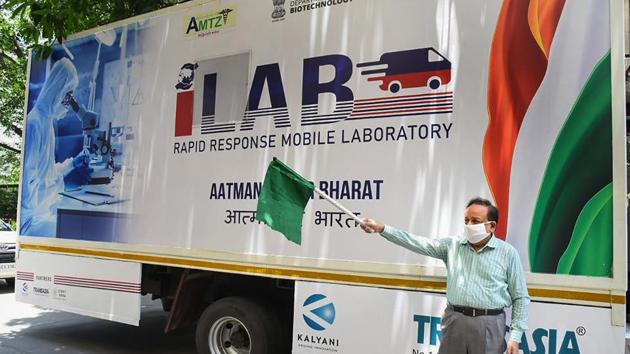
The World Health Organization (WHO) has said ramping up testing is the best way of slowing the advance of the pandemic. India has increased its capacity to test with Delhi, one of the worst-hit by the pandemic in the country, conducting 8,093 tests, the most conducted in a single day, on Wednesday.
Vardhan said most Indians live in rural areas and the country has about 650,000 villages. “This laboratory in a mobile van can easily be deployed in villages where testing facilities are limited. It will also be a boon for many inaccessible areas in the Northeast, and areas where there are no motorable roads. The core of this mobile lab can be disengaged and mounted on a cargo train to be transported to the desired destination. India’s railway network is spread far and wide,” he said at the launch of the lab.
The I-Lab (infectious disease lab) has the capacity for testing about 250 samples through real-time polymerase chain reaction (RT-PCR) and ELISA (enzyme-linked immunosorbent assay) based antibody techniques daily. It includes 50 RT-PCR samples. Officials said another set of machines are expected to be installed to double the capacity to test to 500 samples daily.
The government plans to have 50 such mobile labs to promote the last mile access to Covid-19 testing, according to the minister. In the longer run, such facilities will be provided for testing other infectious diseases like tuberculosis.
A team from Andhra Pradesh MedTech Zone Limited, an enterprise under the state government dedicated to medical device manufacturing, designed the biosafety level II (BSL-II) lab in eight days, by June 14, at the cost of Rs 1 crore.
It is a department of biotechnology initiative.
There are four BSL levels based on the infectious organisms that the researchers are dealing with. BSL-I is considered to be the least hazardous, while BSL-IV poses a maximum safety risk. Each level builds on the previous category, adding more layers of constraints and barriers to contain contamination.
The organisms include viruses, bacteria, fungi, parasites, etc. SAR-CoV-2, which causes Covid-19, belongs to the BSL-II category.
The mobile labs will be a part of the department of biotechnology’s hub and spoke model. There are close to 20 hubs in the country with 100 testing laboratories, and these labs will be linked to these hubs.
“The project is a part of India’s effort to expand its network of facilities for handling infectious diseases in the country, both in terms of testing and treating,” said Vardhan.
Experts say in the absence of full-fledged labs having mobile testing is a good idea. “BSL II labs are not everywhere so having these labs on site will definitely help. Linking them with some main laboratory will also help in cross-checking results in case of any doubts,” said Dr Charu Hans, a former head of the microbiology department at Delhi’s Ram Manohar Lohia Hospital.


