E-Paper



Modi announces National Deep Water Exploration Mission for energy security
In his Independence Day speech, Modi emphasised that a significant portion of the budget allocated for buying petrol, diesel, and gas can be provided for fighting issues such as poverty

 Prefer HTon Google


Prime Minister Narendra Modi on Friday announced the launch of the National Deep Water Exploration Mission for energy security by extracting deep-sea resources, including oil and gas reserves. In his Independence Day speech, Modi emphasised that a significant portion of the budget allocated for buying petrol, diesel, and gas can be provided for fighting issues such as poverty.
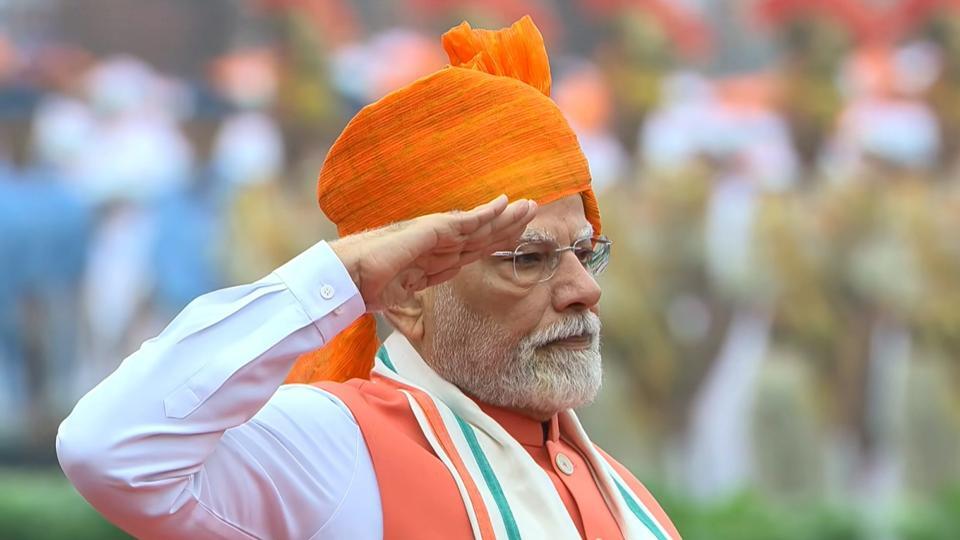
“If we had not been dependent, that money would have been used for the future of my country’s youth. That money would have been used to fight against poverty and for the welfare of farmers,” Modi said. “The money would have been used to change the situation in villages. But we have to give it to the foreigners. Now we are working towards becoming self-reliant.”
Modi said the world is very conscious of the critical mineral mission. “We need self-reliance in the critical mineral sector also for defence, energy, and technology needs. That is why we have launched the National Critical Mineral Mission. There are over 1200 exploration sites under this.”
Modi said solar energy production has increased by 30 times in the last 11 years. “We are making new dams so that hydropower can be expanded and clean energy can be available to us. India is taking up Mission Green Hydrogen and is investing thousands of crores.”
He referred to initiatives in nuclear energy and said 10 new reactors are working rapidly. “By 2047, when India celebrates 100 years of independence, we aim to increase our nuclear energy capacity tenfold.”
He called reform a continuous process. “We have to keep reforming according to the current situation. We have made big reforms in the field of nuclear energy,” Modi said, adding that India continues to remain sensitive to environmental issues.
“When the world is worried about global warming, I want to tell it that India had decided that by 2030, it will have 50% of clean energy. See the determination and power of my brothers and sisters... we achieved it by 2025. We have achieved the goal five years in advance. We are as sensitive to the world as we are to nature.”
India has surpassed its target of installing 50% of its power capacity from non-fossil fuel sources, achieving one of its key nationally determined contributions under the Paris Agreement five years ahead of schedule, the Union cabinet said last month.
On July 14, new and renewable energy minister Pralhad Joshi said India’s achievement of 50% non-fossil fuel installed capacity ahead of the target year is a testament to its ambition, innovation, and commitment to sustainable development. “It affirms that development and decarbonisation are not contradictory goals, but can reinforce each other. As the country moves towards the goal of 500 GW of non-fossil capacity by 2030 and net-zero emissions by 2070, the path forward must be bold, inclusive, and technology-driven.”