E-Paper



Modi, UN chief spell out green pledges for Indians
Prime Minister Narendra Modi and United Nations secretary-general Antonio Guterres launched on Thursday India’s flagship program on climate change to encourage individual and collective action reduce emissions, save energy and cut down on waste.


Prime Minister Narendra Modi and United Nations secretary-general Antonio Guterres launched on Thursday India’s flagship program on climate change to encourage individual and collective action reduce emissions, save energy and cut down on waste.
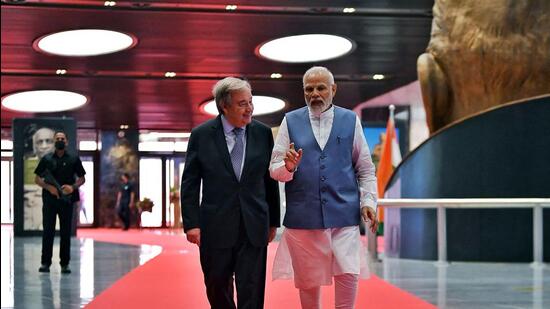
Touting the principle of sustained lifestyles, India’s Mission Life, where life is short for “lifestyle for environment” will encourage people to adopt environmentally friendly behaviour like switching off engines at traffic lights, using reusable carry bags and turning off taps when not in use.
“Climate change goes beyond only policy-making and people themselves are finding that they should contribute as an individual, families and as communities to the environment,” said Modi during the event also addressed by Guterres, who is on a three-day visit to India.
The mission is one of the strategies India will use for mitigation of climate change under its nationally determined contributions (NDC) under the Paris Agreement on combatting climate change.
“People are experiencing the effects of climate change in their surroundings, and in the last few decades, unexpected calamities have been witnessed. Mission Life makes the fight against climate change democratic, in which everyone can contribute within their capacity,” he said, citing the adoption of LED bulbs in India as an example of a change that led to significant energy savings.
Guterres said overconsumption was at the root of the triple planetary emergencies of climate change, biodiversity loss and pollution. “We are using the equivalent of 1.6 earths to maintain our lifestyles. And that great excess is compounded by great inequity. The combined greenhouse gas emissions of the richest 1% are more than twice the poorest 50%,” he said.
He also called on India to lead the energy transition in G20 countries with financial support from developed countries…. We need to unleash a renewables revolution – and I look forward to working with India in driving this agenda forward,” he added.
Modi said the annual per capita carbon footprint in India is about 1.5 tonnes, lower than the global average of 4 tonnes per year. At the same time, the country was making significant efforts on renewal energy. “Today we are ranked fourth in wind energy and fifth in solar energy. India’s renewable energy capacity has increased by about 290% in the last 7-8 years. We have also achieved the target of achieving 40% of the electric capacity from non-fossil-fuel sources 9 years ahead of the deadline.
“We had also achieved a target of 10 % ethanol blending in petrol, and that too, five months before the deadline. Through the National Hydrogen Mission, India has moved towards an environment-friendly energy source. This will help India and many countries of the world to achieve their goal of net zero,” PM Modi said.
India has set itself a net zero emissions target for 2070, later than most countries. India at present is the third largest emitter of greenhouse gases, but richer countries with smaller populations have typically emitted more planet-warming gases.
The difference is recognised globally and is the basis for a principle known as climate justice, for which historical emitters are urged to assist poorer nations in reducing their carbon footprint and tackle the impact on the climate.
The PM had announced the concept of Mission Life at the COP26 summit in Glasgow on November 1. He said it can be a mass movement for “mindful and deliberate utilisation, instead of mindless and destructive consumption” to protect the environment.
According to the brochure by NITI Aayog which curated the Mission, phase 1 will involve change in demand: nudging individuals across the world to practice simple yet effective environment-friendly actions in their daily lives. Phase II will involve changes in supply: changes in large-scale individual demand are expected to gradually nudge industries and markets to respond and tailor supply and procurement as per the revised demands.
Phase III will cover change in policy by influencing the demand and supply dynamics of India and the world, the document said, adding that the long-term vision of Mission Life was to trigger shifts in large-scale industrial and government policies that can support both sustainable consumption and production.
The mission will be incubated, curated and piloted by Niti Aayog and subsequently implemented by the Union Ministry of Environment, Forest and Climate Change, in a non-linear and non-sequential manner, according to the brochure.
In 2022-23, the mission will focus on Phase I. A list of 75 individual Life actions across 7 categories have been identified by Niti Aayog for this. These include: energy; water; single-use plastic; sustainable food systems; waste; healthy lifestyles and e-waste.
Under energy for instance, the recommended action includes the use of LED bulbs and wherever possible, for people to take the stairs instead of an elevator.
The mission will be implemented till 2027-28 with annual targets. At the end of 2028, Life aims to inspire 1 billion pro-planet people; 515,000 Life villages; 3700 urban local bodies and 766 districts.
When estimated against a business-as-usual scenario by 1 billion Indians in 2022-23 to 2027-28, the impact of Life actions can be significant, the brochure states. For example, switching of the car / scooter engines at traffic lights / railway crossings can save up to 22.5 billion kWh of energy, it added.
India has two quantifiable goals in its updated NDC released in August--to reduce the emissions intensity of its Gross Domestic Product (GDP) by 45% from 2005 levels by the year 2030, and source about 50% of its energy requirement from non-fossil fuel-based sources by the same deadline.
“We cannot fix the planet on which we live without fixing how we live. A dramatic change is needed in how individuals consume, how our economies produce, and how our policies and politics promote and deliver on the collective goals of society. Mission Life has the potential to become a transformative global and people’s movement,” said Arunabha Ghosh, CEO, Council on Energy, Environment and Water (CEEW).
“The world’s top 10% households account for 36-45% of global greenhouse gas emissions, while the bottom half account for only 13-15%. For developing countries like India too, as we move from scarcity to prosperity, it is important for us to avoid wasteful consumption of resources. Behavioural interventions can be powerful, especially when facilitated by infrastructure like last mile connectivity for public transport and policies like time-of-day tariffs for EV charging,” said Ulka Kelkar, director, climate program, World Resources Institute (WRI) India.