E-Paper



Month on, questions linger on AI crash; report ‘soon’
The preliminary report on the Air India flight 171 crash will be released soon, as investigators focus on potential fuel switch issues and communication challenges.


The preliminary investigation report into the Air India flight 171 crash will be released “very soon”, aviation minister Ram Mohan Naidu said on Friday, the informal deadline according to international norms for an initial analysis that could offer some clues for what caused India’s worst aviation disaster in decades that killed 260 people.
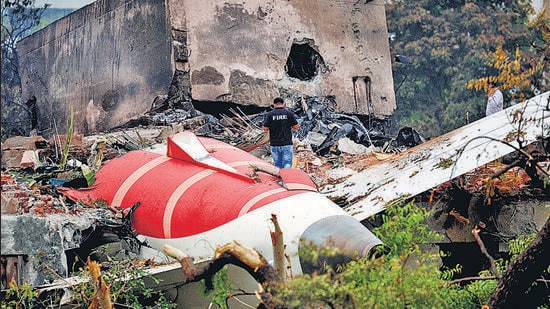
Saturday marks a month since the Boeing 787 crashed moments after take-off, with none of the observations of the plane’s final moments offering any indication of what may have caused the jet to suddenly lose lift. On Friday, a report stated investigators are possibly looking at whether fuel to the engines were switched off — the third western media report to make the contention -- and revealed previously unknown friction between Indian and American investigators working on the case, though they later reportedly worked through their issues.
“AAIB is working on it... it is the responsibility of AAIB, let them do their job,” Naidu said when pressed about the delay. “The ministry is ensuring that transparency and accountability is there in the whole investigation process.”
The minister’s assurance came as families of victims continued their agonising wait for answers, with the 30-day International Civil Aviation Organization-recommended deadline passing without the expected report from the Aircraft Accident Investigation Bureau (AAIB).
AAIB director general GVG Yugandhar had on Thursday briefed the parliamentary standing committee on transport, tourism and culture during an eight-hour session, confirming the investigation was “on track” and would meet ICAO standards by the weekend.
The London-bound flight crashed into a medical hostel complex shortly after departing Ahmedabad, killing 241 people on board and 19 on the ground. Only one passenger survived the catastrophe, which marked the first fatal accident involving the widely operated Boeing 787 Dreamliner.
Officials acknowledged shortcomings in their communication strategy.
“The report release is expected any day now and that will give clarity on the reasons behind the crash,” said an official familiar with the investigation, who declined to be identified.
A second senior government official admitted on condition of anonymity that authorities could have done better. “We should have communicated more in terms of regular statements. But then we chose to stay quiet for some reasons,” the official said.
Since the incident, the government has issued statements only three times—with civil aviation minister Naidu addressing the media on June 14, an official confirmation of black box recovery on June 19, and a statement about data extraction on June 26.
Aviation experts have expressed concern about the delayed release of potentially vital safety information, particularly given the aircraft’s widespread global operation.
“Globally, such information is typically made public quickly, especially when it involves widely operated aircraft like the Boeing 787,” said Mark D Martin, CEO of Martin Consulting. “The delay raises questions.”
Martin emphasised the urgency of transparency given recent aviation incidents in India. “The preliminary report should be released immediately so as to alert all airlines operating the 787 to commence with the necessary operation and maintenance precautions in order to achieve improved safety with operations.”
Another expert said the delay comes at a time when some media reports, especially those of western media, are tilting towards a narrative that there was human error.
“The preliminary report is expected to shed some light on the probable cause of the crash and the sequence of events on the fateful day. However, the government not releasing the report is only delaying it,” said Sam Thomas, president of the Airline Pilots Association of India (ALPA).
On Friday, the Wall Street Journal reported previously unknown friction between Indian and American investigators during the probe over what they perceived as the slow pace of downloading, analysing and sharing the contents of the aircraft’s black boxes.
According to the journal, the National Transportation Safety Board at one point threatened to withdraw American resources from the investigation, though US investigators ultimately remained to assist before returning home. The journal also reported that the fuel switches were a key element in the investigation, two days after Reuters and aviation industry publication The Air Current revealed the line of inquiry.
Officials at AAIB and the ministry of civil aviation did not respond to requests for a comment on the report’s contention.
While AAIB is leading the investigation, officials from the US safety board and plane-maker Boeing have been involved, as is custom.
The crash has led to significant changes in Air India’s operations, with the airline announcing a 15% reduction in wide-body international services until mid-July. Suspended routes include Delhi–Nairobi, Amritsar–London, and Goa–Gatwick, while services to North America, Europe, Australia, and the Far East have also been reduced.
Among the victims were families travelling together. Mukesh Modha, 64, a resident of Porbandar, lost three family members who were on their way to London to perform last rites of his brother who had died of cancer. His brother’s wife Rakshaben Modha, 55, her daughter-in-law Yesha Kamdar, 31, and Yesha’s 1.5-year-old son were among the victims.
“My brother had set up a successful catering business in London and his prayer meeting was to be held in the third week of June,” Mukesh Modha said. The last-minute change of plans by another family member, who cancelled his trip to attend business in Ahmedabad, saved his life.
The sole survivor, Vishwash Kumar Ramesh, a 40-year-old British national, walked away from the burning wreckage in what has been described as a providential escape. He was discharged from hospital on June 17 and performed last rites for his brother Ajay in Diu. “I don’t know how I survived,” he told HT earlier.
The crash also left deep scars for BJ Medical College, where the plane struck. Some 150 students and resident doctors are now in alternative accommodation, said Dr Minaxi Parikh, dean of BJ Medical College.
The debris that was scattered there has now been moved to a location near GUJSAIL near Ahmedabad airport for reconstruction purposes, as investigators work to piece together the sequence of events that led to the disaster.
The investigation team, led by Yugandhar, includes specialists in aviation medicine, air traffic control, and representatives from ICAO participating as observers.
Despite the limited official information released, early findings suggest investigators are focusing on the movement of fuel control switches located in the cockpit’s centre console. Aviation industry publication The Air Current reported on Wednesday the focus on the fuel switches that help power the plane’s two engines.
It was not clear what specific actions involving the fuel switches are being looked at by investigators but the report, quoting unnamed sources, stated that the available information on the black boxes could not rule in or out improper, inadvertent or intentional actions that preceded or followed the apparent loss of thrust before the aircraft crashed.
The preliminary report, when released, is expected to be factual and basic, stopping short of definitive conclusions as the complex investigation continues in the coming months.