
 E-Paper



More than 400 trees cut down in Nagaland’s commercial hub Dimapur
The Dimapur forest division gave the nod for cutting the Eucalyptus trees in July this year. But the authorities got into action only after two people died and 12 others were hurt after two trees were uprooted due to strong winds on October 12


KOHIMA: Over 400 trees along a busy market street in Nagaland’s commercial hub Dimapur have been cut down by authorities over the past four days after strong winds uprooted two tall Eucalyptus trees in the area leading to the death of two people and injuring a dozen others on October 12.
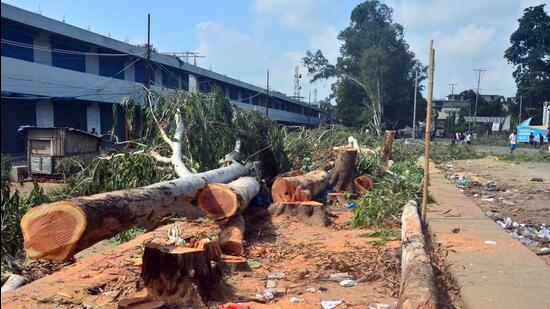
“A total of 403 trees, mostly Eucalyptus, and a few high-risk rain trees and Putranjiva have been cut down,” Dimapur divisional forest officer (DFO) Beizo Suokhrie said after the tree-felling exercise ordered by the district disaster management authority (DDMA) was completed on Thursday. He said the tall decades-old Eucalyptus trees had posed a threat to life for some time.
“Seeing the threat, Dimapur Forest Division enumerated the trees and issued NOC (no objection certificate) to cut them down in July this year,” the official said, adding that Eucalyptus trees tend to grow very tall and are usually not planted near houses or crowded areas.
The NOC was issued following a proposal from environment activists to convert the area into a park. The land belongs to Development Authority of Nagaland and the trees were reportedly planted by NGOs for beautification of the area. Officials said they will try to plant shade-giving and ornamental trees in the now-barren stretch.
It is not clear why the authorities did not cut the trees once the NOC was issued and acted only after two people lost their lives.
“It is so unfortunate that two lives were lost. The incident has shocked public which has never questioned city and town planners. If any lesson is to be learned from the regrettable and tragic incident, it is that no detail is too small or insignificant when dealing with nature and its consequences on the impact this will have on the lives of citizens in the present and future,” said Dimapur-based conservationist Bano Haralu. She added that the same rule applies to one’s backyard, the forests or in the heart of the city.
“We can never recover from the loss of precious lives and injuries to quite a few people due to strong winds that caused some Eucalyptus trees to fall and led to the tragedy last Wednesday (October 12).... Our Eucalyptus trees were unattended for decades – does anybody, especially the district administration, forest department and other departments concerned remember the last time these Eucalyptus trees were pruned? Who actually was in charge of taking care of them and how well has this job been done?” asked Monalisa Changkija, editor and publisher of an English daily Nagaland Page.
Changkija, who is a resident of Dimapur, also questioned the lack of attention paid by successive governments to town planning.
“It was a disaster waiting to happen. Anyone could see how tall the trees had become. We have seen trees which are much shorter than the Eucalyptus trees getting uprooted during harsh storms,” said Khekato, a school teacher who lives a short distance from the spot where two people died.
Khekato has his reservations on the move to cut all trees at a particular location, saying it would make the place hotter. But he added that it was better to chop them if they were a hazard to people.
“If you cannot monitor the trees you plant, especially those that need regular pruning, better not to plant them in the first place or cut them down and instead plant some suitable flowering trees,” he remarked.
The usually busy street with an open market where hundreds of vendors sell local produce alongside a concrete Naga Shopping Arcade (erstwhile Super Market) bore a deserted look after the DDMA’s tree-felling exercise was completed on Thursday.
The district administration has shifted street vendors to a nearby marketing shed which was recently inaugurated.


