
 E-Paper



Nano long gone, Singur is back: PM's ‘real change’ appeal vs Mamata's ‘poriborton’ pitch from years ago
In effort to dismantle legacy of TMC's 2011 “poriborton” (change), PM gives call for "real change" or ‘asol poriborton’ from site of TMC's major agitation

 Prefer HTon Google


Nearly two decades after the plains of Singur in Bengal became the epicentre of a political earthquake that toppled a 34-year-old regime, the town was on Sunday back at the heart of a high-stakes ideological battle. The challenger then, Mamata Banerjee, is now an incumbent of three terms as Chief Minister, who faced sharp attacks from Prime Minister Narendra Modi, whose party BJP is hoping to turn the tables this time.
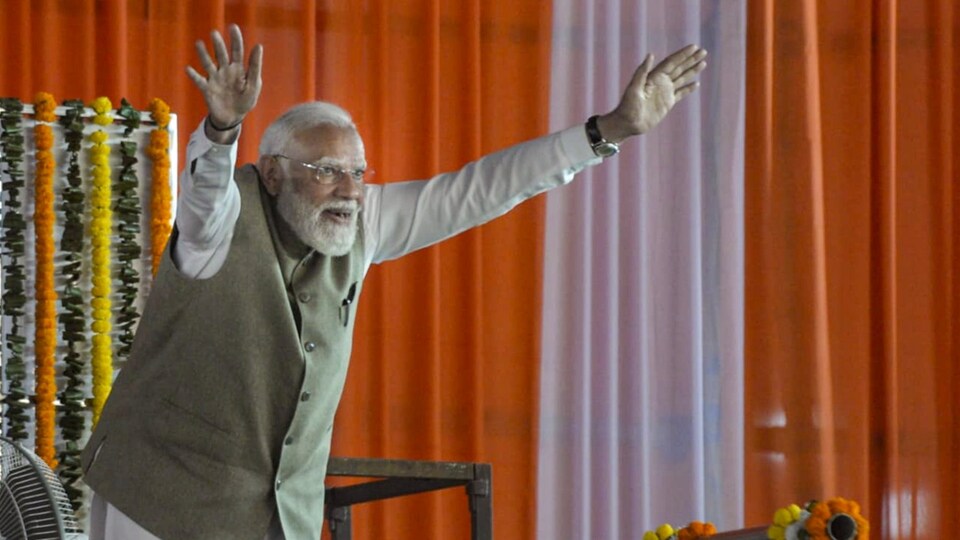
At the Sunday rally, PM Modi framed the upcoming assembly elections as a choice between “good governance” and what he termed “maha jungle raj”. In a pointed effort to dismantle the legacy of CM Mamata Banerjee’s 2011 “poriborton” (change or transformation), the Prime Minister gave a call for "real change" or “asol poriborton” to restore investor and industry confidence in West Bengal.
In the lexicon of Bengal's politics, “poriborton” is a word heavy with history, famously serving as the slogan for the Trinamool Congress (TMC) as it unseated the world’s longest-serving democratically elected communist government in 2011.
That victory was rooted in the 2006 agitation in Singur, where Banerjee led local farmers in fierce resistance against the Left Front government’s attempt to acquire nearly 1,000 acres of farmland for Tata Motors’ Nano car project.
While that movement brought her to power with a brute majority, the skeletal remains of the abandoned factory stand today as a reminder of a project that was never built.
PM Modi did not expressly mention that, but sought to weaponise the TMC’s "politics of agitation" against itself, contrasting it with his vision for industrial growth.
"Every government that obstructs development work is now continuously punished by aware voters," he said, asserting that the people of Bengal have resolved to teach the "ruthless" TMC government a lesson.
To buttress this claim, PM Modi inaugurated multiple infrastructure projects worth ₹830 crore, including new Amrit Bharat Express trains.
‘Comeback’ for Nano, as a political vehicle
For Narendra Modi, Singur is inextricably linked to a pivotal point in his political journey. In 2008, when Ratan Tata famously remarked that he could not operate "with a gun to his head" and pulled the Nano project out of Bengal, Modi as the then CM of Gujarat acted with lightning speed. He reportedly sent a now-famous one-word SMS to the industrialist: “Welcome”.
Within days, the project was relocated to Sanand, Gujarat, where the state administration provided land and clearances in record time. This became a pillar of Modi’s 2014 national campaign, allowing him to showcase a pro-business model as against allegations of communalism he faced due to the 2002 riots in Gujarat.
He used this history to argue that he could "re-industrialise" West Bengal, a state he claims has become an "industrial graveyard" under the current administration.
Although the Nano car model itself ceased production almost a decade ago now, its departure from Bengal remains a potent political symbol — or at least that's what BJP wants it to be.
The TMC has responded to this offensive with characteristic aggression, labeling the BJP leadership as “zamindars (landlords) of Delhi” attempting to “snatch the dignity” of Bengal’s people.
TMC state president Joy Prakash Majumdar accused the PM of peddling liesvis-a-vis the ongoing Special Intensive Revision (SIR) of voter rolls. Modi and his party claim the voter rolls have “infiltrators” or illegal Bangladeshi and Rohingya Muslims “brought in by the TMC”.
Cultural pitch this time from BJP
Besides industry, Modi’s rhetoric in Singur was centered on a sharp critique of the state's law and order. He charged the TMC government with “playing with national security by protecting infiltrators”. He alleged that illegal migrants entering with forged documents must be identified and sent back, claiming that the state government has stalled critical border fencing for years by refusing to provide land to the Centre.
The Prime Minister further accused the TMC of "taking revenge on the people of Bengal" by blocking central welfare schemes.
A major theme of the speech was a deliberate attempt to counter the TMC’s successful "outsider" (bohiragoto) tag, which Mamata Banerjee used effectively in the 2021 election to frame the contest as a fight between "them" and "Bengal's daughter". To neutralise this, the PM highlighted that his government established Subhas Chandra Bose’s statue at Kartavya Path in Delhi and recognised Bangla as a classical language.
A Left twist
While the BJP and TMC traded barbs, the CPI-M, which declined sharply after Mamata's Singur agitation, introduced a twist to the narrative, claiming that the two parties are actually colluding.
CPI-M central committee member Sujan Chakraborty asserted on Sunday that the PM's speeches delivered “nothing new”.
He alleged that the BJP was actually complicit in driving the Tata factory out of Singur when then-CM Buddhadeb Bhattacharjee sought to give a fillip to industry.
The 2026 election is barely three months away. The last time, despite a significant spike in seats for the BJP, the TMC secured a majority in the Vidhan Sabha. The Left is struggling to stay in the game.
(with inputs from ANI, PTI)


