
 E-Paper



Navy test-fires ballistic missile from INS Arihant
In a rare announcement pertaining to a strategic platform, the government on Friday said that the navy successfully test-fired a submarine-launched ballistic missile (SLBM) in the Bay of Bengal from INS Arihant, the country’s first indigenous nuclear-powered ballistic missile submarine, and demonstrated India’s nuclear deterrence capability.

 Prefer HTon Google


In a rare announcement pertaining to a strategic platform, the government on Friday said that the navy successfully test-fired a submarine-launched ballistic missile (SLBM) in the Bay of Bengal from INS Arihant, the country’s first indigenous nuclear-powered ballistic missile submarine, and demonstrated India’s nuclear deterrence capability.
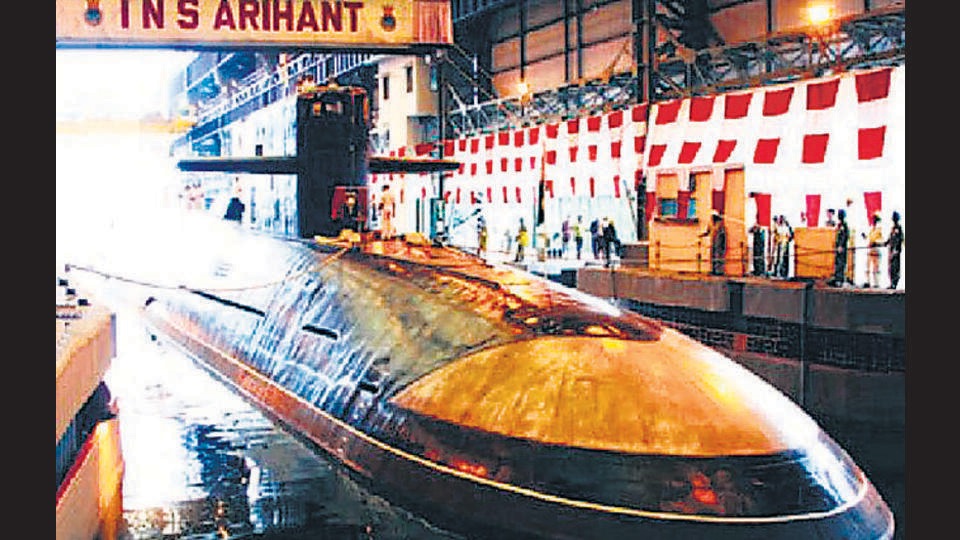
“The missile was tested to a predetermined range and impacted the target area in the Bay of Bengal with very high accuracy. All operational and technological parameters of the weapon system have been validated,” the defence ministry said in a statement.
The fully operational submarine completes the sea leg of India’s nuclear triad, giving it enduring nuclear strike and counterstrike capabilities. The United States, Russia, the United Kingdom, France and China are the only countries that can deliver nuclear warheads from a submarine.
The 6,000-tonne Arihant, which means destroyer of enemies, is armed with 12 K-15 or B-05 SLBMs capable of delivering nuclear warheads up to 750km away. India is also developing K-4 SLBMs capable of striking targets up to 3,500km away. The official statement on the SLBM launch did not name the missile that was tested.
The successful user training launch of the SLBM by INS Arihant is significant to prove crew competency and validate the SSBN (ship submersible ballistic nuclear) programme, a key element of India’s nuclear deterrence capability, the defence ministry said.
“A robust, survivable and assured retaliatory capability is in keeping with India’s policy to have ‘Credible Minimum Deterrence’ that underpins its ‘No First Use’ commitment,” it added. India already has the capability to carry out nuclear strikes with fighter planes and land-launched missiles. The Agni series of ballistic missiles and warplanes such as Rafales, Sukhoi-30s and French-origin Mirage-2000s can deliver nuclear warheads.
This is a significant achievement and demonstrates that the submarine crew has attained proficiency in drills involving underwater launch of missiles, said former navy chief Admiral Arun Prakash (retd).
“However, our underwater nuclear deterrent will attain full credibility only after we acquire intermediate-range ballistic missile (IRBM) capability, and ultimately deploy intercontinental ballistic missiles ICBMs),” Prakash added. IRBMs can strike targets at ranges of 1,000km to 5,000km, while ICBMs can deliver nuclear warheads at ranges of more than 5,000km.
INS Arihant completed its maiden deterrence patrol four years ago. In November 2018, Prime Minister Narendra Modi announced that INS Arihant had successfully completed its first deterrence patrol and that the success of the submarine “gives a fitting response to those who indulge in nuclear blackmail,” in his first comments on the top-secret advanced technology vessel (ATV) project.
“Today (November 5, 2018) is historic because it marks the completing of the successful establishment of the nuclear triad. India’s nuclear triad will be an important pillar of global peace and stability,” Modi had then said.
India plans to build four SSBNs to reinforce its strategic deterrence force at sea under the secret programme, a subject directly handled by the PMO. The second Arihant-class submarine was launched five years ago and is currently undergoing key trials ahead of its commissioning, HT has learnt.


