Activist and Swaraj India founder Yogendra Yadav countered union education minister Dharmendra Pradhan's remarks on the NCERT including a reference to the 1975 Emergency in its textbook.
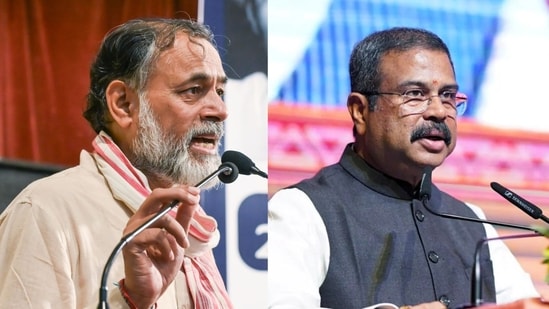
After Pradhan said that the NCERT had done a “good job” by bringing the topic to the “forefront”, Yadav replied that a chapter on the Emergency had already been included in a 2007 textbook, which he had helped in writing.
The row began after the NCERT, in its newly developed Class 9 Social Science texbook, flagged the emergency as “one of the major challenges” faced by the Indian democracy. The section on the Emergency was included in a chapter highlighting the strengths and challenges of a democracy.
Pradhan's praise for NCERT, Yadav's ‘lie’ response
Backing the NCERT's move to introduce the 1975–77 National Emergency into the Class 9 Social Science syllabus, Pradhan said the move helped future generations understand the “dark deeds of that period”.
“This is correct. NCERT has done the right thing. Future generations should know and understand the dark deeds of the Emergency so that such a situation does not arise again. That is why NCERT brought it to the forefront. NCERT did a good job...” Pradhan said.
{{/usCountry}}“This is correct. NCERT has done the right thing. Future generations should know and understand the dark deeds of the Emergency so that such a situation does not arise again. That is why NCERT brought it to the forefront. NCERT did a good job...” Pradhan said.
{{/usCountry}}Responding to the remark, Yadav said it was a “lie”, adding that the “ugly truth” had not been hidden from students.
“Dear @dpradhanbjp ji, this is a lie. There was a full chapter on the Emergency in the NCERT textbook since 2007. I was involved in writing it and ensuring that the ugly truth was not hidden from students of Political Science,” he said in a post on X. Yadav also attached an op-ed he had authored wherein he had talked about how the ‘Emergency’ had made it to school textbooks during the Congress government.
What does the NCERT textbook say on Emergency?
The text in the section under the challenges to a democracy highlights “dissatisfaction” with the Indira Gandhi government, and issues including unemployment, inflation and others. “One of the major challenges to democracy in India was recorded when an Emergency was imposed in 1975-77. In the early 1970s, public dissatisfaction with the government led by Indira Gandhi was growing. Rising unemployment, inflation, and allegations of misgovernance led to widespread protests,” the text reads.
It states that a “majority of fundamental rights were suspended” during this period, citing internal disturbance. ““In June 1975, a National Emergency was imposed by the government on the grounds of internal disturbance. During this period, a majority of Fundamental Rights were suspended, the press was censored, and numerous political leaders and activists were arrested,” the text says.