
 E-Paper



New freshwater fish species discovered in Manipur’s Taretlok river
A new species of Labeonine fish, was found in the Taretlok River, a tributary of the Chindwin River near Nambashi Valley in Kasom Khullen

 Prefer HTon Google


Imphal: A new freshwater fish species was found in the Taretlok river of Manipur’s Kamjong district, a study published Thursday in the peer-reviewed journal Zootaxa said.
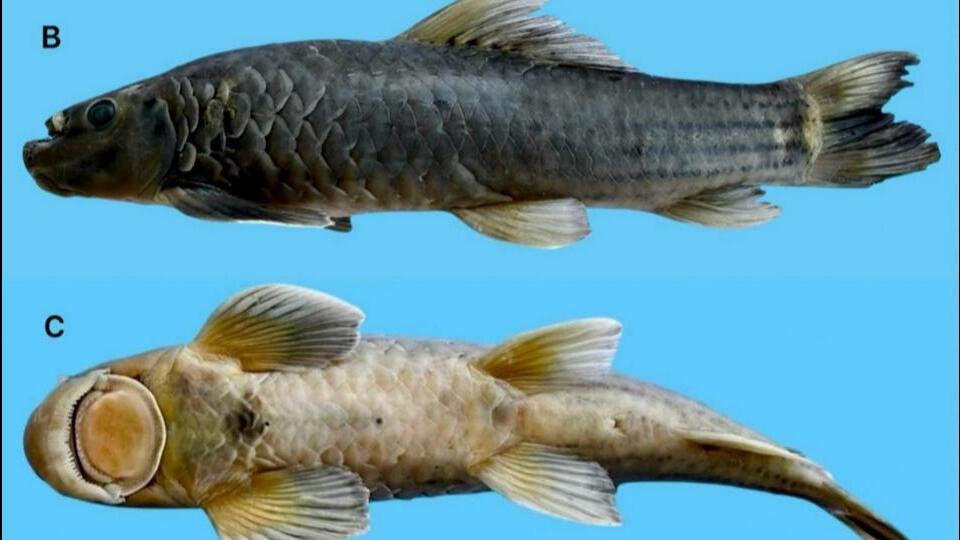
“Garra Nambashiensis, a new species of Labeonine fish, was found in the Taretlok River, a tributary of the Chindwin River near Nambashi Valley in Kasom Khullen. We submitted our paper on the discovery to the journal in March this year, but it was accepted as a new species a few days ago,” Associate Professor of Dhanamanjuri University (DMU) Bungdon Shangningam, who led the research team — which included research scholars Kongbrailatpam Babyrani Devi, Thonbamliu Abonmai, and Kh Rajmani Singh from Manipur — said.
Shangningam said that Garra nambashiensis, which falls within the 9–14 cm size range and is locally known as Nutungnu (Anal tribe dialect), belongs to the ‘proboscis species group’ as it possesses a prominent, quadrate-shaped, unilobed proboscis and a transverse lobe on the snout.
Also Read: New gecko species discovered in Assam, named after state forest department
“This new species of fish has a quadrate-shaped unilobed proboscis with a row of 7–8 medium to large-sized conical acanthoid tubercles on the anterolateral margin, a black spot on each side of the opercle, immediately anterior to the upper angle of the gill opening; the dorsal fin’s last branched ray extending beyond the anal-fin origin; dorsal-fin base with 8–11 scales; and the presence of six distinct narrow black stripes extending to the posterior margin of the hypural plate,” Shangningam, who was earlier affiliated with the Ministry of Environment, Forest and Climate Change, explained.
Also Read:Two new damselfly species discovered in Western Ghats of Maharashtra, Kerala
Zootaxa’s citation mentions that the new species was collected from “swift-flowing riffles (shallow sections of a river or stream) with algae-covered gravel beds and mixed substrate comprising cobbles, boulders, pebbles, sand, fine silt and coarse sediments.”
Currently, 32 members of the ‘proboscis species group’, distributed in the Chindwin, Brahmaputra, Barak, and Kaladan river systems of Northeast India and adjoining areas in Bhutan, Tibet (China), and Bangladesh, are considered valid and were compared with the newly described species, the study said.


