
 E-Paper



Pluck Shalimar, taste Firdous: New varieties bring cheer to Kashmir’s apple-growers
To increase the production and compete with the foreign apples, SKUAST has developed various indigenous and high-density varieties. In the coming months, the Jammu and Kashmir government will be rolling out new plant varieties and root stocks will be later distributed among the growers.


Five years ago, horticulturist Farooq Ahmad Malik decided to replace his ageing apple trees with new ones. He travelled all the way to Sher-e-Kashmir University of Agriculture Sciences and Technology (SKUAST) and procured plants of some new varieties developed by the scientists there.
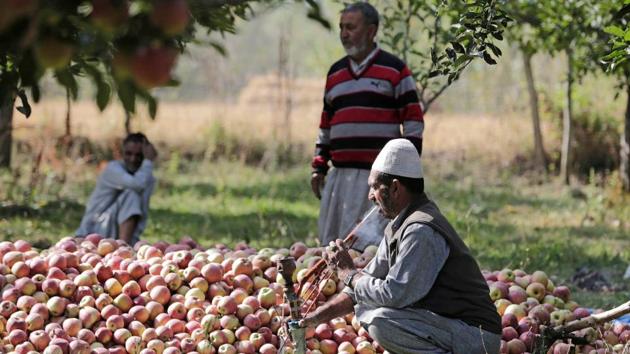
Last year, the new plants started bearing the fruit and 56-year-old Malik is happy for the decision he took. “The new plants are not only of better quality but the yield will also be better once they are fully grown,” he said.
In the coming months, the J&K government will be rolling out half-a-dozen new plant varieties and root stocks will be later distributed among the growers. These plants will reach growers in different parts of the Valley, especially Shopian in South Kashmir and Rafiabad in the north. Rafiabad is known as the apple bowl of north Kashmir, where orchardists grow all types of apples.
Officials say in J&K more than 1.70-lakh hectares are under fruits and the production has already crossed 18-20 lakh metric tonnes. The officials of J&K horticulture department say that they are exhorting farmers to replace the ageing trees with new varieties. “Even many growers are opting for high density plantations,’’ says Bashir Ahmad, a senior officer with the J&K horticulture department.
And to increase the production and compete with the foreign apples, SKUAST has developed various indigenous and high-density varieties. In the coming years, more than 20 varieties of apple plants will be available which could bring a major turnaround in the Valley’s horticulture sector, which has over 2.5 million families associated directly or indirectly.
Scientists in past two decades have developed Shireen, Firdous, Lal Ambri, Shalimar and Akbar and the results of these indigenous varieties are encouraging. However, from past two years, scientists of the university are working on five to six new apple varieties of the high density plants, besides, some indigenous varieties.
SKUAST vice-chancellor Nazeer Ahmad, who himself is an horticulturist, told Hindustan Times that 8 to 10 local varieties are being developed and the focus is on the high-density plants now. “We are working on at least 20 varieties and five to six will be released for commercial purposes in the coming weeks, which later will be distributed among the fruit growers. The root stock can be multiplied in the coming years,’’ he said.
The V-C said the apples produced from these plants could easily compete with any international variety. “Not only this is going to bring a lot of money to growers, but also help them to compete in the international market,’’ he said.
A senior scientist at SKUAST involved in the project said indigenous varieties have their own advantages and they were given names used in local parlance. “Akbar is good in size, Firdous and Shireen are very sweet with a good shelf life, while Lal Ambri quality-wise matches the foreign apples. Most of these varieties are scab-resistant,” he said.
Nazir Ahmad Khan, who deals in apples, said growers needed to upgrade fruit varieties.
“The competition has increased, so has the urge among the young growers to replace the old orchards with the new varieties.’’
At SKUAST about 25 scientists and experts are working on developing apple varieties. The university has orchards spread over 45 acres where these new varieties are tested. In August, the harvest produced in its orchards was displayed before the growers and farmers.
“Around 1,000 people visited our orchards and after seeing results, they got motivated to replace old trees with new ones,’’ said the vice-chancellor.


