
 E-Paper



No ex-gratia payouts for Covid deaths, says govt
MHA) pointed out that Covid-19 was completely different from 12 notified natural disasters such as earthquakes and floods under the Disaster Management Act, 2005 in which ₹4 lakh ex gratia is usually provided from SDRF.


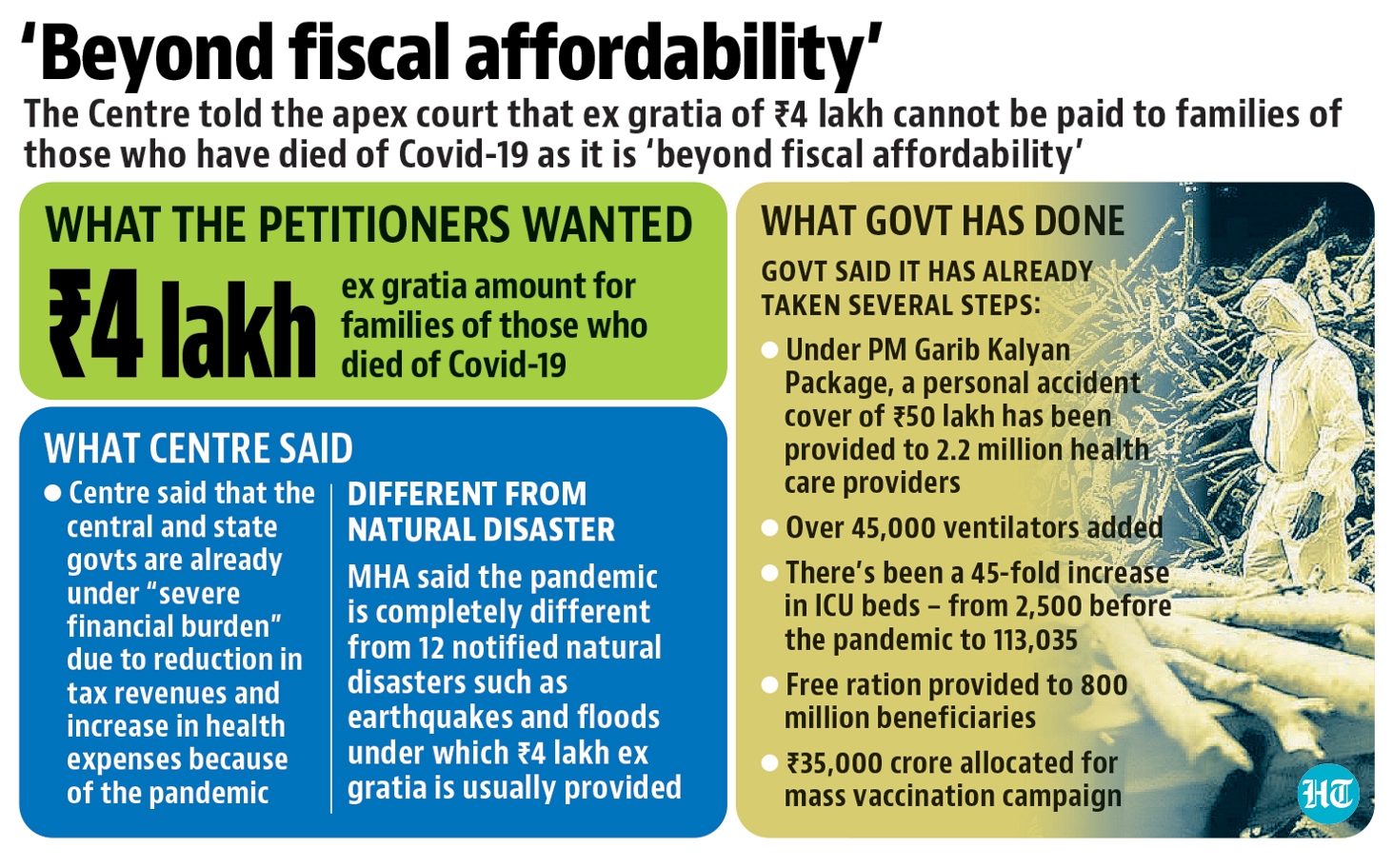
The Centre has told the Supreme Court that ex gratia amount of ₹4 lakh cannot be paid to the families of those who have died of Covid-19 as it is beyond fiscal affordability and the finances of central and state governments are under severe strain, with the possibility of such payouts having the “unfortunate consequences” of affecting the pandemic response.
In a 187-page affidavit filed in the Supreme Court on June 19, it said that the central and state governments were already under severe financial burden due to reduction in tax revenues and increase in health expenses on account of the pandemic.
The ministry of home affairs (MHA) pointed out that Covid-19 was completely different from 12 notified natural disasters such as earthquakes and floods under the Disaster Management Act, 2005 in which ₹4 lakh ex gratia is usually provided from the State Disaster Response Fund (SDRF).
The ministry was responding to petitions filed by two lawyers — Gaurav Bansal and Reepak Kansal — seeking ex gratia for families of those who died of Covid-19. The apex court, on May 24, asked for the Centre’s response, while also saying that there should be a uniform policy for issuing death certificates to those succumbing to the infectious disease.
“There is no precedent of giving ex gratia for an ongoing disease or for any disaster event of long duration, extending for several months or years. In fact, granting ex gratia for one disease, while denying the same for those accounting for larger share of mortality, would not be fair or proper. It would create unfairness and invidious discrimination between persons suffering from one disease and those suffering from another,” the affidavit, reviewed by HT, said.
The affidavit, filed by Govind Mohan, additional secretary, ministry of home affairs, said: “Already the finances of State Governments and the Central Government are under severe strain, due to the reduction in tax revenues and increase in health expenses on account of the pandemic. Thus, utilization of scarce resources for giving ex-gratia, may have unfortunate consequences of affecting the pandemic response and health expenditure in other aspects and hence cause more damage than good.”
The home ministry said it was easy to deal with notified disasters but not with Covid-19, which required day-to-day expenditure, monitoring, changes in priorities and modifications in the methods and modalities related to the response.
The affidavit came in response to the two PILs that have been listed before the Supreme Court on Monday. The PILs filed referred to two notifications of the central government, one issued on March 14, 2020 declaring Covid-19 as a notified disaster under the National Disaster Management Act 2005 (DMA) and the other issued on April 8, 2015, quantifying ex gratia compensation of ₹4 lakh to victims killed in a notified disaster.
It said that the annual allocation for the year 2021-22 for SDRF for all states combined is ₹22,184 crore and if ex gratia of ₹4 lakh is given for every person who lost their life due to Covid-19, the entire amount of SDRF may possibly be spent on this item alone, and states will not be left with funds for organising Covid-19 response. “Hence, the prayer of the petitioner for payment of ex-gratia to all deceased persons due to Covid-19, is beyond the fiscal affordability of the state governments.”
It said that unlike floods, earthquake, cyclones, etc., thousands of crores of rupees have already been spent by the Centre and states on prevention, testing, treatment, quarantine, hospitalisation, medicines and vaccination. “It is not known that how much more is required,” it said while adding that applying the scheme of assistance, eligible for natural disasters, to pandemic was inappropriate.
Asserting that it would be incorrect to say that families affected by Covid-19 can only be supported through ex gratia assistance, the Centre said: “These deaths have affected families from all classes — the rich and poor, professionals and informal workers, and traders and farmers. The Government is fully conscious of the need to provide them the necessary help and support. However, it is not correct to state that such support could be provided only through ex-gratia assistance for those who have died. In the current context of the pandemic, it would be a rather pedantic and narrow approach.”
“A broader approach, which involves health interventions, social protection, and economic recovery for the affected communities, would be a more prudent, responsible, and sustainable approach. Globally, the Governments in other countries too have followed this approach and have announced interventions that provide fiscal stimulus. The Government of India has followed a similar approach,” it said.
It added: “It is well settled through numerous judgments of the Supreme Court that this is a matter which should be performed by the authority (National Disaster management authority), to whom it has been entrusted and not one where the Court will substitute its own judgment for the decision to be taken by the Executive. Any attempt to second guess may create unintended and unfortunate Constitutional and administrative ramifications.”
The government said it has already taken several steps as part of “Minimum Standard Relief” under Section 12 of the Disaster Management Act, by way of increase in the health infrastructure, ensuring food safety to every citizen, insurance cover to those who were dealing with the pandemic by remaining near Covid-infected patients, etc.
It said that under the Pradhan Mantri Garib Kalyan Package (PMGKP) launched on March 30, 2020, a comprehensive personal accident cover of ₹50 Lakh has been provided to 2.2 million health care providers throughout the country, including community health workers and private health workers who may have been in direct contact and care of Covid-19 patients. It said ₹442.4 crore has already been released to the insurance company in this regard.
It added that in the last one year and three months, more than 45,000 ventilators have been added in the country. About the augmentation of health facilities during the pandemic, the affidavit said that there has been a 45-fold increase in total ICU beds in the country – from 2,500 before the pandemic to 113,035 now. It also cited free ration provided to 800 million beneficiaries.
Subsequently, the Centre allocated ₹35,000 crore for mass vaccination campaign, it said.
The affidavit also explained the context for declaring Covid-19 as a notified disaster in March 2020. While states were provided funds to deal with Covid-19 under the National Health Mission, in order to supplement efforts of the state governments, the Centre decided to declare Covid-19 as a disaster by way of a “special one-time dispensation”. This was done to facilitate use of funds under SDRF towards measures for quarantining, sample collection, screening, and procurement of essential equipment or labs for response to Covid-19, the Centre told the court.
The response of the Centre will be taken up by a bench of justices Ashok Bhushan and MR Shah on Monday.
The petitions also raised the issue of hospitals and municipal authorities not citing Covid-19 as the cause of death in their records in some cases. Kansal’s petition pointed out that many of these deaths were shown as failed heart or a lung condition even though the root cause was Covid-19. The petition sought that this be fixed to enable the kin of Covid-19 victims to receive compensation.
Addressing the issue, the Centre cited its October 9, 2020 letter issued by the ministry of health and family welfare to all states and Union Territories. Reproducing the text from the letter, the affidavit said: “All deaths with a diagnosis of COVID-19, irrespective of co-morbidities, are to be classified as deaths due to COVID-19.” This rule was not to apply to a death due to accidental trauma, poisoning, acute myocardial infarction where Covid-19 was an incidental finding. These were part of death certification guidelines issued by the Centre to the states and UTs.
The Centre said that anybody who failed to register Covid-19 deaths will suffer penal consequences under Section 188 of Indian Penal Code, which punishes acts in breach of public servant’s order. Such offences are punishable with an imprisonment ranging between one and six months or fine.


