E-Paper



No GST on petrol for now, says FM
The decision on including fuel in GST has been most widely watched since these products hit record highs in the past year with the centre and states raising their levies on it, as a measure to make up for the revenue lost due to the pandemic.

 Prefer HTon Google


The apex federal body on indirect tax matters, the Goods and Service Tax (GST) Council, on Friday considered bringing petrol, diesel, natural gas and aviation turbine fuel (ATF) within the ambit of GST, but decided against it on revenue considerations.
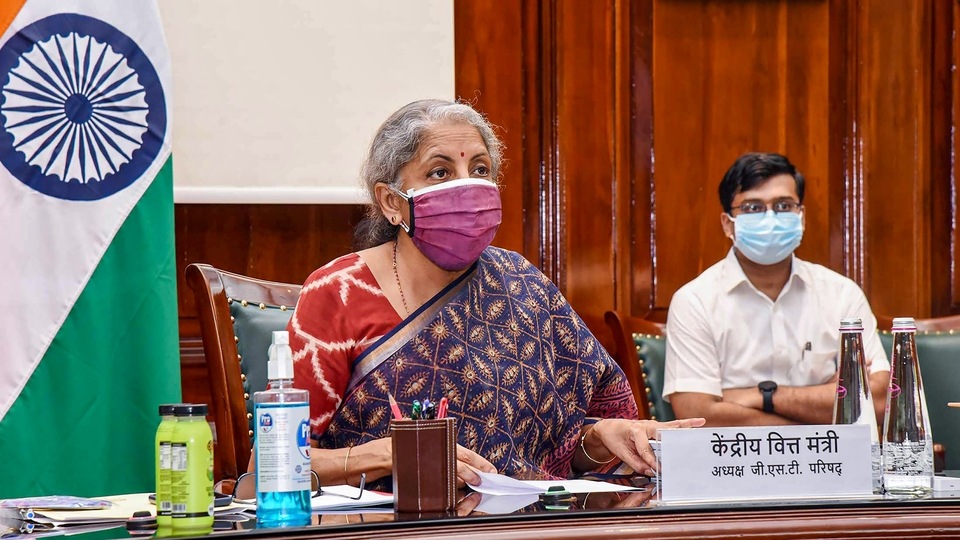
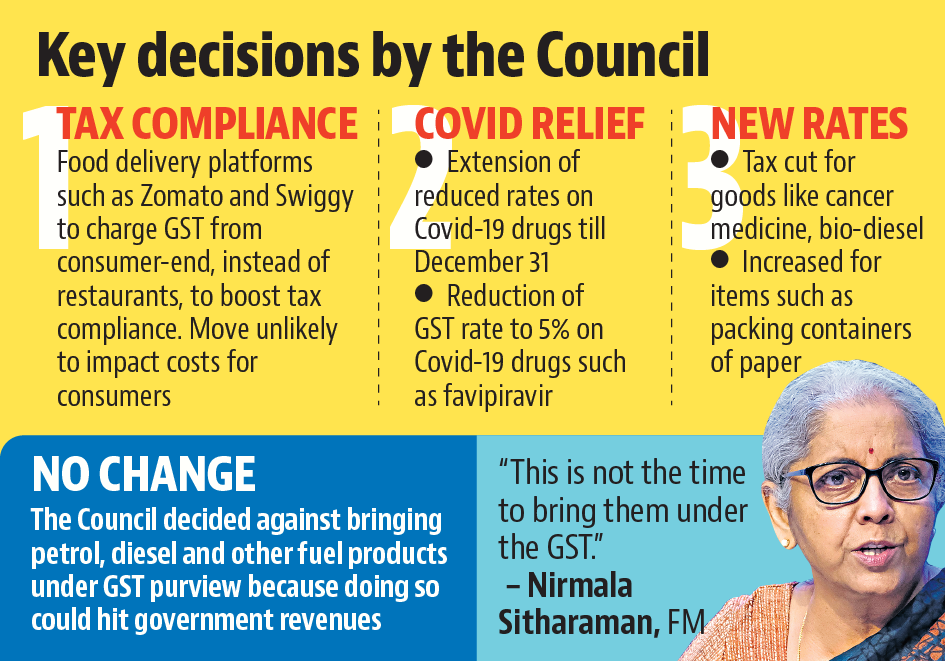
Briefing the media about the Council’s decisions, Union finance minister Nirmala Sitharaman said: “It was brought on to the table for discussion. Members spoke very clearly that they wouldn’t want it to be included in the GST.”
She said Council took up the matter as per the directive of the Kerala High Court, and the court will be informed of its decision.
The council, however, reduced tax rates on key Covid-19-related medicines — Itolizumab, Posaconazole, Infliximab, Favipiravir, Casirivimab, Imdevimab, Deoxy-D-Glucose, Bamlanivimab, Etesevimab, and extended duty exemption on other Covid-related drugs: Amphotericin B, Remdesivir, Tocilizumab, and anti-coagulants such as Heparin. The reductions and the extensions of the past reduction will last till December 31.
The Council also readjusted duty on several items, including tax exemption on goods supplied at Indo-Bangladesh border ‘haats’ (market). HT reported the plans to do so on Thursday.
The Council also decided that online food delivery platforms such as Swiggy and Zomato will collect tax on food items from the consumers for ease of tax administration as GST is a levy on consumption. The move will, however, not impact the end consumer, revenue secretary Tarun Bajaj said.
Sitharaman said the Council decided to exempt GST on import of muscular atrophy drugs like Zolgensma and Viltepso for personal use from 12% to zero as these medicines cost crores of rupees.
While tax concessions on Covid-related drugs have been extended by three months, the exemptions given previously on related medical equipment will end on September 30.
As a result of the tax rejig, consumers will get relief on retro fitment kits for vehicles used by the differently-abled. Fortified rice kernels supplied in welfare schemes will also become cheaper.
GST on medicine keytruda, used in treatment of cancer, has been reduced from 12% to 5%, and tax on biodiesel supplied to oil marketing companies for blending with diesel has been reduced from 12% to 5%.
Import of leased aircraft has also been exempted from payment of integrated GST (IGST). IGST is levied on inter-state transfer of goods and services and it is shared between the Centre and the state. All imports are treated as inter-state supplies and accordingly IGST is levied on them in addition to the applicable custom duties.
Tax rationalisation, mainly undertaken to correct duty anomalies so that manufacturers get full input tax credit, made few items costlier. They are -- ores and concentrates of metals such as iron, copper, aluminium and zinc as they have been moved from 5% slab to 18%.
Specified renewable energy devices and parts will now attract 12% GST instead of 5%.
Items such as cartons, boxes, bags, packing containers of paper currently attracting 12-18% will now be put in 18% tax bracket.
GST on waste and scrap of polyurethanes and other plastics, all kinds of pens, railway parts, locomotives and miscellaneous goods of paper like cards, catalogue, printed material are now shifted from 12% to 18% slab, according to an official statement.
Sitharaman said the Council also decided to correct long-pending issue of inverted duty structure suffered by footwear and textiles sectors. “GST rate changes in order to correct inverted duty structure, in footwear and textiles sector, as was discussed in earlier GST council meeting and was deferred for an appropriate time, will be implemented with effect from January 1, 2022,” she said.
Briefing the Council’s decision Sitharaman said while the statutory five-year period for compensating states for their revenue losses would end on June 30, 2022, the government would continue compensation cess till April 2026 to service principal and interests on money already borrowed to compensate states.
At the time of introducing the new indirect tax regime, the GST law assured state governments a 14% increase in their annual tax revenue for five years and the Centre committed to meeting any shortfall in revenue through the cess levied on luxury goods and sin products such as liquor, cigarettes, aerated water, automobiles, coal and other tobacco commodities. The government raised money from market in 2020-21 and 2021-22 to compensate states for shortfall in the protected revenue as compensation cess was inadequate due to devastation impact of Covid-19 pandemic on businesses.
The decision on including fuel in GST has been most widely watched since these products hit record highs in the past year with the centre and states raising their levies on it, as a measure to make up for the revenue lost due to the pandemic.
As a result, central and state levies on petrol and diesel are over 50% of their retail prices.
Santosh Dalvi, partner and deputy head of indirect tax at KPMG India said, “Amidst revenue concerns expressed by states, the decision to defer inclusion of petroleum products within the ambit of GST will affect petroleum industry and consumers with continual cascading of taxes.”
“The big decision to extend the period of GST Compensation Cess till March 2026 in order to service borrowed principal and interest will affect sectors suffering from such cess which expected relief after five years,” he said.
MS Mani, senior director at consulting firm Deloitte India said, “The multiple rate changes announced indicates that the GST Council is willing to alter rates in cases where the rates are leading to an inverted duty structure or where there are other valid reasons for changing the rates.”
“While food delivery services would constitute e-commerce services, sufficient safeguards need to be taken in subjecting them to GST to ensure that smaller food outlets are protected and consumers do not end up paying more,” he said.