
 E-Paper



‘Not allowed to meet Dara Singh’: Suresh Chavhanke protests outside Odisha jail
Keonjhar jail superintendent Kuanr Marandi earlier said Suresh Chavhanke could not be allowed to meet Dara Singh as he was neither a member of his family nor his lawyer


BHUBANESWAR: Authorities in Odisha on Wednesday didn’t allow Sudarshan TV editor-in-chief Suresh Chavhanke meet Dara Singh, who serving a life term in three murder cases including one relating to the killing of Australian missionary Graham Staines and his two children in 1999.
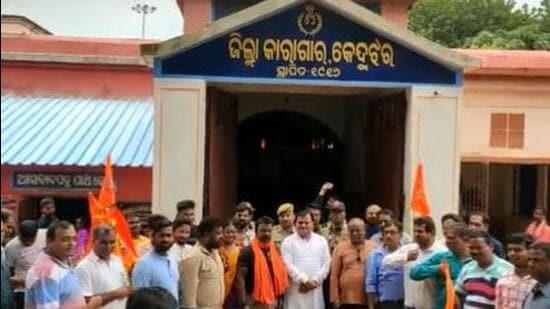
Chavhanke, who sat on a protest outside Keonjhar district jail against the state’s decision on Wednesday, landed in Odisha in Bhubaneswar on Tuesday on a two-day visit. Chavhanke claimed he had been cleared to meet Dara Singh but the jail authorities told him on Wednesday that he couldn’t meet him. He added that the visit was in his personal capacity.
“We had given an application to the government 15 days ago and they had agreed. But today when I arrived, the jail officials refused to let me meet him though they took a copy of my Aadhaar card. This is a violation of our human rights. We want to meet Dara Singh and this is a violation of our democratic rights. This is why I am sitting in protest and I will not leave until I meet him,” said Chavhanke over phone.
Ahead of Chavhanke’s visit, the state police’s intelligence wing, special branch, sounded an alert and told all zonal officers on September 19 to collect ground-level intelligence and take “necessary security, preventive and precautionary measures as deemed proper”.
But long before Chavhanke turned up at the jail, Keonjhar jail superintendent Kuanr Marandi said that he did not think that the meeting could be permitted.
The jail official said only family members or lawyers are allowed to meet an inmate.
“In this case, I don’t think the person can be allowed as he is neither a family member nor his lawyer. Even for a family member or lawyer wishing to visit a convict in jail, we first check some identity such as Aadhaar before allowing entry…. Dara’s family members interact with him virtually through the online e-mulaqat system that was started some time ago,” said Marandi.
On Twitter, Chavhanke has been espousing the cause of Dara Singh for several years to seek his freedom arguing that he had already been behind bars since 2000.
First arrested in January 2000, Dara Singh, now 59 years old, is lodged in Keonjhar’s district jail in three murder cases.
On September 7, the Orissa high court rejected Dara Singh’s plea to release him on bail in the murder case of Roman Catholic priest Arul Doss in Odisha’s Mayurbhanj district in 1999.
In 2003, a trial court in Khurda district sentenced Dara Singh to death and awarded a life term to 12 others for burning alive Graham Staines and his two sons in Manoharpur village of Keonjhar district.
Staines was sleeping with his sons, aged 8 and 10, in a station wagon in a sal forest of Keonjhar district when a mob led by Singh poured petrol on it and set the vehicle afire. In 2005, the Orissa high court commuted Singh’s sentence to life. In 2011, the SC upheld Singh’s life sentence.
In 2007, a trial court in Mayurbhanj district sentenced Singh to life for killing and then burning Muslim trader SK Rehman of Padiabeda village in Thakurmunda block of the district. In January this year, a bench of Orissa high court rejected Singh’s criminal appeal seeking his release from jail in SK Rehman murder case. Dara pleaded that the 21 years spent in jail be considered a life term.
In 2007, Dara Singh and three associates were sentenced to life imprisonment by a Mayurbhanj court for killing catholic priest Arul Doss in 1999.



