E-Paper



Number Theory: Cold days, warm nights characterise this winter
Data shows that temperatures have dropped suddenly in the last week, which might have created a perception of it suddenly being cold in some parts of India.
Updated on: Jan 4, 2024, 09:07:53 IST

 Prefer HTon Google
Share via


Copy link

Large parts of north India, including the national capital, have seen a sudden spike in cold weather in the last one week. Is this a result of this winter being harsher than usual? An HT analysis of Indian Meteorological Department’s (IMD) data shows that it could be a result of colder-than-normal maximum or daytime temperatures even though minimum temperatures continue to be significantly higher than normal. However, the data does show that temperatures have dropped suddenly in the last week, which might have created a perception of it suddenly being cold in some parts of the country. Here are four charts that explain this in detail.
Cold days, warm nights characterise this winter
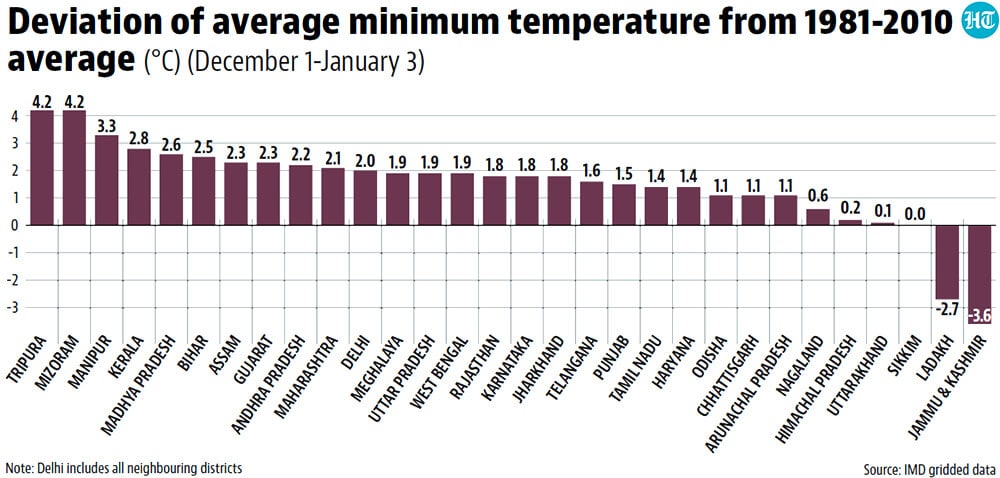
 This winter is the 5th warmest by minimum temperaturesIMD considers the December-February period as the official winter season. The current winter season (for the period up to January 3) is ranked the fifth warmest by India’s average minimum temperature since 1951. It is 1.34°C warmer than the 1981-2010 average, considered the normal by IMD. Even the past week was not cold as it should be. India’s average minimum in the week ending January 3 was 1.41°C warmer than the 1981-2010 average. This is the seventh highest warming for the week ending January 3 since 1951-52. In fact, when disaggregated at the state level, the warming in minimum temperatures appears even more extreme. Only a few hilly states in the north and northeast have recorded normal or below normal minimum temperatures this winter. For seven states and Union territories, including Delhi, the average minimum temperature this winter is the warmest since 1951-52. To be sure, Delhi includes all neighbouring districts in IMD’s gridded dataset.
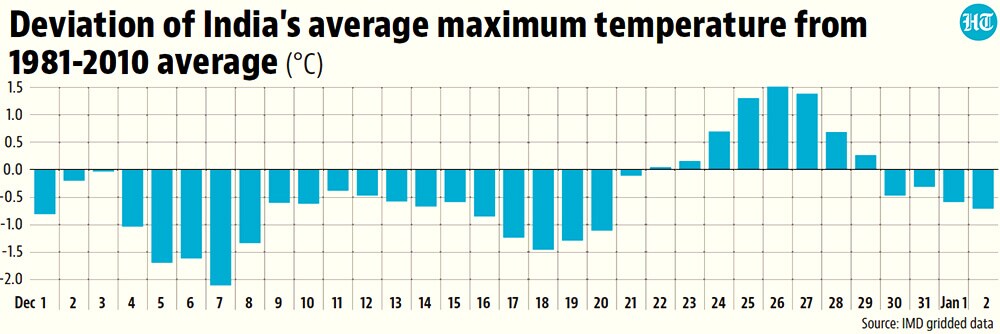
- But maximum temperatures are lower than normal this seasonTo be sure, maximum temperatures are indeed lower than normal this winter season. India’s average maximum temperature up to January 2 (data for January 3 will only be available on January 4) is ranked the 16th coldest since 1951. As this rank suggests, the downward deviation in maximum temperatures is not as high as the upward deviation in minimums. The average maximum for the winter so far is 0.45°C cooler than normal. For the week ending January 2, the average maximum is almost normal (0.04°C warmer than normal). But the deviation from normal maximums has been slightly higher (0.54°C colder than normal) in the last three days ending January 2. Because most people are outdoors during the day, a drop in maximum temperatures can add to the perception of cold.
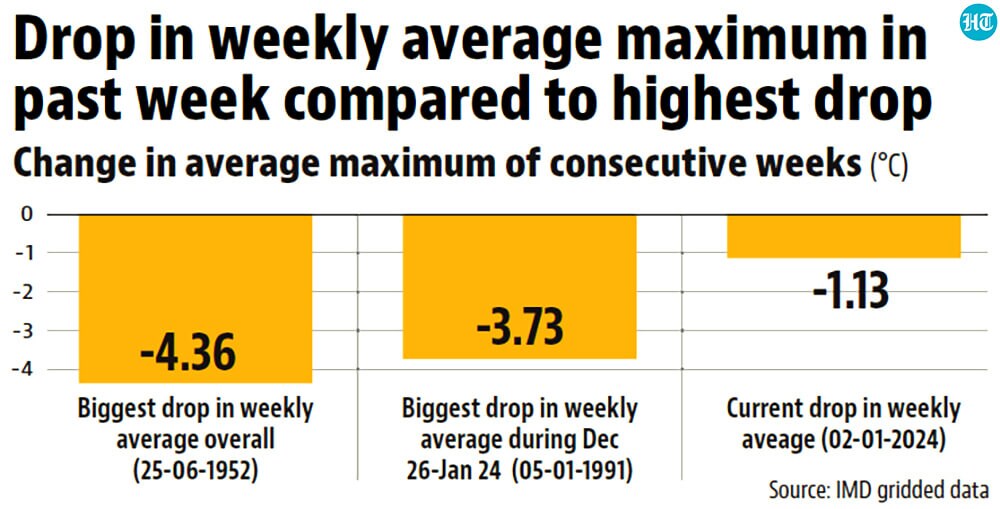
- So, why do temperatures feel suddenly cold right now?One reason why the current weather feels cold could be just that temperatures have decreased sharply in the past week. For example, India’s average maximum has decreased by 1.13°C in the week ending January 2 compared to the week ending December 26, according to IMD’s gridded dataset. This is not the most extreme change in weekly average of maximum but not insignificant either. The drop in weekly average of maximum is ranked in the top 28% of drops in maximum between consecutive weeks since 1951, the earliest year for which IMD has gridded data. If one were to look at the coldest 30-day period during winter (December 26-January 24) the weekly drop between weeks ending December 26, 2023 and January 2, 2024 is ranked in the top 30% category.
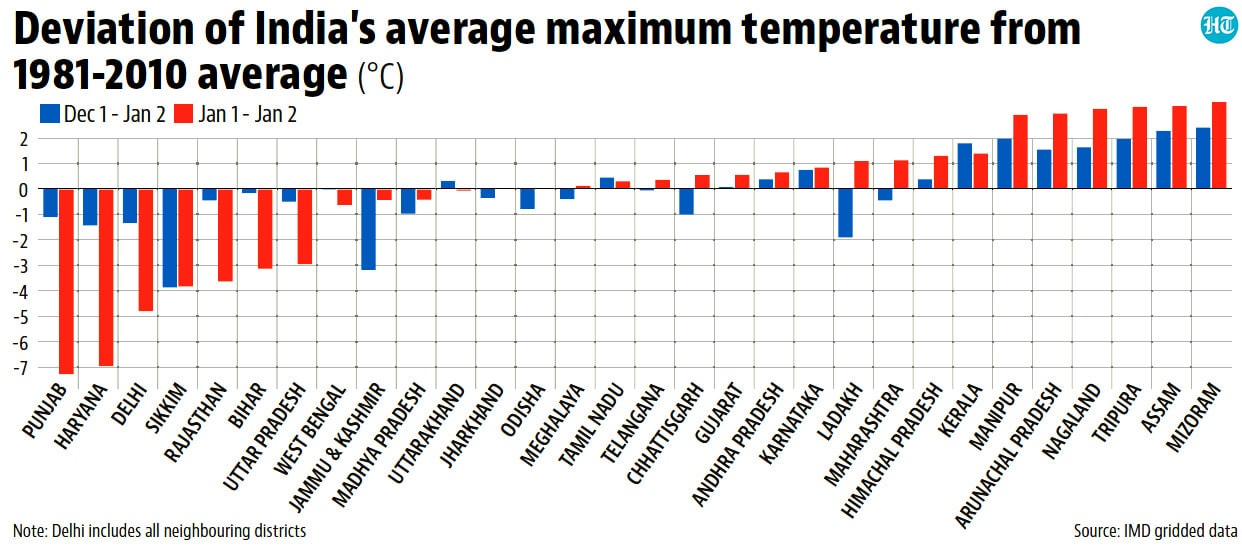
- The drop in maximum temperatures is not a nationwide trendThe reason why India’s average maximum has not deviated far from normal is that extreme cooling in maximums is limited to a few states. Only seven states and UTs have more than 1°C cooling in maximum temperatures and only five states and UTs (Delhi, Haryana, Jammu and Kashmir, Ladakh, and Sikkim) are experiencing their top 10 coolest winter seasons by this metric. Having said that, the drop in maximum temperatures in some parts of north and northwest India has really jumped in the last two days. For example, Punjab, Haryana, and Delhi were 7.3°C, 7°C, and 4.8°C cooler than normal in the first two days of January compared to 1.1 to 1.4°C cooling overall this season. It is this number which has suddenly led to the perception of a spike in cold in the new year.