E-Paper



Number Theory: Is Congress's political predicament tactical?
If Congress has to surge past BJP or even close gap in the 2024 polls, it needs to win at least some seats where BJP has been defeating it in a direct contest.
Published on: Apr 20, 2024, 10:44:38 IST


Share via


Copy link

The Congress, in the 2024 elections, will contest the lowest number of parliamentary constituencies (PCs) it has ever contested in a national elections. Will this electoral tactic work for the Congress? Though the answer to this question will only be known when the results will be declared on June 4, it offers a good opportunity to ask whether electoral tactics has played a role in the decline of the Congress, especially vis-à-vis the Bhartiya Janata Party (BJP), which has replaced it as the dominant national party. Here are three charts which aim to answer this question.
Is Congress' political predicament tactical?
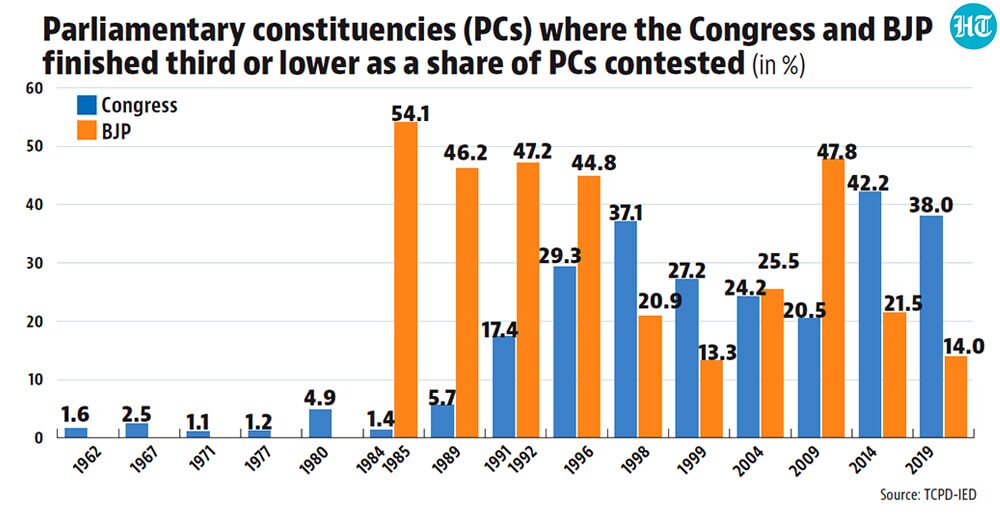
 At least on one metric, the Congress’s electoral tactics in 2014 and 2019 were among the worstWhat is the best way to see whether or not a political party is optimising its strength in an elections? An argument can be made that a party should not be fighting in constituencies where it finishing at the third position or lower. The share of PCs where the Congress finished on the third position or lower was 42% and 38% in 2014 and 2019 elections. These are the highest these numbers have been for the Congress since the 1962 elections, the earliest period for which data is available in the Trivedi Centre for Political Data (TCPD) database. This suggests that the Congress should have contested fewer seats in the 2014 and 2019 elections.
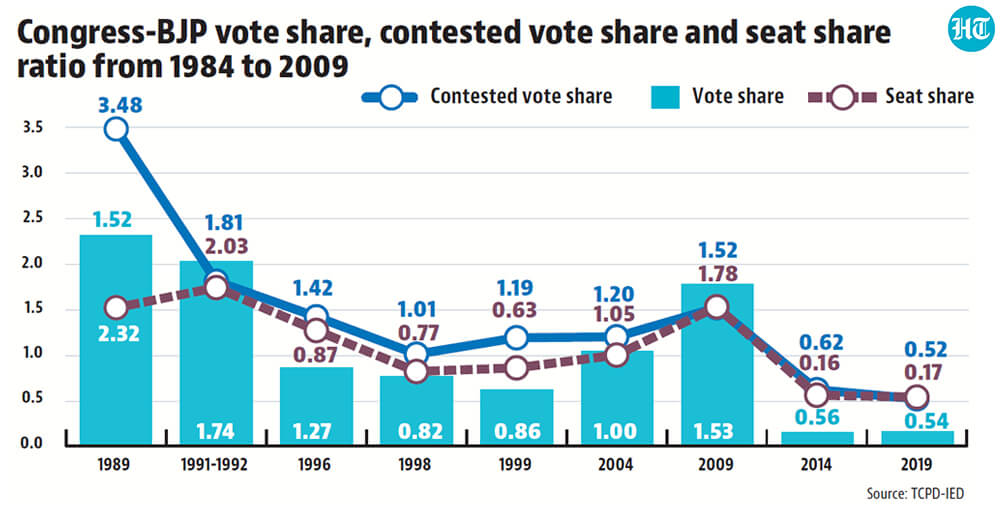
- Congress’s electoral confusion starts from the period of BJP’s emergenceChart 1 clearly shows that the Congress’s marginalisation as the PC-level gained momentum after the 1989 elections, which is when the BJP first emerged as a serious political force. In the 1989 and 1991 elections, the BJP finished behind the Congress in terms of number of seats. In 1996, 1998 and 1999 elections, it surged past the Congress before falling behind again in the 2004 and 2009 elections. It was in the 1996, 1998 and 1999 elections that the BJP seems to have planned its electoral tactics much better than the Congress. While the Congress was ahead of the BJP in every elections between 1984 and 2009 in terms of overall vote share, the BJP was ahead of the Congress in terms of contested vote share in 1996, 1998 and 1999. This is likely to have been a major factor in the BJP getting more seats than the Congress.
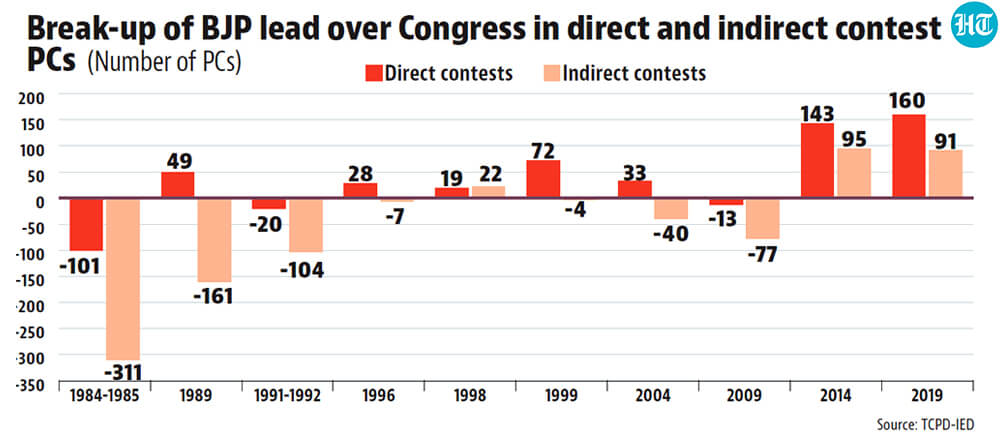
- Will contesting fewer PCs help the Congress in 2024?This is where an analysis of victories of the Congress and the BJP against different parties can help us understand the real picture. In order to answer this question, HT broke up every constituency won by the Congress and BJP into two categories: direct contest wins where the Congress and BJP finished first or second against each other, and indirect contest wins where the Congress or the BJP finished first but the other party finished third or lower or did not contest that PC. The data is revealing. The BJP had a lead of 238 and 251 seats over the Congress’s tally in the 2014 and 2019 Lok Sabha elections , and 60% and 64% of this lead came from PCs where the Congress lost to the BJP in a direct contest. One can argue that at least in these PCs, the Congress’s major problem was the lack of appeal of its own politics rather than a wrong decision to contest a seat even when it was not in the reckoning. In fact, a long-term look at these numbers suggests that the Congress has been struggling with this challenge for a while. The BJP has won more seats than the Congress in PCs where these two parties have finished first and second in every elections since 1996, except 2009. This also includes the 2004 elections when the Atal Bihari Vajpayee government suffered a shock defeat and the Congress formed a government with its pre- and post-poll allies.
- What does it mean?If the Congress has to surge past the BJP or even close its gap with it in the 2024 elections, it needs to win at least some of the seats where the BJP has been defeating it in a direct contest. The fact that it has been able to do this in only one elections (2009) after 1996 should give some food for thought to India’s grand old party. The 2009 elections were the only one which the BJP contested when Vajpayee was out of the reckoning for the prime minister’s post, and Narendra Modi had not made his bid yet. The Congress, on the other hand, did not have a declared prime ministerial candidate in any election in this period, except 2009. This suggests that electoral tactics may not be effective in the absence of clear and capable political leadership.