E-Paper



Parliament panel renews push for EWS fee relief, scholarships in Sainik Schools
Defence panel renewed calls for lower Sainik School costs, wider scholarships and greater support for girls and economically weaker students.

 Prefer HTon Google


The parliamentary standing committee on defence has reiterated its recommendations to make Sainik Schools more affordable and inclusive, after noting that the defence ministry had “not furnished any reply or comment” on key proposals, including extending tuition fee reimbursement, scholarships for girl cadets, and greater financial support for economically weaker students.
Panel seeks wider fee support for Sainik cadets
In its report on the analysis of the action taken by the ministry regarding its March 2026 recommendations, tabled in Parliament on Friday, the committee reiterated that the Centre should extend reimbursement of tuition fees for Sainik School cadets joining the National Defence Academy (NDA) and Naval Academy (NA) from the current Classes 11 and 12 to Classes 9 to 12, arguing that the move would “motivate” the cadets of Sainik Schools to join the NDA, NA and other defence-related establishments and “benefit” in increasing the intake for the NDA and NA.
The report comes nearly five months after the panel, in its March report, urged the ministry to address the issue of rising fees in Sainik Schools on a priority basis. At the time, it had recommended creating a dedicated fund to provide financial assistance or special concessions for students from middle-class, lower middle-class and low-income families so that deserving candidates are not denied admission because of an unaffordable fee structure. It had also sought reforms aimed at greater inclusivity, fee rationalisation and wider access to Sainik Schools.
Reviewing the ministry’s response, however, the 31-member committee headed by BJP MP Radha Mohan Singh said several of its recommendations had gone unanswered.
Also read: 22 cadets from Lucknow UP Sainik School clear NDA written exam
Govt urged to expand scholarships, financial aid
“The Ministry has not furnished any reply or comment” on enhancing the Central government’s share in scholarship and incentive schemes, the committee noted, asking the Centre to increase its contribution “wherever possible” to provide “holistic support” to Sainik School students. It also observed that the ministry had not responded to its recommendation for introducing a special scholarship scheme for girl cadets and asked it to review the existing scholarship policy to encourage more girls to join the armed forces. The ministry had said scholarships are currently administered by state governments, with varying rates across states, and that it has requested states and UTs to adopt a uniform scholarship structure.
The committee also renewed its push for greater financial support to economically weaker students. While the ministry maintained that the existing reservation policy was “satisfactory” because there is no reservation for economically weaker sections (EWS) in Kendriya Vidyalayas or Navodaya Vidyalayas, the panel was unconvinced.
Acknowledging “the social background of the students”, the committee reiterated that the ministry should review the Sainik Schools Society Rules & Regulations, 1997, to introduce provisions for exemption, minimisation or subsidisation of fees for students from the EWS category. Such a step, it said, “will certainly create a milestone by way of enabling desirous students getting an opportunity to serve the nation.”
Also read: Kataria calls on Rajnath for Sainik School in Chandigarh
Panel seeks more all-girls Sainik Schools
The report also flagged the ministry’s response on girls’ education in Sainik Schools.
While welcoming progress in hostel infrastructure—21 schools now have girls’ hostels and construction is underway in nine others—the committee noted that the ministry had “not furnished any reply or comments regarding steps taken for incrementally increasing the number of all-girls Sainik Schools.” It reiterated that more all-girls Sainik Schools would “surely pave the way for intake of more female officers in the NDA course along with other areas of defence-related institutions/organisations” and sought details of the ministry’s plans in the next action taken statement.
Also read: Leadership | The uniform is a national trust
PPP Sainik Schools see progress, but delays remain
The committee also reviewed progress in the government’s ambitious plan to establish 100 new Sainik Schools under the public-private partnership (PPP) model. It welcomed the increase in the number of schools signing Memorandums of Agreement—from 64 in March to 80 now—and noted that 58 schools are operational in PPP mode. However, it again asked the ministry to establish a dedicated mechanism for faster disposal of pending applications, set up a high-powered committee to remove implementation bottlenecks, and prepare a comprehensive action plan to ensure at least one new Sainik School is established in every state and Union Territory.
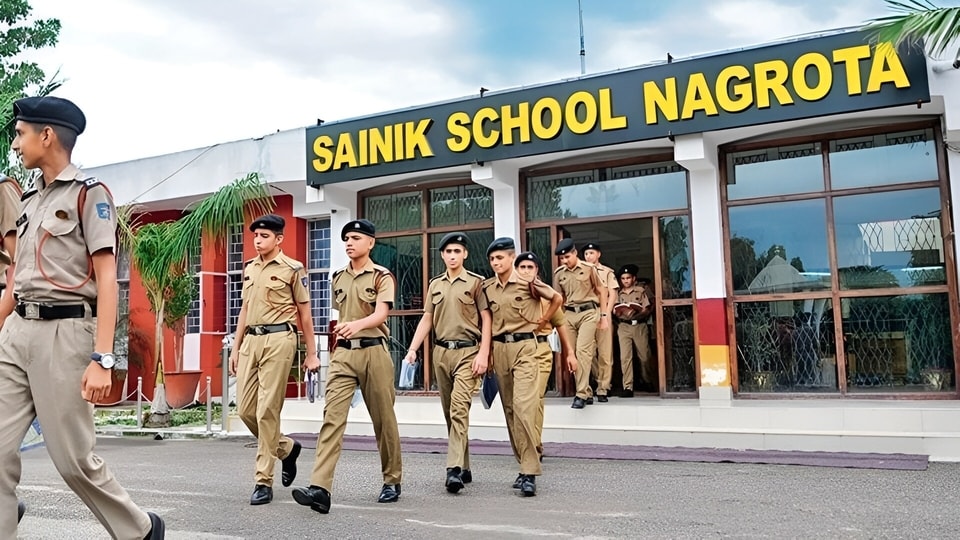
There are 91 operational Sainik Schools in the country, including 33 traditional institutions run under the Sainik Schools Society and 58 new schools established under the Centre’s PPP-based New Sainik Schools initiative. Both run classes from Class 6 to 12. According to rules, traditional Sainik Schools raise fees by 10% annually, with 2025-26 annual charges at several schools ranging from about ₹1.7 lakh to ₹2 lakh, including boarding and other expenses. New Sainik Schools under the PPP model have no uniform fee structure, but the Centre provides 50% fee support, capped at ₹40,000 a year, to up to half the students in Classes 6 to 12 on a merit-cum-means basis.