E-Paper



Number Theory: Reading just headline numbers from 2023 PLFS report can mislead
The three calendar year PLFS reports for 2021, 2022, and 2023 suggest a growth in jobs and a decline in unemployment rate in the 15+ age group
Updated on: Mar 6, 2024, 19:50:47 IST


Share via


Copy link

The National Sample Survey Office (NSSO) released the Periodic Labour Force Survey (PLFS) report for the calendar year 2023 on March 4, the third in the calendar year series. These reports are the thinnest among the three kinds of reports NSSO publishes using PLFS. They contain only three indicators: the labour force participation rate (LFPR), the worker population ratio (WPR), and the unemployment rate. An HT analysis, using unit-level data, shows why reading just these three numbers of the calendar year reports can be misleading.

Reading just headline numbers from 2023 PLFS report can mislead
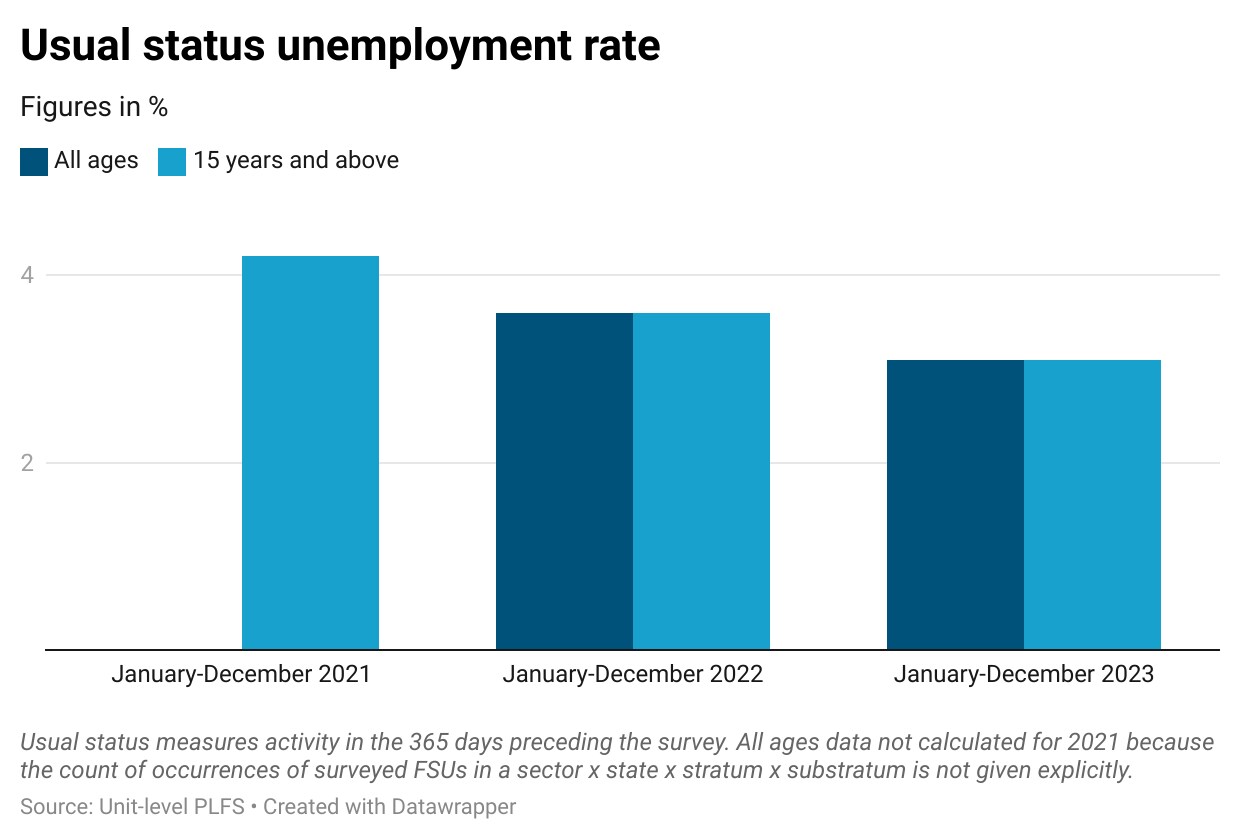
 What do the calendar year PLFS reports show?The three calendar year PLFS reports published so far – for 2021, 2022, and 2023 – suggest a growth in jobs. They show that the unemployment rate in the 15+ age group (the only one for which the report publishes data) has decreased from 4.2% in 2021 to 3.1% in 2023 in the usual status, which measures activity over a 365-day period. The unemployment rate has decreased although the combined share of workers and job seekers in this age group – called LFPR – has increased. This means that the overall proportion of workers in this age group or WPR has increased during this period. At least between 2022 and 2023, these trends also hold true for the overall population, according to unit-level data analysed by HT. It is not possible to check this for 2021 because the unit-level data for 2021 is missing a variable needed for calculating the weight of each household. Nonetheless, the population below 15 years of age is unlikely to change the unemployment rate much because only a small fraction of it generally participates in the labour force. For example, the unemployment rate for the overall population and the 15 years and above age group was the same in 2022 and 2023.
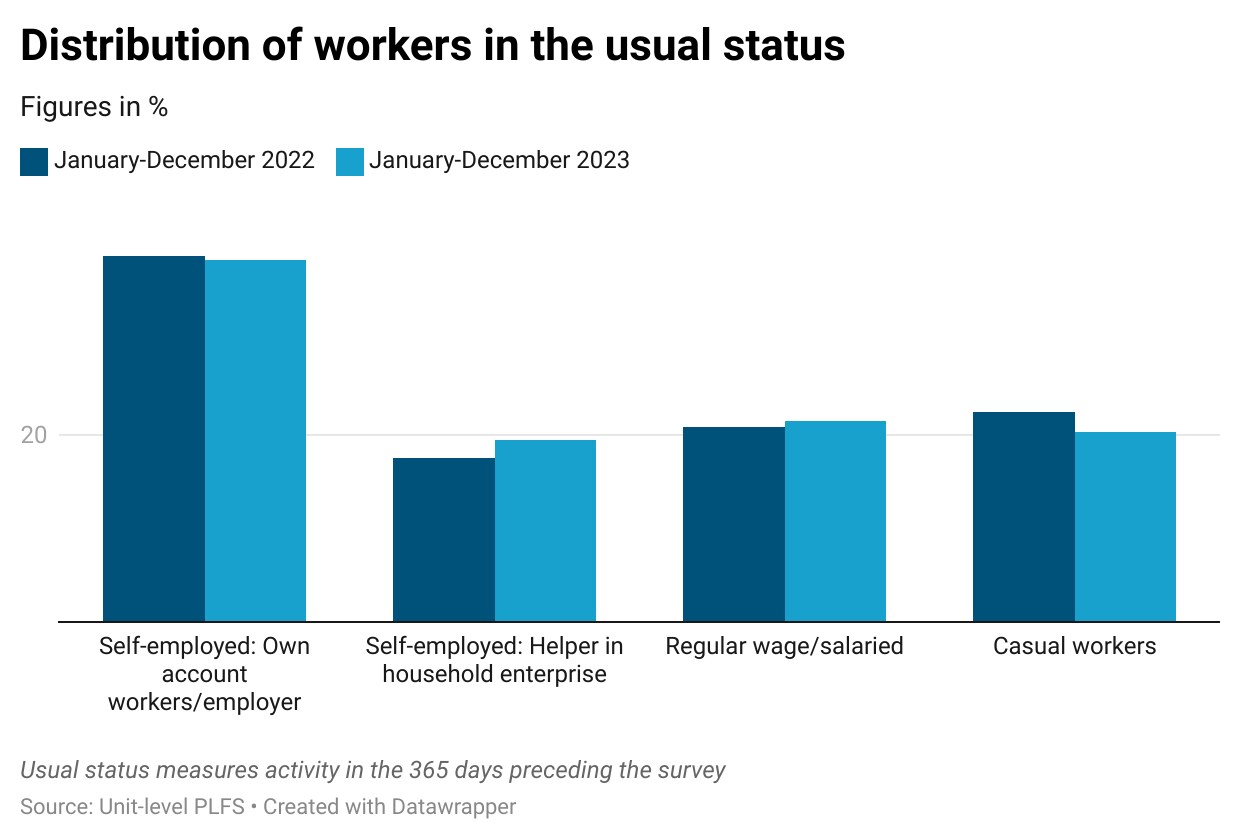
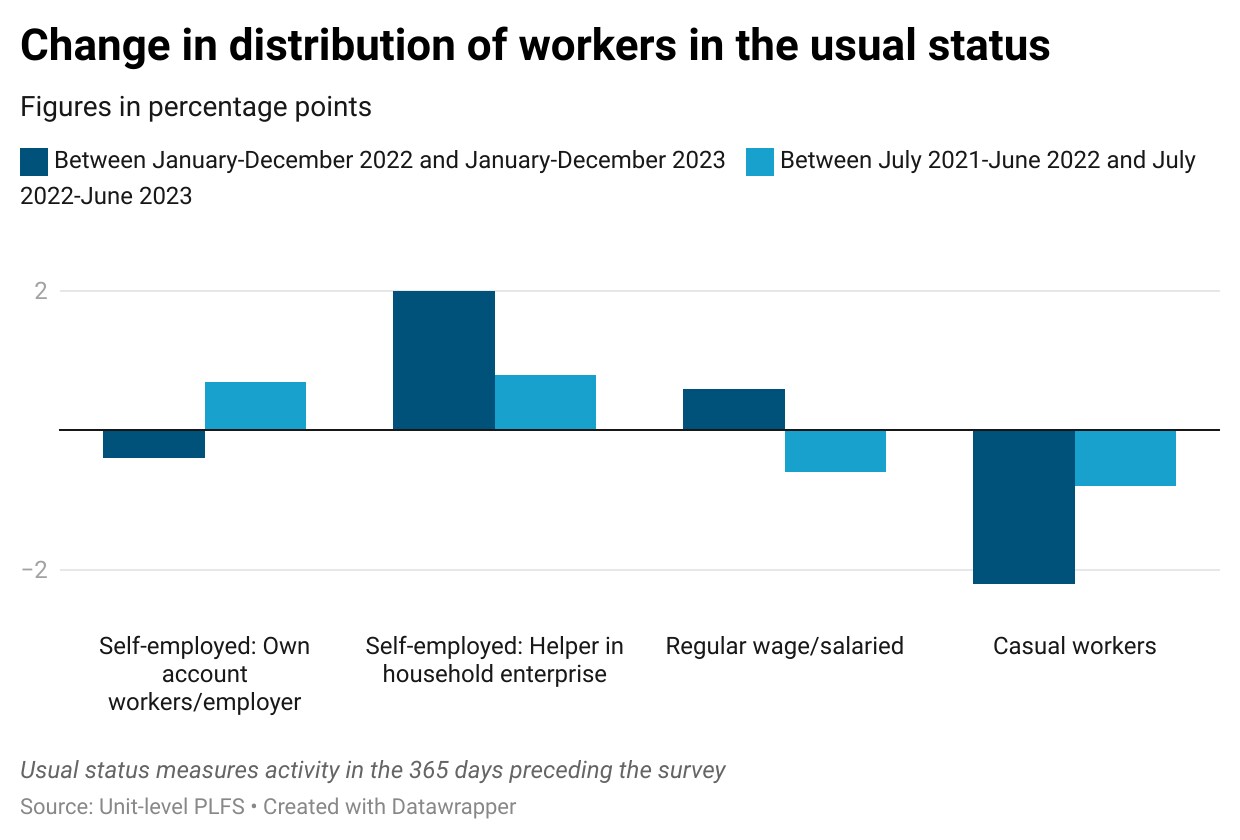
- Unit-level data shows that growth in unpaid family workers is decreasing unemployment rateA falling unemployment rate with rising LFPR is usually a healthy trend in labour markets. It suggests that the number of jobs is growing faster than the number of job seekers. However, drawing this conclusion from PLFS would be misleading. Unit-level data shows that the share of unpaid family workers (they are a kind of self-employed workers in PLFS) in the work force has increased by 2 percentage points between 2022 and 2023 to 19.5%. In contrast, the proportion of regular wage or salaried workers – on average they are the best paid among different kinds of workers recorded by PLFS -- has increased by just 0.6 percentage points to 21.5% in 2023. Clearly, unpaid work driving the growth in jobs is not a healthy trend. If such unpaid workers were counted as unemployed, India’s headline unemployment would show a trend opposite to that shown by the calendar year reports. This adjusted unemployment rate increased from 20.4% in 2022 to 22% in 2023.
- Unpaid work also increased in the regular July-June PLFS, but not by this degreeTo be sure, the trends discussed above for the calendar years from 2021 to 2023 also hold roughly true for the regular July-June year followed by PLFS. However, in this July-June calendar (the basis of the most detailed annual reports of PLFS), the growth in the proportion of unpaid workers between the latest two PLFS conducted in 2021-22 and 2022-23 was only 0.8 percentage points compared to 2 percentage points between calendar years 2022 and 2023.
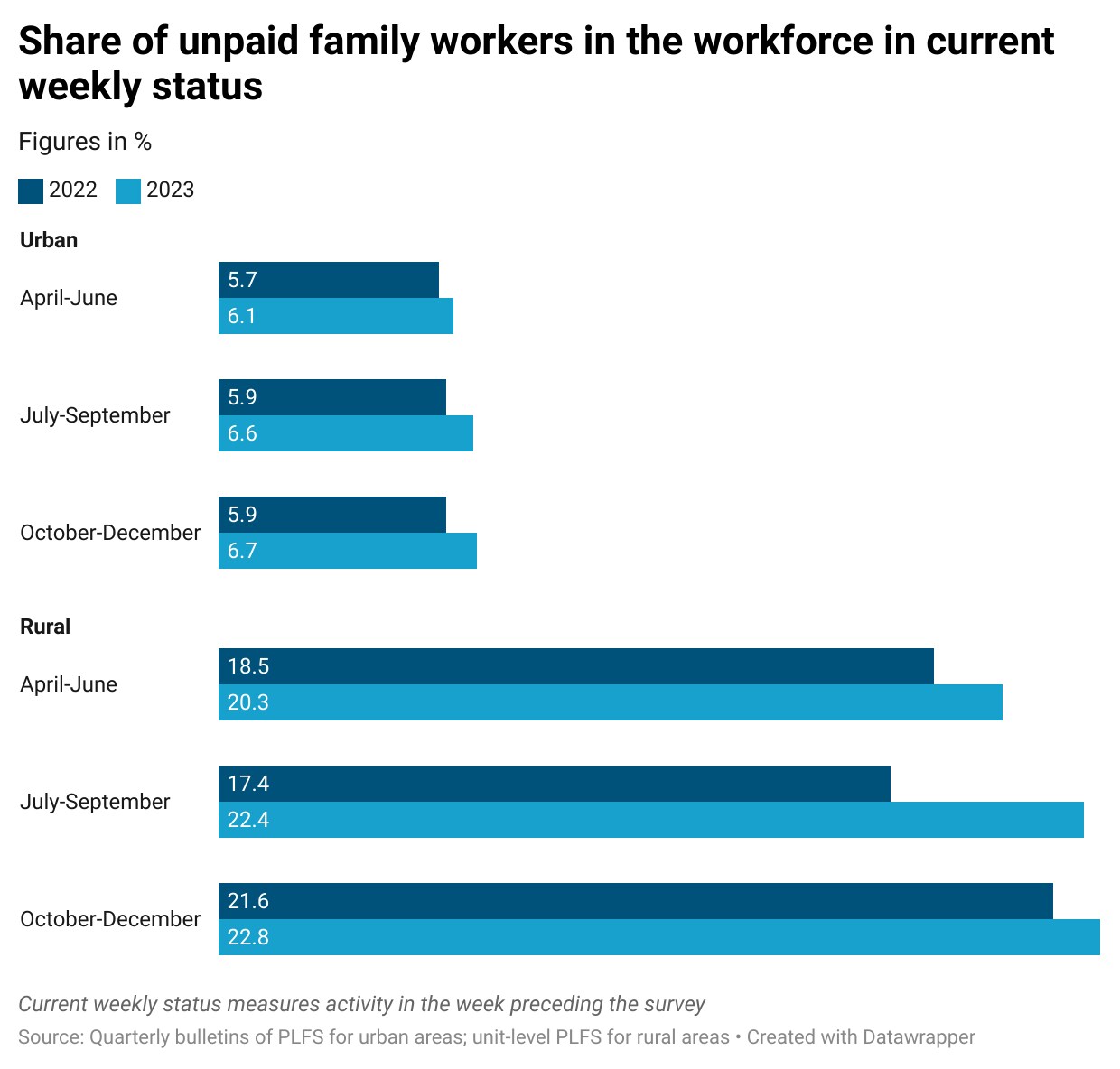
- Does this mean unpaid work has increased in the last six months of 2023?The proportion of unpaid workers in the workforce was 18.3% in the July 2022-June 2023 PLFS and it was 19.5% in January 2023-December 2023. It might be tempting to read this as a rise in unpaid work in the last six months of 2023. However, it would be wrong to compare the July-June PLFS data with the calendar year data, especially in a 365-day reference period of the usual status. For this reference period, workers’ status is determined just on the basis of the activity on which they spent relatively longer time. Therefore, it is not necessary that the January-December data necessarily tells workers’ status in the last six months of 2023. For example, a salaried person who quit their job in July 2023 will be counted as a salaried person during January-December 2023 in the usual status.