E-Paper



Number Theory: Record fires in Uttarakhand, Himachal and J&K as winter turns dry
An HT analysis of satellite data suggests that fires in the two hill states and Jammu & Kashmir are unprecedented this January

 Prefer HTon Google


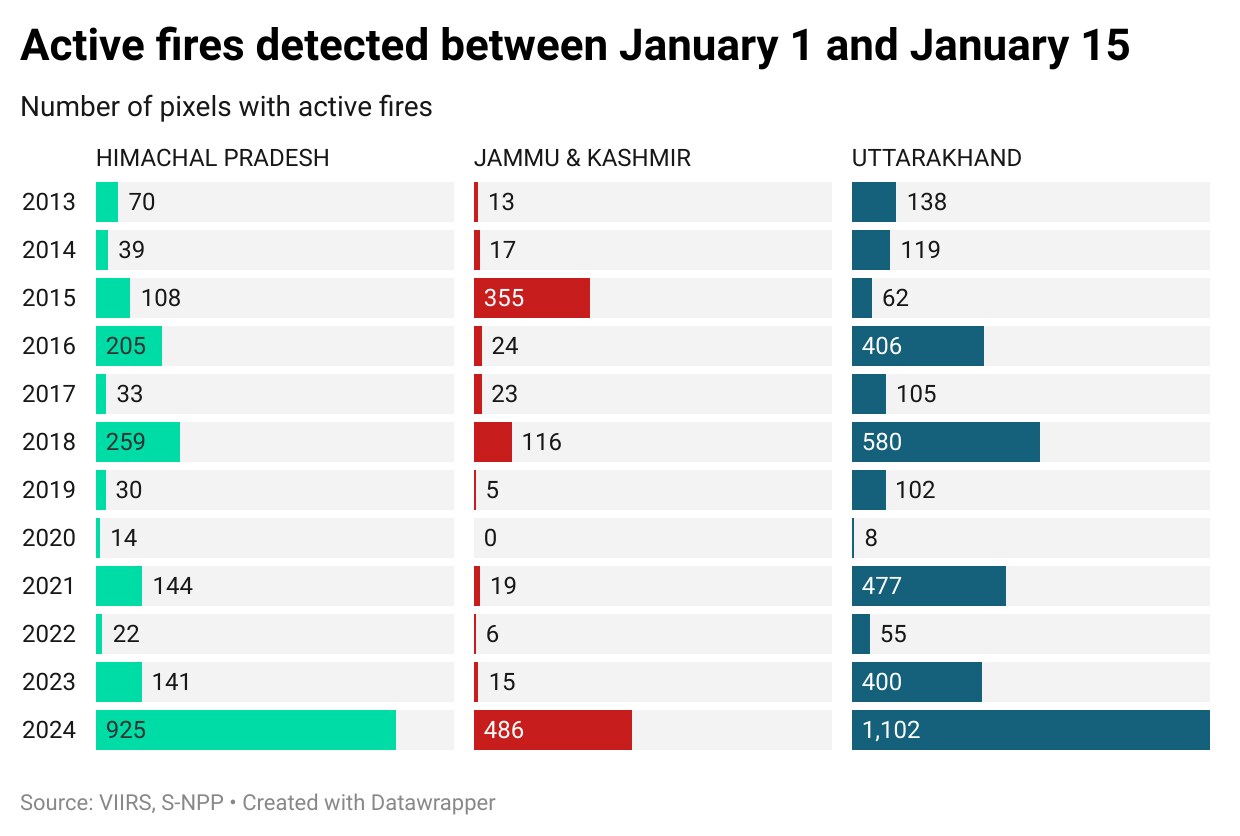
Forest fires have been reported across several areas in Uttarakhand, Himachal Pradesh, and Jammu & Kashmir in the past three days. For example, the defence ministry’s public relations wing said in a post on X on January 14, that a forest fire had been brought under control in Dera Ki Gali of Poonch district. The New Indian Express reported on January 15 that forests in Pipalkoti of Chamoli district, Jugju in Joshimath district, and Jamrakhala on the Pauri-Srinagar highway of Uttarakhand were on fire. Similarly, fires were reported from forests in the Vashisht and Shanaag areas of Manali in Himachal Pradesh, according to an ANI report on January 15. An HT analysis of satellite data suggests that such fires in the two hill states and Jammu & Kashmir were unprecedented this January. While the trigger for the fires could be human or natural, the fuel for them is likely to be the dry winter that these regions are experiencing. Here are three charts that explain this.

 Fires in Uttarakhand and Himachal are 2 and 4 times the previous recordData from the visible infrared imaging radiometer suite (VIIRS) instrument aboard the Suomi-NPP satellite (it has data on active fires from January 20, 2012) shows that Uttarakhand, Himachal Pradesh, and Jammu & Kashmir have reported 1102, 925, and 486 fires from January 1 to January 15 (latest available data). For the January 1-15 period, these are the highest-ever number of fires that each of these regions has reported since 2013. However, this rank alone does not show how unprecedented the fires are. Compared to the average fires reported in the first two weeks of January in 2013-2023, the fires this year are 4.9 times, 9.6 times, and 9 times in Uttarakhand, Himachal Pradesh, and Jammu & Kashmir respectively. This number is also very high if the fires this year are compared with the previous record for the first fifteen days of January in each state: 1.9, 3.6, and 1.4 in Uttarakhand, Himachal Pradesh, and Jammu & Kashmir respectively. To be sure, these numbers need to be read with caution. The VIIRS instrument has a resolution of 375 metres and the satellite makes two passes over India in a day. This means that the fire count shown here is actually a count of 375x 375 metre pixels where active fires were seen when the satellite made a pass over a region. However, a very large increase in pixels with active fires suggests that the fires this January in hilly states are indeed unusual.
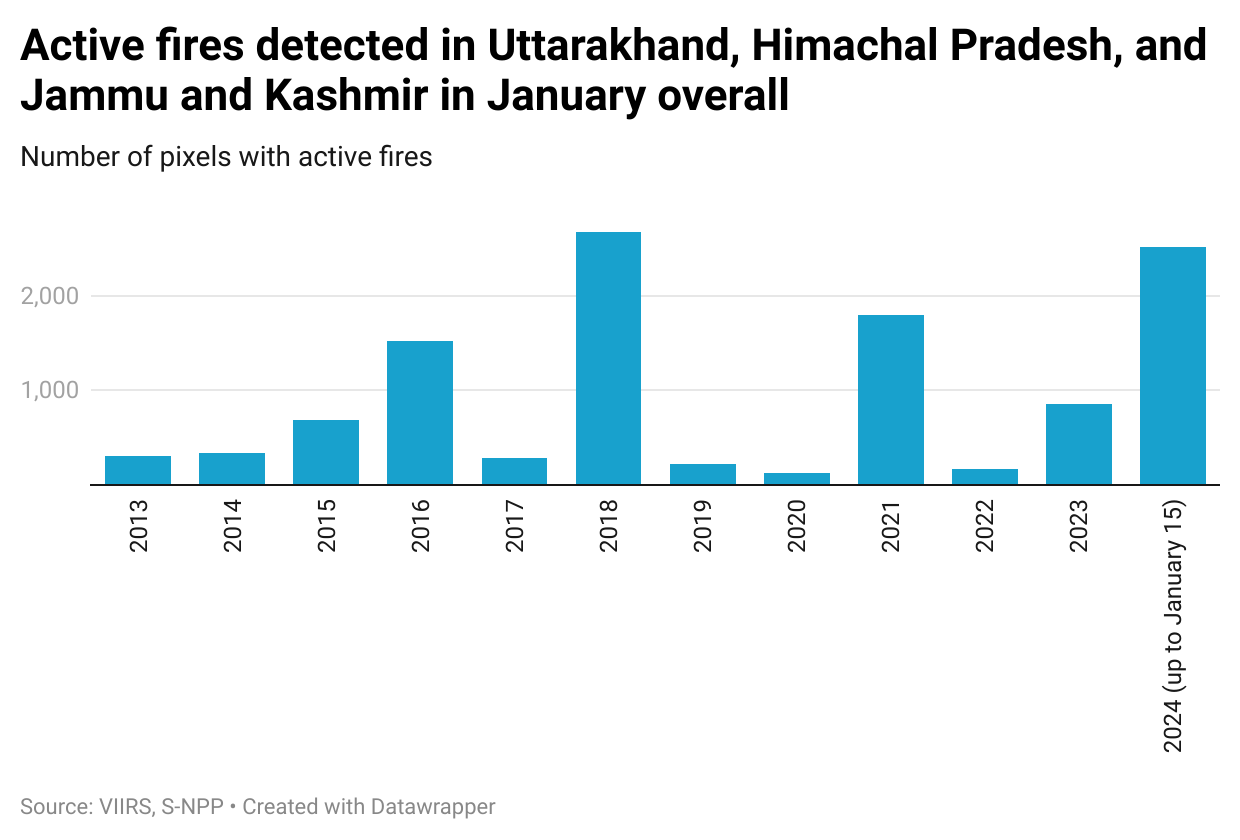
- Do forests in the hill states usually catch fire in January?The comparison above is limited to the first fifteen days of January because that is how far we are in 2024. However, data shows that 2024 could end up becoming an outlier even if the entire month of January is considered for counting fires in earlier years. The two hill states and Jammu & Kashmir taken together have reported an average of 817 fires in January from 2013 to 2023 compared to 2,513 this year already. However, in 2018, they did report a higher number of fires in January taken in its entirety, 2,670.
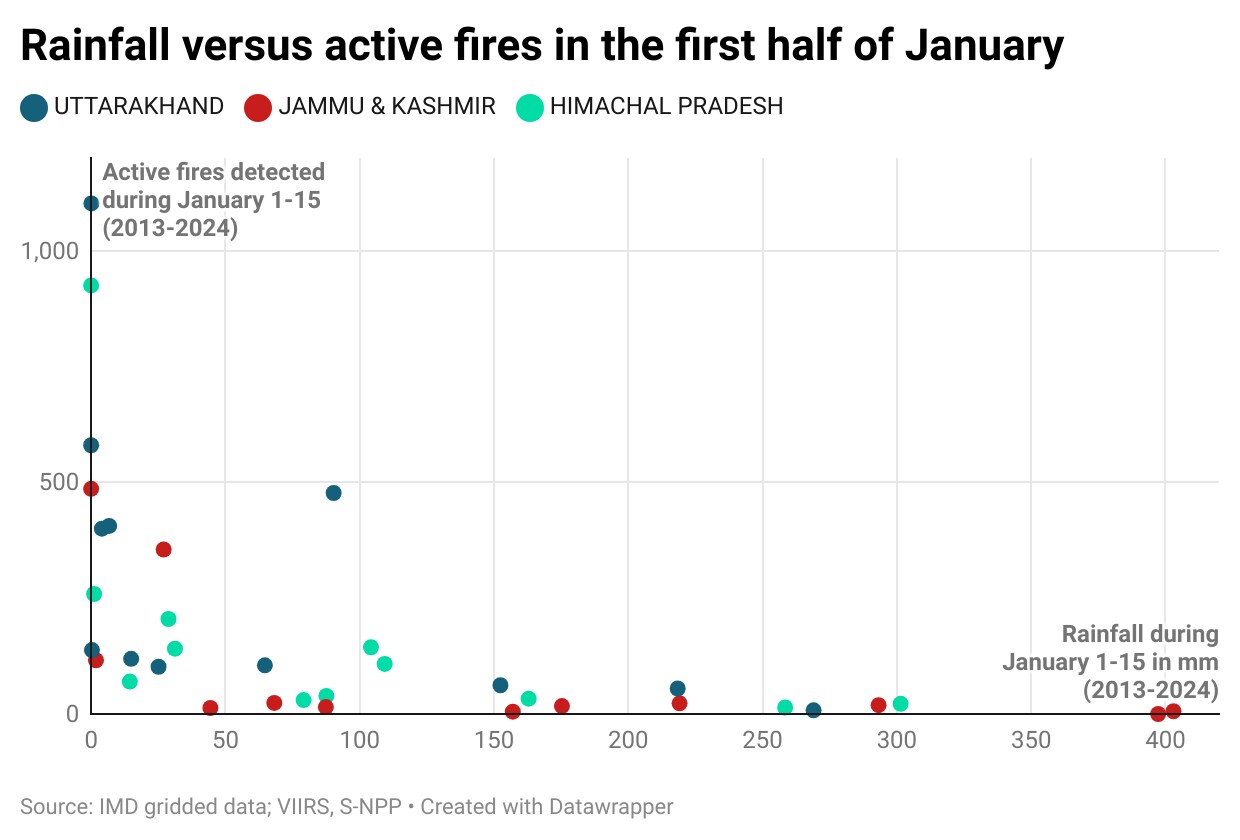
- A dry winter is somewhat responsible for the surge in fires this yearAccording to India Meteorological Department’s (IMD) gridded dataset, Uttarakhand, Himachal Pradesh, and Jammu & Kashmir have received 11m, 10 mm, and 24 mm rain respectively this winter, which officially starts on December 1. This is the 11th, fifth, and fourth driest winter season since 1901 for these regions. January so far has been even drier. Data up to 8.30am on January 15 shows 0.1 mm of rain in Uttarakhand and no rain in Himachal Pradesh and Jammu and Kashmir, making it the sixth driest January for Uttarakhand since 1901, and the driest ever for the other two regions. As is obvious, this is likely to have made forests drier and more vulnerable to fires. To be sure, the surge in fires cannot be blamed on the weather alone. While fires in January indeed spiked in years when the weather was dry, the correlation isn’t perfect. This could be because state-level rain may not capture the dryness of areas where the forests are. On the other hand, fuel (dry forests in this case) alone does not lead to large-scale fires, many of which start by a human hand. Timely intervention by forest departments of these regions can help reduce the scale of fires.