E-Paper



Number Theory: Telangana’s shifting political grounds
HT analysis of past results in Telangana suggests that the state’s political ground has been continuously shifting
Updated on: Nov 27, 2023, 09:35:54 IST


Share via


Copy link

Telangana, the last of the five poll-bound states in this election cycle, will vote on November 30. Almost all reportage from the state suggests a straight contest between the ruling Bharat Rashtra Samiti (BRS); it was earlier called the Telangana Rashtra Samiti (TRS), and the Congress. While the exact nature of the 2023 contests will only be known once the results are declared on December 3, an HT analysis of past results in Telangana suggests that the state’s political ground has been continuously shifting. Here are some charts which explain this in detail.

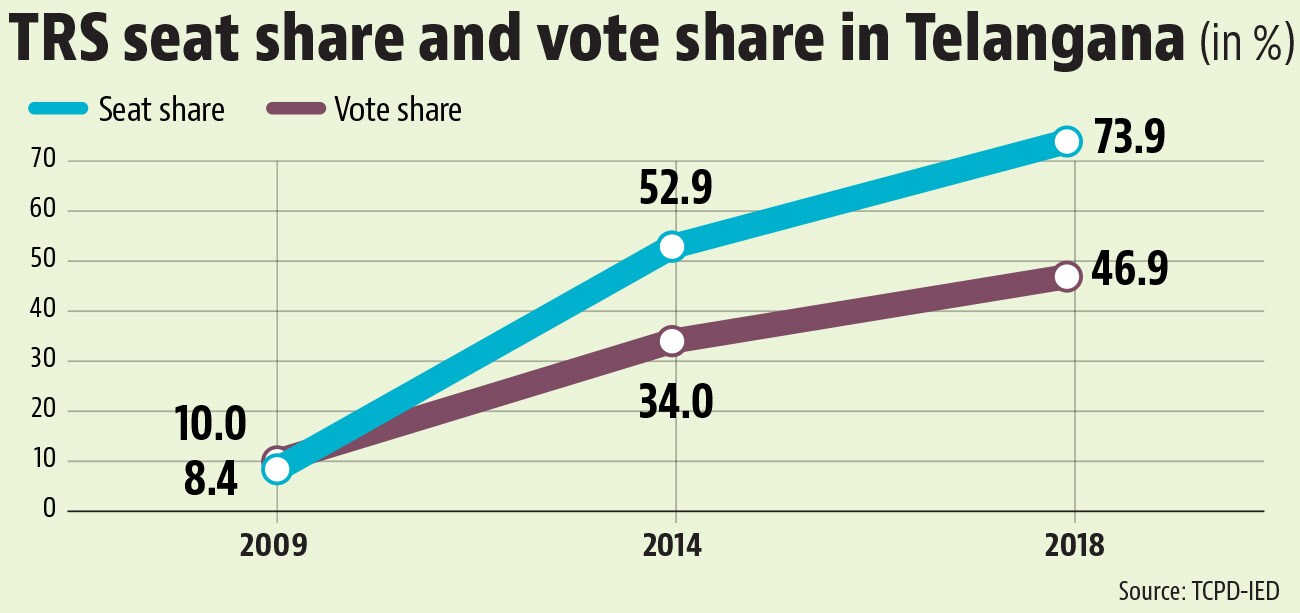
 TRS’s fortunes jumped only after the creation of TelanganaK Chandrasekhar Rao, the founder of TRS and Telangana chief minister, had formed his party in 2001 after walking out of the Telugu Desam Party (TDP) on the issue of creation of a separate Telangana. The TRS fought its first assembly election in 2004 and even in the 2009 elections, finished a poor third behind the Congress and the TDP the part of Andhra Pradesh which is now Telangana. The TRS’s dismal showing until 2009 changed completely with the formation of Telangana, and its seat share and vote share jumped significantly in the 2014 and 2018 (the TRS got the assembly elections pulled back by a year) assembly elections. Chart 1: TRS seat and vote share in Telangana
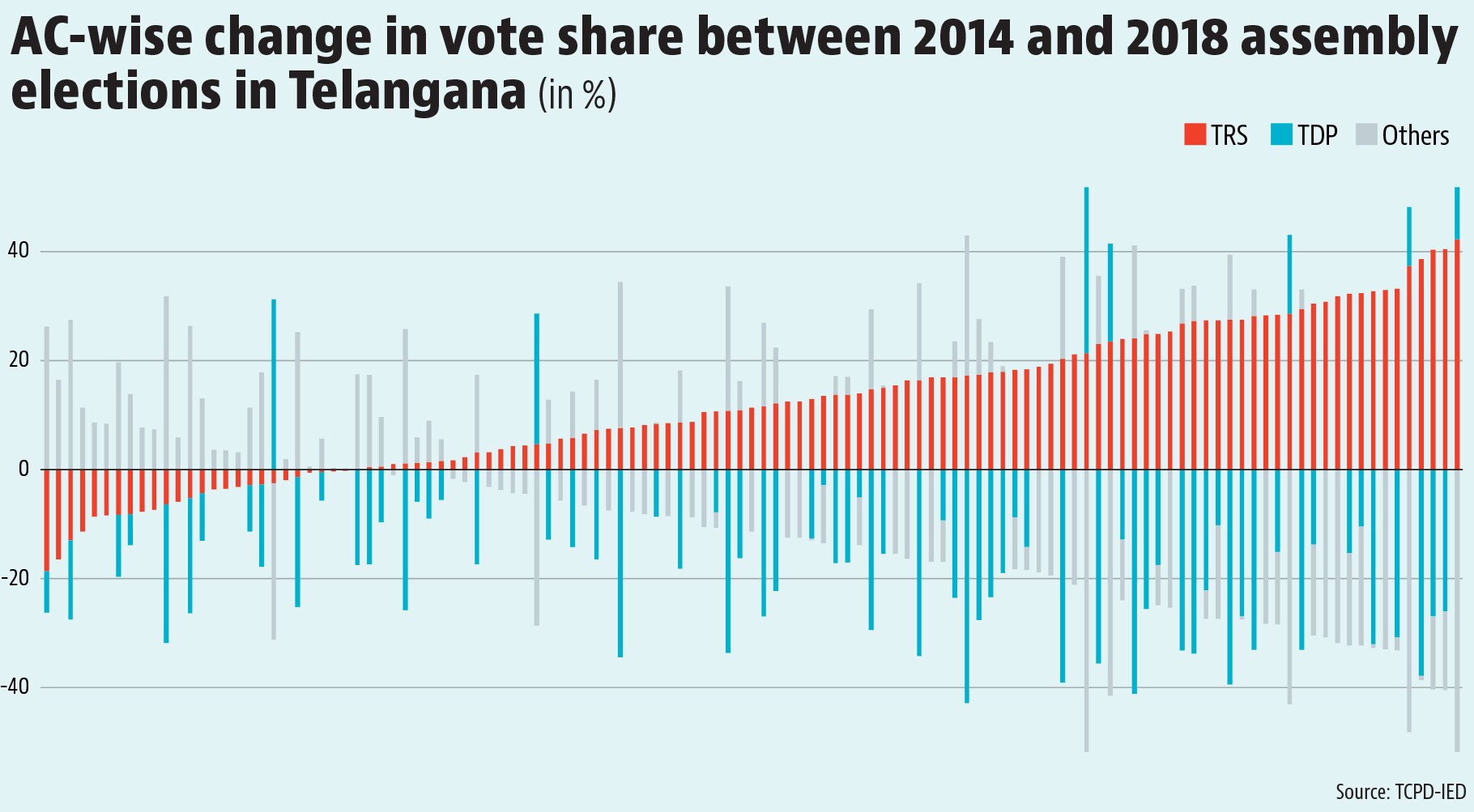
- The TDP giving a walkover in the 2018 elections was a big reason behind the TRS’s massive victoryWhat was the reason behind the TRS’s massive victory in 2018 compared to the 2014 elections? The question is an interesting one because the vote share of the principal opposition party, namely the Congress did not change much between 2014 and 2018. What really helped the TRS was the TDP pretty much withdrawing itself from the contest in 2018. It contested just 13 out of 119 ACs in 2018, compared to contesting 72 in 2013. A large part of the TDP votes went to the TRS in the 2018 elections. Chart 2: AC-wise change in vote share between 2014 and 2018
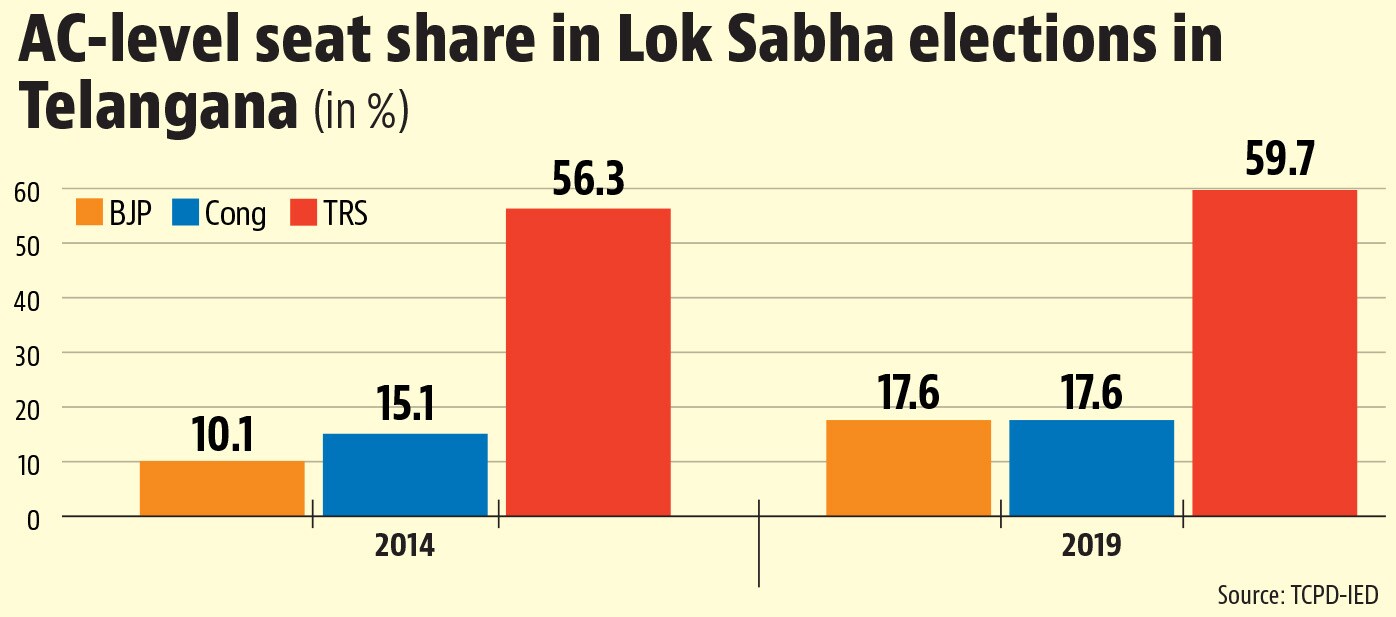
- 2019 suggested that the BJP could replace the Congress as the state’s main oppositionWhile the TRS has maintained its dominance in every state-wide election held in Telangana since 2014, the 2019 period suggested some churning in the opposition space in the state. In the 2019 Lok Sabha elections, the BJP won four Lok Sabha constituencies, one more than what the Congress could manage. To be sure, the Congress’s AC-wise victories – if one were to disaggregate Lok Sabha into ACs – were same as the BJP’s and its vote share remained larger than the BJP’s. Chart 2: : AC-level seat share in Lok Sabha elections in Telangana (%)
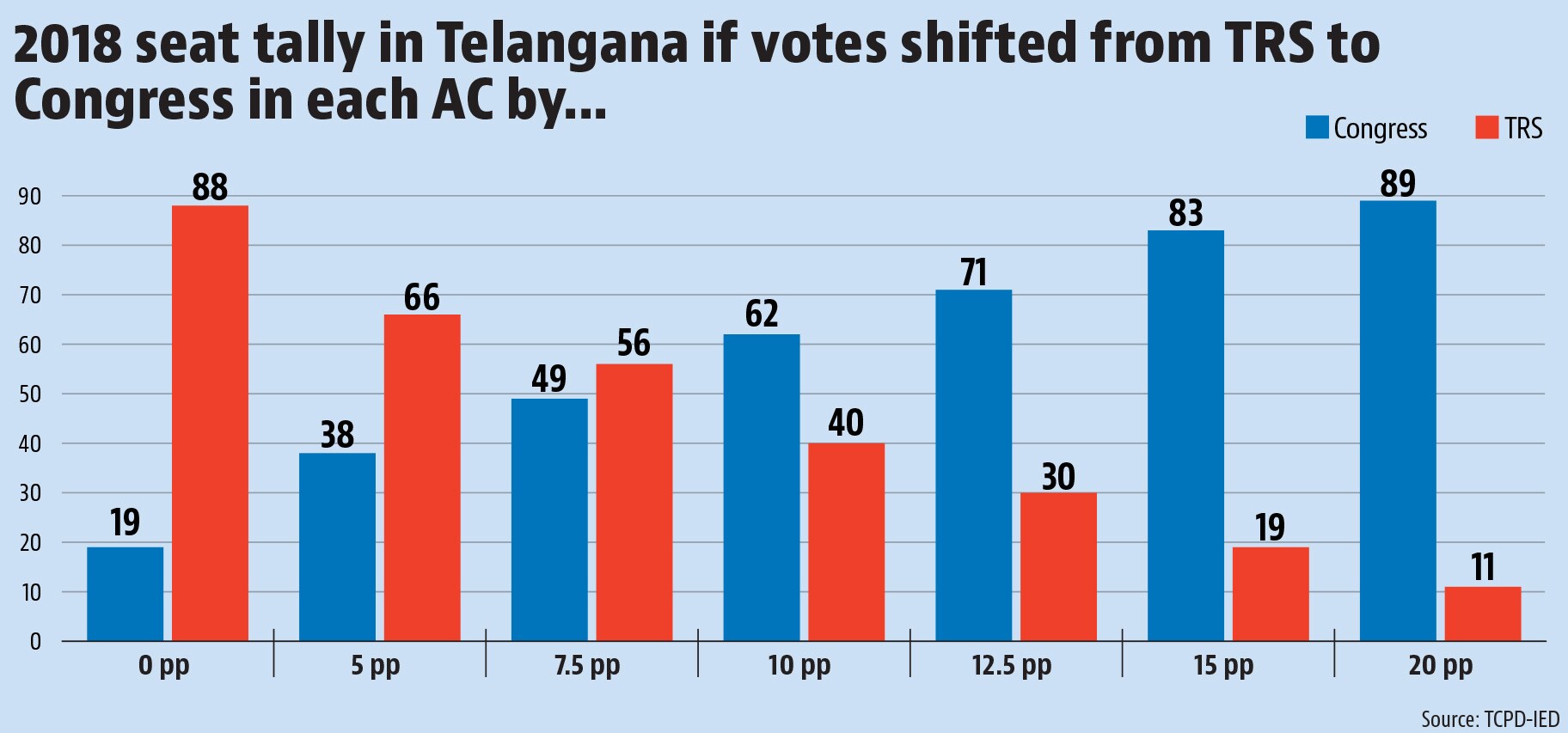
- How much anti-incumbency is needed for the Congress to win?The answer to this question is important if the 2023 election is indeed a straight contest between the TRS and the Congress. One way to answer this question is by shifting TRS votes to the Congress in every AC in the 2018 election. The 2018 election is the closest to the current situation of the TDP not participating in the election. This analysis shows that the TRS needs to lose around 10 percentage points to the Congress in every AC for the latter to win. Such a shift would give the Congress and TRS 62 and 40 seats respectively with the halfway mark being 60. At even a slightly smaller shift of 7.5 percentage points, neither party would get a majority, with the Congress-TRS split being 49-56. At a 5 percentage points shift, the TRS would still win 66 seats. Chart 4: 2018 seat tally in Telangana if votes shifted from TRS to Congress