E-Paper



Number Theory: The link between climate crisis and your clock
Rising temperatures are leading to a faster melting of polar ice which is spreading earth’s mass away from the poles to the center

 Prefer HTon Google


The world will have to make many adjustments to live with the adverse effects of the climate crisis. One of them could also be on how frequently we would need to adjust our clocks.
Bizarre as it sounds, scientists now have conclusive proof of this theory. It is best explained by the analogy of gymnasts spreading their legs to slow down their speed while getting out of a spin. The science is as follows. Rising temperatures are leading to a faster melting of polar ice which is spreading earth’s mass away from the poles to the center. This is now having an effect on earth’s rotation speed. This will delay an adjustment to our digital clocks by three years -- from 2026 to 2029 – compared to the scenario where there was no acceleration in polar ice melting. These findings were published by Duncan Carr Agnew, a geophysicist at the University of California, San Diego, in Nature last week. Here are three charts which explain this in detail.
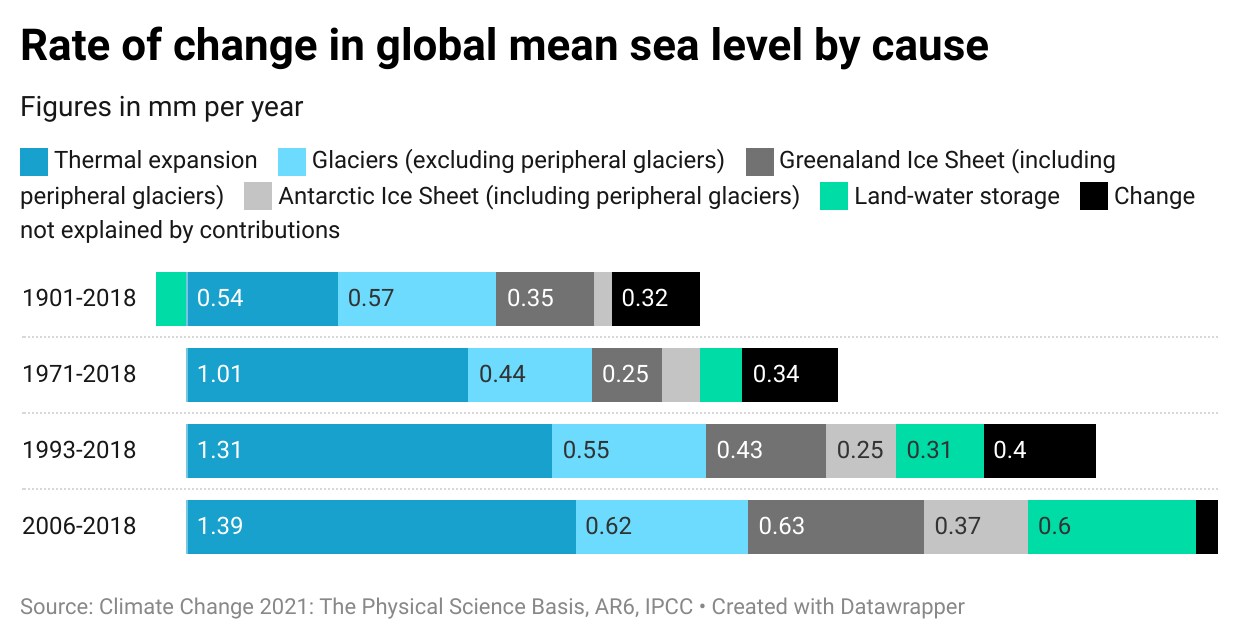
 The melting of ice is not only increasing sea level, it is increasing that level at a faster rateThe sixth assessment report of the Intergovernmental Panel on Climate Change (IPCC) shows this clearly. For the 1901-2018 period, the rate of sea level rise was 1.73 mm per year. In comparison, this rate was 2.33 mm per year in 1971-2018, 3.25 mm per year in 1993-2018, and 3.69 mm per year in 2006-2018. The consistent growth in the rate of sea level rise shows that sea level rise has accelerated. This acceleration has happened because rapid global warming is not only expanding the water present in seas, but is also melting some of earth’s permanent ice and adding more water to the seas. This latter contributor, increasing in importance over time, has special relevance for the rate at which earth spins on its axis. Polar ice keeps a part of earth’s mass fixed at the poles – close to the axis on which earth spins. As this ice melts and joins the seas in lower latitudes, part of earth’s mass is transferred away from the axis. According to the Nature paper, the rate of this transfer is now big enough to decelerate earth’s rotation consequentially.
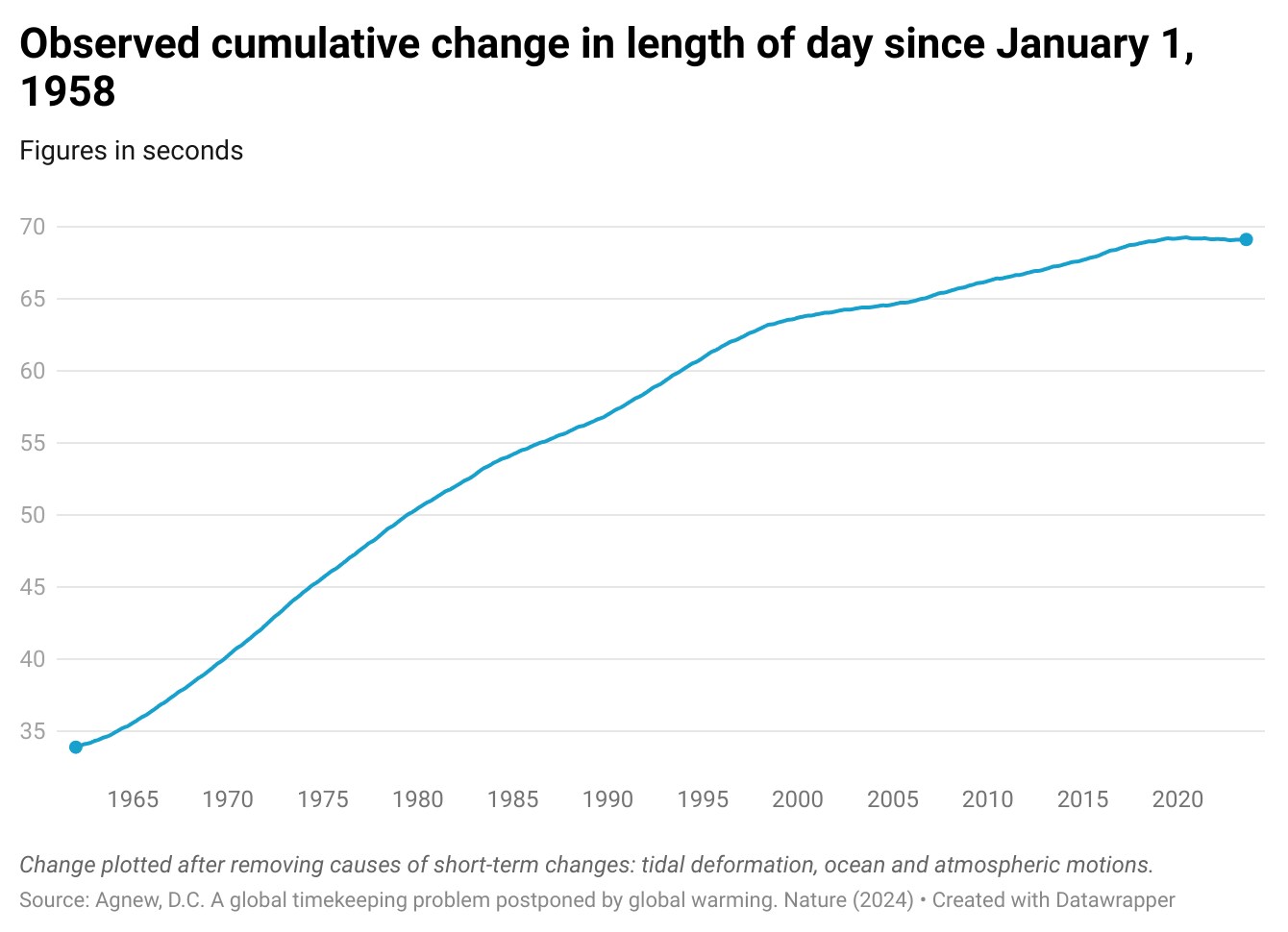
- For most of 20th century, this did not affect earth’s spin rate substantiallyOne way of looking at how polar ice melting is affecting earth’s rotational speed is by tracking changes in the length of a day on earth. This is because a day, as understood by earth’s one full rotation relative to the stars, will become shorter if earth spins faster and longer if earth spins slower. Because such changes are very small, they could not be measured earlier. In fact, the unit of time itself was tied to earth’s rotation relative to the stars up to 1955. This problem was solved in 1955 when a “physical second” was defined using caesium atoms. By January 1, 1958, this physical second and the second measured through earth’s rotation could be defined to agree with each other. They have diverged since then. During the period analysed in the Nature article, the earth’s rotation was first decelerating and resulted in days becoming longer. This needed a second to be added almost every year to the atomic clock-based day or the Universal Coordinated Time (UTC) -- 23 times between 1972 and 1999 – to keep it aligned with the rotation-based day. The need for these “leap seconds” has decreased since (only four additions needed since 1999), suggesting that earth’s rotation speed is now accelerating. However, up to the 20th century, the acceleration in earth’s rotation was mostly because of a factor we have little control over: the motions of earth’s liquid core. When earth’s core started slowing down -- to maintain the rotational version of Newton’s third law of motion -- earth’s surface (crust and mantle together called surface here for simplicity) sped up. This decreased the need for adding up leap seconds. This can also be seen in the accompanying chart: changes in the rotation-based length of day have become flatter.
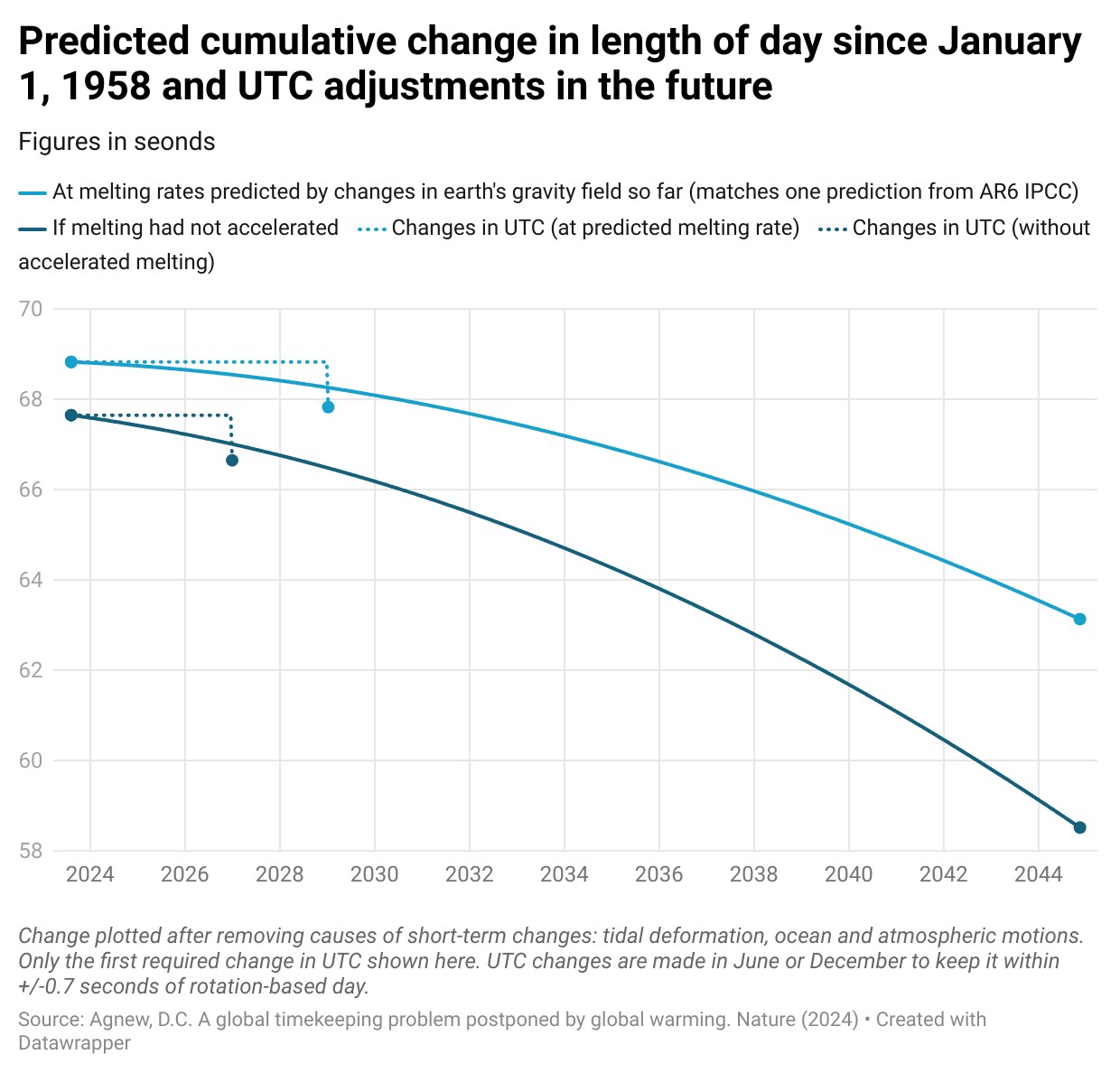
- But now polar ice melting is likely to delay clock adjustments by three yearsWhile core’s motion is the main culprit in most of the time period analysed, Agnew’s finding is that another factor is now becoming consequential: the melting of polar ice. Using measurements of earth’s magnetic field, Agnew subtracted the impact of all long-term factors that affect earth’s rotation: like land continuing to shift since the burden of ice-age melted away and the present-day re-arrangement of mass from polar ice melting. This helped him find the rate at which the length of day would increase without the rate of polar ice melting increasing. This showed that the acceleration of earth’s surface would require a negative leap second in 2026. On the other hand, actually observed changes show that such a negative leap second will be required only in 2029. This means that polar ice melting is reducing the rate at which earth’s rotation is accelerating. In other words, polar ice melting is now decelerating earth’s rotation.