E-Paper



Odisha: Covid-19 deaths not reconciled, data doesn’t reflect true picture
Odisha’s director of health services Bijay Mohapatra admitted that the Covid-19 related deaths being shown in the department’s Twitter handle was not real-time data and a reconciliation of the death toll was pending.


A year after battling the Covid pandemic successfully during its first wave, Odisha appears to have faltered during the second wave with number of actual Covid deaths acceding the numbers in official data even as the virus spreads deep into rural areas with high test positivity rates.
Data shows it took just 29 days in April this year to register 1 lakh new Covid cases compared to the 169 days taken in the first wave last year. As cases gallop, the state government on Wednesday extended the lockdown to entire state for a period of 14 days after similar restrictions failed to curb the spread in western Odisha and the state’s urban areas.
On Thursday, the state reported 10,521 new cases, taking the total number of active cases to 81,585 amid a positivity rate of 21.77%. While the total number of active cases has doubled since last year’s peak figure of 39,184, anecdotal evidence suggests under reporting of Covid-related deaths. Though officially the death toll stood at 133 in April, inquiries with various Covid hospitals and district authorities suggested many more people had died due to the infection.
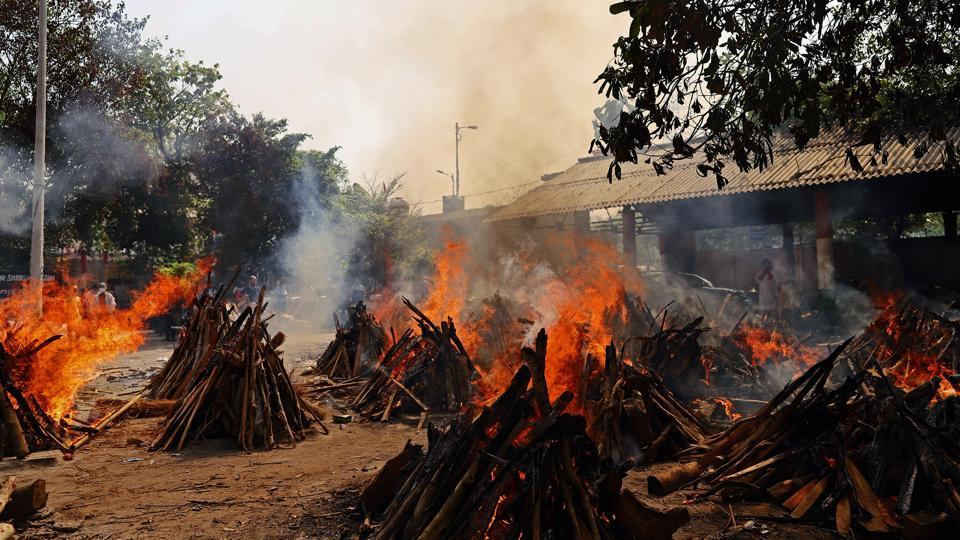
In Bhubaneswar, official figures put active Covid cases at 8,947 and the deaths at 12 for the month of April. However, Bhubaneswar Municipal Corporation said 20-30 bodies were being cremated daily at the Satya Nagar crematorium in the state capital for over a fortnight. On Monday, at least 40 bodies were cremated there while 8-9 bodies were in queue, said the municipality.
“In the early parts of April, I would see at least 10 pyres burning at any given point of time. Now there are more and more bodies,” said a resident of Satyanagar, who lives close to the crematorium.
In neighbouring city of Cuttack, the workers at the crematorium in Sati Choura too have been busy. On Sunday last, at least 44 bodies were cremated there according to Cuttack Municipal Corporation (CMC) officials, who didn’t wish to be named. But as per government statistics, only three persons in Cuttack succumbed to Covid in April. Again, in coastal district of Balasore, at least 14 deaths have been reported from Covid hospitals, but only 5 deaths have been shown on the state government portal.
In western Odisha’s Nuapada, were the test positivity rate in April was consistently around 35% (which means one out of every three persons tested there turns out to be positive for the disease), the official death toll was just 4. But local officials said 82 deaths were reported from the Covid hospitals of the district. Similarly, in Sambalpur district, more than 191 deaths due to Covid were reported from hospitals, but the government data cites only 82 deaths.
Immunology consultant in SUM Covid hospital, Pradipta Patra said compared to the first wave of Covid last year, the mortality is higher in the second wave. “In the first wave, there were more asymptomatic cases, but in the second wave there are more symptomatic cases where lungs are getting affected in a greater degree. More and more patients are requiring oxygen,” he said. Health department officials confirmed that during Covid peak last year, the maximum demand for Oxygen was 23 MT per day while in April it was 36 MT.
Director of health services Bijay Mohapatra admitted that the deaths being shown in the department’s Twitter handle was not real-time data and a reconciliation of the death toll was pending. “The deaths that you see that are not the deaths that happened yesterday. We notify the deaths only after we get report from districts where a committee audits each of the deaths. So at any given point of time, there may be 100 deaths that are being audited,” he said.
CDMO of Nuapada district, Kali Prasad Behera admitted that death audits were taking time as they have been busy with overall Covid management. "We are doing the audit as per the ICMR protocol," he said.
Unlike last year, when the test positivity rate (TPR) hovered around 10 and 11% during July and August, this year the TPR has consistently been above 15% for the last 10 days. On Thursday, Odisha’s TPR went beyond 20%, the third time in the last 7 days. Yet, the state government has not pushed forward the number of tests, more so in western Odisha districts that are recording 50% positivity.
In April, the daily tests have never gone past the 50,000 figure and the RT-PCR tests, considered to be the gold standard of Covid testing, barely constitutes 40% of the total tests. Leading microbiologist Dr TM Mohapatra, who was earlier associated with the Indian Council of Medical Research (ICMR), said the state should have been testing at least 1 lakh samples every day. “As the current strain is very infectious compared to last year’s, tests should have been ramped up. It would be difficult to find out the extent of the spread and save people if tests are not increased,” he said.
However, the tests have not gone up partly due to couple of RT-PCR machines malfunctioning and suppliers not providing required number of testing kits, forcing the state government not to go beyond the set target.
Activist Pradip Pradhan alleged that delayed tests were hampering the fight against Covid.
“One of my friends got his RT-PCR test done 5 days ago, but his report is yet to come. How would he be treated without a RT-PCR report,” he asked.
As lesser number of tests was being conducted despite high positivity rates, health activists were wary of the virus spreading further in rural hinterland. Of the 13,050 active cases in Khurda, more than 4,000 are in hundreds of villages of the district. Of the 5,423 active Covid cases in Cuttack district, around 1,600 are spread in several villages.
In Nuapara district, bordering Chhatisgarh and Sundargarh that borders Jharkhand, the TPR crossed 50% on some days indicating every second person to be tested was positive. It was in Nuapara and Kalahandi districts, where infections were first reported in late March after several people travelled to watch a cricket match in neighbouring Chhatisgarh, bringing the virus to their home.