
 E-Paper



Omicron in India infected younger population: Govt data on 3rd wave
Analysing Delta versus Omicron, the government said in the 3rd wave of the Covid pandemic, there have been lesser complications, lesser use of drugs.

 Prefer HTon Google


In the Omicron-driven third wave of the Covid-19 pandemic in India, a comparatively younger population was more infected, a survey by the Indian Council of Medical Research into hospital data has revealed. The data has been sourced from 37 hospitals across the country, director general of ICMR, Dr Balram Bhargava said.
The average age of hospitalisation during the third wave was around 44, while earlier the average age was 55. The hospitalisation data between December 16, 2021, and January 17, 2022, was compared with that of November 15 and December 15.
In the Omicron-driven third wave of the Covid-19 pandemic in India, a comparatively younger population was more infected, a survey by the Indian Council of Medical Research into hospital data has revealed. The data has been sourced from 37 hospitals across the country, director general of ICMR, Dr Balram Bhargava said.
The average age of hospitalisation during the third wave was around 44, while earlier the average age was 55. The hospitalisation data between December 16, 2021, and January 17, 2022, was compared with that of November 15 and December 15.
|#+|
Also Read: Full vaccination halves death risk, govt data suggests
Explaining the clinical profile of those who got hospitalised during the third wave in India, Dr Bhargava said that they were comparatively young but with surprisingly high co-morbidities. "Having said that, the co-morbidities present in this younger population were pretty high. About 46 per cent had co-morbidities, these are the people who are younger...but nearly half of them had some co-morbidities," Dr Bhargava said.
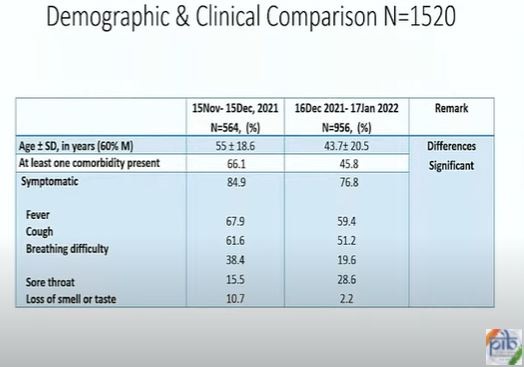
The third wave, which is believed to be waning in India now, has been markedly different from the second wave of the pandemic which witnessed a huge number of deaths. There have been other differences too, the government data pointed out. As doctors treating Omicron patients earlier pointed out, the government data said that all symptoms were in lesser proportions among the hospitalised patients. Sore throat was the predominant symptom.
Here are the differences between the Delta wave and the Omicron wave
1. Breathing difficulty and loss of smell or taste were not the primary symptoms in the Omicron wave. Sore throat, fever and cough were reported among the patients more predominantly.
2. All symptoms were lesser in the 3rd wave
3. The average age of infected and hospitalised patients in the 3rd wave was 44 years compared to 55 years earlier.
4. The presence of comorbidities was 46% as compared to 66% earlier.
5. Lesser use of drugs were noticed during the third wave and there were lesser complications in the cases.


