
 E-Paper



Orders are not enough, right discourse is a must too: Justice Chandrachud
The senior Supreme Court judge was delivering the Justice YV Chandrachud memorial lecture on ‘The Future of Mediation in India’ at the ILS Law College, Pune.


Justice cannot always be measured through implementation of legal norms, and wins and losses in the court hall, Supreme Court judge Dhananjaya Y Chandrachud emphasised on Friday, lamenting how a ‘Karva Chauth’ advertisement featuring a same-sex couple had to be withdrawn last year despite the Supreme Court decriminalising homosexuality in 2018.
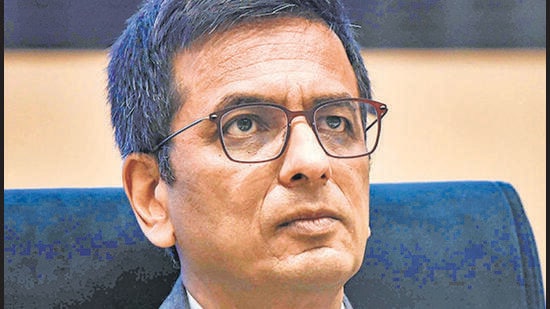
According to Justice Chandrachud, “justice done can quickly be undone” if people do not continue the right discourse to ascertain the interests of the marginalised groups.
The senior Supreme Court judge was delivering the Justice YV Chandrachud memorial lecture on ‘The Future of Mediation in India’ at the ILS Law College, Pune, during which he asserted that class actions in courts are not the only way to meaningfully claim rights in public spaces.
“Though the courts expand the horizon of constitutional rights to safeguard the interests of the marginalised groups, if people do not keep up with the rights discourse ‘justice done can quickly be undone’...The question is whether raising rights claims in courts is the only way by which justice is achieved,” underscored Justice Chandrachud.
The judge pointed out that the top court judgment on the decriminalisation of homosexuality in the Navtej Singh Johar case alone was not sufficient for members of the LGBTQ community to realise their rights.
“Four years after the judgment, an advertisement for a fairness cream that depicted a homosexual couple celebrating Karwa Chauth was taken down after strong protests,” he rued.
Justice Chandrachud was referring to the advertisement issued by Dabur’s Fem Crème bleach showing a lesbian couple celebrating Karva Chauth. After public outrage against the advertisement on the social media, the company took it down and tendered an unconditional apology for hurting public sentiments.
The judge added that on a socio-political level, rights claims deviate attention from realising paramount changes in human relationships and social institutions — changes that would establish factual equality.
He also highlighted the importance of mediation as a tool for social change, where, he said, the social norms are brought in consonance with constitutional values through the exchange of ideas and flow of information.
“I think the future of mediation in India is its ability to impact social change in a manner that the law does not...It empowers the marginalised in the course of the process...This is the future of mediation in India,” he said.
Justice Chandrachud drew a distinction between a court verdict and a resolution arrived through mediation. “Let us not forget that a judicial verdict recognising the rights of individuals or a group takes the colour of a ‘dicta’. It is a verdict arrived at after lawyers and judges speak in a language that the common person does not know, nor understand. In contrast, the resolution arrived at after invaluable discourse during mediation secures justice for individuals and groups in their own terms,” he explained.
Illustrating his version though an example, the judge narrated how a gay rights group in Rochester, New York, mediated effectively in 1984 to gain the right to march in a civic parade.
“The group decided to not take the fight to the courts because they wanted a customised solution to their problem through constructive dialogue and meaningful discourse...Mediation integrates the rights discourse with the concern for the needs of the parties,” added Justice Chandrachud.
If the legal remedies available to parties are detached from social realities, he sid, mediation confers an avenue for citizens to determine the interpersonal relationship in ways that the law denies them.
“Moreover, the remedies that are provided under the law adopt a ‘one-size-fits-all’ approach. The law, in most cases, does not account for the nuances in inter-personal relationships and social norms. In such situations, mediation offers an alternative and finer approach to secure a customised remedy,” said Justice Chandrachud.
He further flagged the massive pendency of cases at all levels of courts in the country, particularly the pendency of more than 4.1 crore cases in district and taluka courts.
“Courts in India are extremely burdened and desperately congested — both literally and metaphorically. In light of these numbers, dispute resolution mechanisms like mediation are an important tool in increasing access to justice by providing redress and settlement of disputes in a non-adversarial manner, free from the formalistic procedural practices of the law,” said the judge.
Justice Chandrachud opined that mediation provides an opportunity to reformulate and preserve sustainable relationships between different parties, whether they are business partners or life partners.
“At an intrinsic level, I consider the value of mediation as an end in itself. One of the central tenets of mediation is self-determination by parties — it provides a distinct participatory role for the stakeholders to negotiate and reach creative and practical solutions beyond the constraints of legal remedies,” he added.
The finer approach inherent in the process of mediation is beneficial to communities that face marginalisation, said Justice Chandrachud, pointing out marginalised communities and women have often stated that their voices are heard and legitimated when they have used mediation as a forum of redressal.


