
 E-Paper



The resilience of Indian democracy over 4 decades
What binds 1984 and 2004, 2014 and 2024 is the ability of India’s institutions and citizens to deliver on their core mandate


1984: Four decades ago, the Bharatiya Janata Party (BJP) won two seats in the Lok Sabha election. The Congress crossed the 400 mark to form a government with the kind of majority that no government had ever seen till then, no government has seen ever since , and no government is likely to obtain in the future.
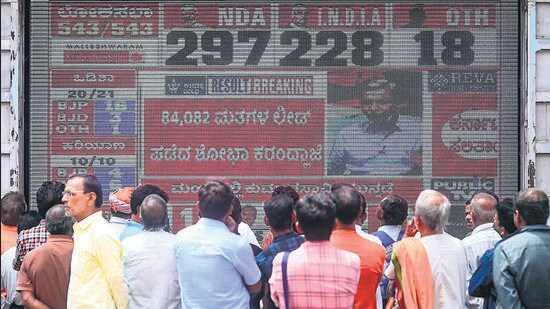
2004: Two decades ago, the BJP crashed from being the single largest party in the Lok Sabha and running a reasonably competent Union government to slipping below the Congress and making way for a new government. It marked the inauguration of a decade-long stint in opposition for the party.
2014: A decade ago, Narendra Modi graduated from being the chief minister of Gujarat to the prime minister of India. He formed the first government that was based on a single-party majority in thirty years and ended the period of fragmented coalition governments. The BJP won, and continued to win, propelled by Modi’s persona that embodied, for different audiences, different messages.
2024: As Modi returns to head the Union government for a third consecutive government, the era of a single party majority government has just concluded, and Indian politics appears to be returning to the 1989-2014 normal of a degree of fragmentation, a degree of accommodation, even a degree of instability within a broader system of stability.
Now think of the common features through this 1984, 2004, 2014, and 2024 period.
For one, on all four occasions, just like all the occasions since 1951, the conduct of the elections and then the appointment of a new government has happened under the framework of the Constitution of India. This Constitution, with its fundamental precepts of universal adult franchise, periodic elections, fundamental rights, and a process detailing the peaceful transfer of power, kept India steady even as countries across Asia and Africa emerging from colonialism collapsed under the weight of strongmen and dictatorships, coups and ethnic strife.
This is such an obvious and simple point, but it bears repetition on a day when India has just elected its 18th Lok Sabha. India is deeply fortunate to have had the same constitution, drafted by a set of visionaries, that has stood the test of time and enabled the battle of political ideologies and social groups within a non-violent framework. To understand the value of this achievement, just look at the neighbourhood where almost every country has had multiple constitutions or major systemic instability in the same period.
Two, all these moments over the past four decades have witnessed moments of great inter-community tension. Exactly four decades ago this week, Operation Bluestar wounded Sikh psyche and sensibility with deeply damaging consequences that haunt India till today; it led to the assassination of a sitting prime minister; this was followed by the worst anti-Sikh pogrom on the streets of the capital and elsewhere in Indian history, encouraged by the leaders of the Congress; and that in turn led to one of the most openly majoritarian election, fought on an anti-Sikh sentiment, that propelled Rajiv Gandhi to his historic win. Two decades ago, one reason for the Atal Bihari Vajpayee government’s fall, according to the then PM himself, was his inaction after the Gujarat riots, although rural distress was the main cause. A decade ago, Narendra Modi’s win, which had many causes, was a clear triumph of the Hindutva sensibility and led to deep worries about what it would mean for minority rights. And this election has witnessed an explicitly communal campaign that has seen deepening of tensions on religious lines, often due to political rhetoric of the ruling party itself.
But in all the four cases, Indian democracy had self-correcting mechanisms. There were wounds that never healed, but politics also had a way of letting discontents express themselves through democratic mechanisms, of allowing communities to come together including in multi-religious electoral coalitions, of institutions exercising checks. And Indian society moved on, though a truth and reconciliation commission to process the traumas of strife may be a useful exercise at some point.
Three, at each moment in the last four decades, when there was either a fear of executive excesses or executive incompetence, voters sent a message. The euphoria over Gandhi’s big victory of 1984 disappeared in just a few years, corruption scandals rocked his government, he flirted with communalists on both the Hindu and Muslim side of the spectrum, but nothing worked and he lost power in the next election. The Vajpayee government’s political misjudgments and a popular sense that its period of economic growth had left out the poor saw the incumbent get replaced, as did a consolidation of minorities across north India. The United Progressive Alliance-2 government’s perceived corruption and the weakness of prime ministerial authority saw the end of the Manmohan Singh government and the electorate delivering a sharp rebuke to the Congress, a rebuke from which it is still recovering. And this year, even as Modi’s supporters expected a bigger triumph, amid fears of growing authoritarianism and economic discontent and identity-based grievances, voters believed that India needed a government that had more checks in place and changed the nature of the mandate.
Four, it is remarkable that Indian politics, while influenced by external ideas both positively and negatively, is relatively autonomous of external intervention. This may seem like an obvious point again but look around and see the active role of the Soviets, Americans, Saudis and Pakistanis in Afghanistan at different moments; the active America intervention in Pakistan’s governing arrangements including in military affairs and elections just this year; the role of China in Myanmar and increasingly in the rest of the Indian subcontinent; or India’s own external interventions in Nepal, Maldives, Sri Lanka and Bhutan.
India’s size, its diversity, its democracy, its open society allows room for external players to intervene. But the story of Indian politics is not their intervention; it is India’s relative immunity from this intervention. It is the fact that Indians have continued to take their own political decisions, expressed in the polling booth, based on their own judgment, after examining the ideas proposed by their own domestic parties, every five years. This autonomy is a rare feature and must be zealously guarded, especially at a time when great power competition has intensified and adversaries have an interest in shaping political outcomes. This doesn’t mean there should be conspiratorial thinking about every oped published in a western newspaper and interpreted as intervention; India isn’t that insecure or weak. It merely means that the decision making authority of Indian voters must be protected and respected.
And finally, what binds 1984 and 2004, 2014 and 2024 is the ability of India’s institutions (often compromised and maligned, sometimes with good reason), and citizens to deliver on their core mandate. It is because citizens organise themselves as a part of political parties, political parties agree to compete peacefully under a set of commonly agreed upon rules, the Election Commission plans and holds a gigantic logistical exercise, security personnel dutifully serve across the country to create an environment of security, local teachers and government officials sit at polling booths, the media plays the role of interrogating and examining voter attitudes and preferences and reports on the activities of parties and candidates, bureaucrats perform the multiple roles they are meant to in order to sustain the everyday functions of government, citizens vote, officials count, polling agents keep a watch, and everyone accepts the verdict that Indian democracy stays alive.
As long as these five features — a stable Constitutional framework, the polity and society’s ability to navigate inter community strife without causing permanent rupture, democracy’s self correcting mechanisms to check executive actions and excesses, autonomy from external intervention and citizens and institutions performing their roles — persist, Indian democracy is safe. That was proven again on Tuesday as voters delivered a mandate for continuity and change.
-
 ABOUT THE AUTHORPrashant Jha
Prashant Jha is the Washington DC-based US correspondent of Hindustan Times. He is also the editor of HT Premium. Jha has earlier served as editor-views and national political editor/bureau chief of the paper. He is the author of How the BJP Wins: Inside India's Greatest Election Machine and Battles of the New Republic: A Contemporary History of Nepal.Read More


