
 E-Paper



O2 Audit: Around 20% of oxygen plants announced during second wave operational
The Centre announced new plants will be set up across the country after the April-May peak of Covid-19 triggered an unprecedented shortage of medical oxygen, with reports suggesting there may have been hundreds of deaths nationwide during this period because the gas was in short supply.


The Union government has sanctioned 1,222 pressure swing absorption (PSA) plants that act as oxygen generators for hospitals, and of these, 245 – roughly a fifth – have been commissioned in different regions till July 20, the Union health ministry told parliament last week.
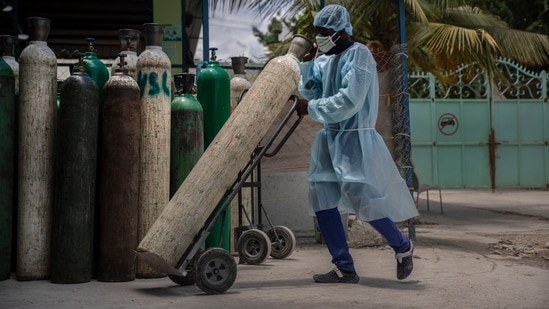
The Centre announced new plants will be set up across the country after the April-May peak of Covid-19 triggered an unprecedented shortage of medical oxygen, with reports suggesting there may have been hundreds of deaths nationwide during this period because the gas was in short supply.
In October 2020, during the first wave of Covid-19 cases, the central government invited tenders for 162 PSA oxygen plants -- by April 2021, only 33 of these were operational, according to a tweet by the Union health ministry on April 18.
In the aftermath of the second wave, the government first announced on April 26 that 551 plants will be set up using the PM Cares funds. These were in addition to an unnamed number that were to be funded by central ministries and public sector units (PSUs).
On June 14, a statement by the ministry of science and technology quoted Defence Research & Development Organisation (DRDO) secretary C Satish Reddy as saying that the number of PSA plants to be set up under PM Cares was 850. DRDO has been executing some of the PSA plants projects, while for the rest, the government has floated tenders.
In a statement by the Prime Minister’s Office on July 9, officials told the new cabinet that in all, over 1,500 PSA plants were set to be installed in the country. Altogether, these will support 400,000 beds, the statement added but without specifying by when these would be installed -- the Prime Minister directed officials to ensure it is done at the earliest.
According to officials in the health ministry, who asked not to be named, an additional 250 PSA plants are expected to be installed by August 15 and the remaining from the lot of 1,222 sanctioned will be commissioned by the end of the year.
The July 23 statement by the health ministry to parliament also states that the number of plants to be set up by central ministries and PSUs in addition to the 1,222 is 351, and that the states have separately informed the Union government that they are setting up 1,023 plants on their own.
The health ministry’s reply in parliament said the 1,222 plants will together account for a capacity of around 1,771MT a day – which comes to about a fifth of the peak 9,690MT liquid medical oxygen dispatched by the Centre to states in a single day in the April-May period.
Officials in other states indicated that the number of plants they are working on may be higher than for which information has been shared with the Centre. Uttar Pradesh, which got 127 plants from the Centre, has sanctioned 414 PSA plants on its own and 145 of them have become operational, an official said.
Rajasthan, which got 51 from the Centre, sanctioned 429 plants on its own and of them 280 are operational, according to the state government.
Similarly, health department officials in Maharashtra said the state planned 462 PSA plants and of them 98 are operational.
According to projects.datameet.org, a portal that tracked reports about deaths due to oxygen shortage or disruption in hospitals in April and May this year, 619 people may have died during the crisis.
The government in its response to parliament said oxygen supply for medical purposes increased to 9,690 metric tonnes in May 2021 from 5,770 in August 2020.
The health ministry informed Parliament on July 23 that on July 15, 1,244 liquid medical oxygen tankers were available in the country as compared to 225 in March 2020.
The ministry also said that in 2019-20, it released ₹1,113 crore to states under National Health Mission for Covid management, apart from ₹15,000 crore given under Covid Emergency Response and Health System Preparedness package. The phase two of the package of ₹23,132 crore (including state contribution) has also been approved, the ministry said.
(With inputs from state bureau)


